

234
Chapter 18 Transition Metal Complexes with CO, N2, NO and O2 Ligands
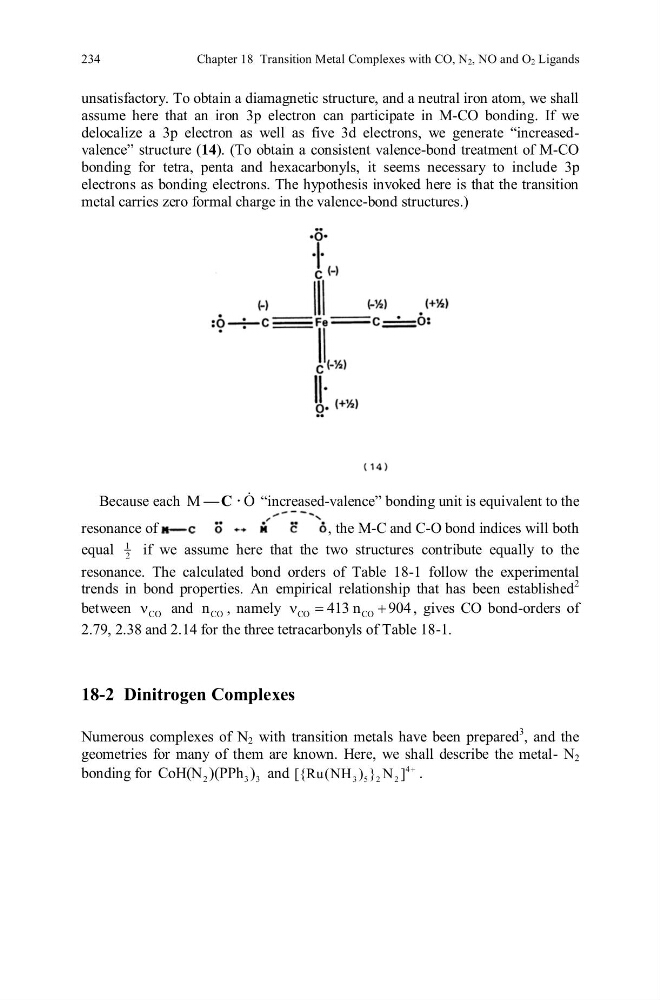
unsatisfactory. To obtain a diamagnetic structure, and a neutral iron atom, we shall
assume here that an iron 3p electron can participate in M-CO bonding. If we
delocalize a 3p electron as well as five 3d electrons, we generate “increasedvalence” structure (14). (To obtain a consistent valence-bond treatment of M-CO
bonding for tetra, penta and hexacarbonyls, it seems necessary to include 3p
electrons as bonding electrons. The hypothesis invoked here is that the transition
metal carries zero formal charge in the valence-bond structures.)
Because each
— C · “increased-valence” bonding unit is equivalent to the
resonance of
, the M-C and C-O bond indices will both
equal
1
2 if we assume here that the two structures contribute equally to the
resonance. The calculated bond orders of Table 18-1 follow the experimental
trends in bond properties. An empirical relationship that has been established
2
between CO
and CO
n , namely CO
CO
413 n
904
, gives CO bond-orders of
2.79, 2.38 and 2.14 for the three tetracarbonyls of Table 18-1.
18-2 Dinitrogen Complexes
Numerous complexes of N 2 with transition metals have been prepared
3 , and the
geometries for many of them are known. Here, we shall describe the metal- N 2
bonding for
2
3 3
CoH(N )(PPh ) and
4
3 5 2
2
[{Ru(NH ) } N ]
.
Chapter 18 Transition Metal Complexes with CO, N2, NO and O2 Ligands
unsatisfactory. To obtain a diamagnetic structure, and a neutral iron atom, we shall
assume here that an iron 3p electron can participate in M-CO bonding. If we
delocalize a 3p electron as well as five 3d electrons, we generate “increasedvalence” structure (14). (To obtain a consistent valence-bond treatment of M-CO
bonding for tetra, penta and hexacarbonyls, it seems necessary to include 3p
electrons as bonding electrons. The hypothesis invoked here is that the transition
metal carries zero formal charge in the valence-bond structures.)
Because each
— C · “increased-valence” bonding unit is equivalent to the
resonance of
, the M-C and C-O bond indices will both
equal
1
2 if we assume here that the two structures contribute equally to the
resonance. The calculated bond orders of Table 18-1 follow the experimental
trends in bond properties. An empirical relationship that has been established
2
between CO
and CO
n , namely CO
CO
413 n
904
, gives CO bond-orders of
2.79, 2.38 and 2.14 for the three tetracarbonyls of Table 18-1.
18-2 Dinitrogen Complexes
Numerous complexes of N 2 with transition metals have been prepared
3 , and the
geometries for many of them are known. Here, we shall describe the metal- N 2
bonding for
2
3 3
CoH(N )(PPh ) and
4
3 5 2
2
[{Ru(NH ) } N ]
.