

18-4
Dioxygenyl Adducts
241
for 2
O could coordinate with the low-spin (S = 0) configuration (34) for
2
Fe
. In
(34), the six vacant orbitals may be
2
3
d sp hybridized. Five of these orbitals may
be used for coordination with the five nitrogen atoms of structure (31), and the
sixth orbital is available for coordination with the 2
O . For oxyhemoglobin, the
iron atoms lie in the plane of the nitrogen atoms of the porphyrin ligands
11
. By
coordinating the 2
O of structure (33) to the
2
Fe
of the configuration (34),
Pauling and Coryell
13 obtained the standard Lewis structure (35) for each
2
Fe O
linkage of oxyhemoglobin. This valence-bond structure can then participate in
resonance with the standard Lewis structure (36). By comparison of these
structures with their Pauling “3-electron bond” ground-state structure for
2
O
( O O cf. Fig. 2-1), Pauling and Coryell concluded that a “profound change in
the electronic structure of 2
O occurs when it bonds to hemoglobin”. However, if
we use structures (35) and (36) to generate “increased-valence” structures (37) and
(38), it is possible to show that this need not be the case.
By delocalizing lone-pair electrons from the Fe
and O
of structures (35)
and (36) into vacant bonding Fe-O or O-O orbitals, we reduce the magnitude of
the atomic formal charges, and obtain “increased-valence” structures (37) and
(38)
16-20
.
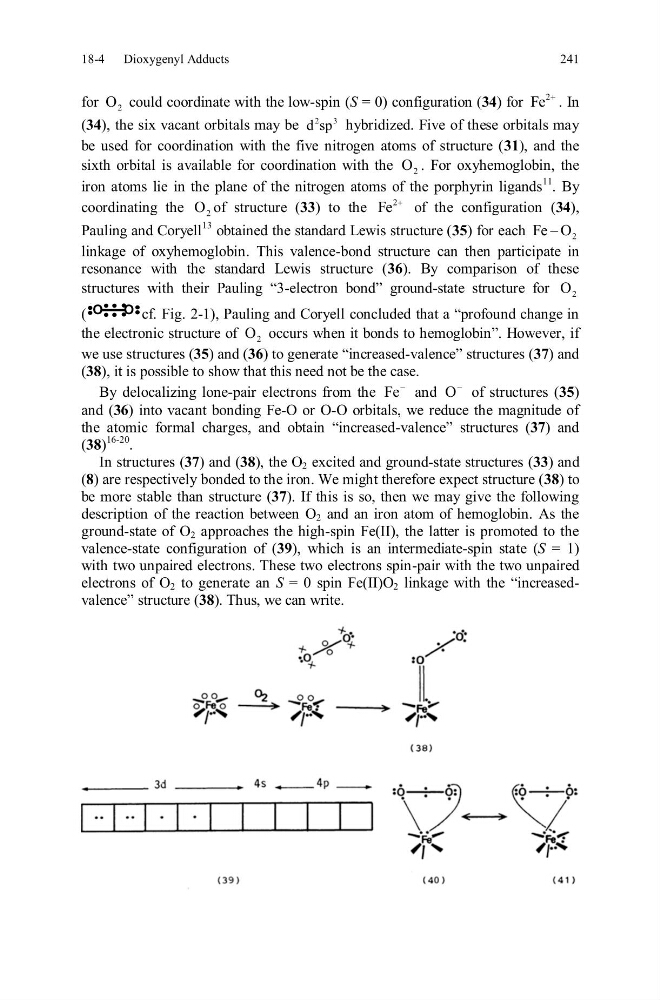
In structures (37) and (38), the O 2 excited and ground-state structures (33) and
(8) are respectively bonded to the iron. We might therefore expect structure (38) to
be more stable than structure (37). If this is so, then we may give the following
description of the reaction between O 2 and an iron atom of hemoglobin. As the
ground-state of O 2 approaches the high-spin Fe(II), the latter is promoted to the
valence-state configuration of (39), which is an intermediate-spin state (S = 1)
with two unpaired electrons. These two electrons spin-pair with the two unpaired
electrons of O 2 to generate an S = 0 spin Fe(II)O 2 linkage with the “increasedvalence” structure (38). Thus, we can write.
Dioxygenyl Adducts
241
for 2
O could coordinate with the low-spin (S = 0) configuration (34) for
2
Fe
. In
(34), the six vacant orbitals may be
2
3
d sp hybridized. Five of these orbitals may
be used for coordination with the five nitrogen atoms of structure (31), and the
sixth orbital is available for coordination with the 2
O . For oxyhemoglobin, the
iron atoms lie in the plane of the nitrogen atoms of the porphyrin ligands
11
. By
coordinating the 2
O of structure (33) to the
2
Fe
of the configuration (34),
Pauling and Coryell
13 obtained the standard Lewis structure (35) for each
2
Fe O
linkage of oxyhemoglobin. This valence-bond structure can then participate in
resonance with the standard Lewis structure (36). By comparison of these
structures with their Pauling “3-electron bond” ground-state structure for
2
O
( O O cf. Fig. 2-1), Pauling and Coryell concluded that a “profound change in
the electronic structure of 2
O occurs when it bonds to hemoglobin”. However, if
we use structures (35) and (36) to generate “increased-valence” structures (37) and
(38), it is possible to show that this need not be the case.
By delocalizing lone-pair electrons from the Fe
and O
of structures (35)
and (36) into vacant bonding Fe-O or O-O orbitals, we reduce the magnitude of
the atomic formal charges, and obtain “increased-valence” structures (37) and
(38)
16-20
.
In structures (37) and (38), the O 2 excited and ground-state structures (33) and
(8) are respectively bonded to the iron. We might therefore expect structure (38) to
be more stable than structure (37). If this is so, then we may give the following
description of the reaction between O 2 and an iron atom of hemoglobin. As the
ground-state of O 2 approaches the high-spin Fe(II), the latter is promoted to the
valence-state configuration of (39), which is an intermediate-spin state (S = 1)
with two unpaired electrons. These two electrons spin-pair with the two unpaired
electrons of O 2 to generate an S = 0 spin Fe(II)O 2 linkage with the “increasedvalence” structure (38). Thus, we can write.