

224
Chapter 17 Some Tetrahedral Molecules
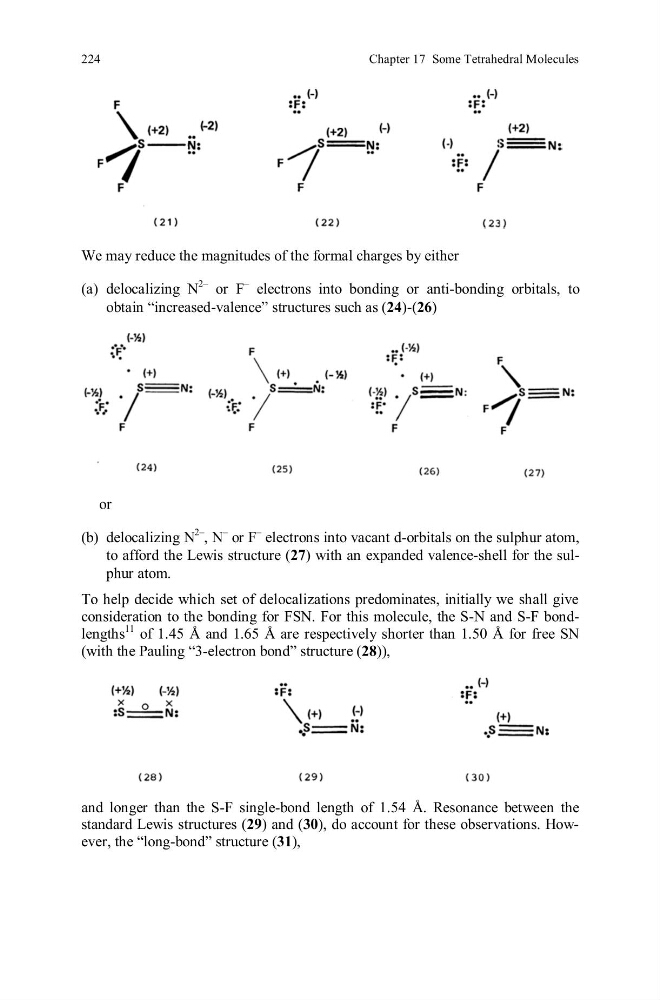
We may reduce the magnitudes of the formal charges by either
(a) delocalizing N
2– or F
– electrons into bonding or anti-bonding orbitals, to
obtain “increased-valence” structures such as (24)-(26)
or
(b) delocalizing N
2–
, N
– or F
– electrons into vacant d-orbitals on the sulphur atom,
to afford the Lewis structure (27) with an expanded valence-shell for the sulphur atom.
To help decide which set of delocalizations predominates, initially we shall give
consideration to the bonding for FSN. For this molecule, the S-N and S-F bondlengths
11 of 1.45 Å and 1.65 Å are respectively shorter than 1.50 Å for free SN
(with the Pauling “3-electron bond” structure (28)),
and longer than the S-F single-bond length of 1.54 Å. Resonance between the
standard Lewis structures (29) and (30), do account for these observations. However, the “long-bond” structure (31),
Chapter 17 Some Tetrahedral Molecules
We may reduce the magnitudes of the formal charges by either
(a) delocalizing N
2– or F
– electrons into bonding or anti-bonding orbitals, to
obtain “increased-valence” structures such as (24)-(26)
or
(b) delocalizing N
2–
, N
– or F
– electrons into vacant d-orbitals on the sulphur atom,
to afford the Lewis structure (27) with an expanded valence-shell for the sulphur atom.
To help decide which set of delocalizations predominates, initially we shall give
consideration to the bonding for FSN. For this molecule, the S-N and S-F bondlengths
11 of 1.45 Å and 1.65 Å are respectively shorter than 1.50 Å for free SN
(with the Pauling “3-electron bond” structure (28)),
and longer than the S-F single-bond length of 1.54 Å. Resonance between the
standard Lewis structures (29) and (30), do account for these observations. However, the “long-bond” structure (31),