

17-3
F3NO, (CH3)3NO, F3SN, and FSN
223
For 3
F , the standard Lewis structures are of types (13)-(15). The N-F and
N-O bond-lengths
9 of 1.432 Å and 1.159 Å for this molecule are respectively
longer than the N-F bonds of
3
NF (1.37 Å) and similar to the bond-length
(1.15 Å) for free NO with valence-bond structure
1
1
2
2
:N O: (Section 4-5).
Resonance between the six structures of types (14) and (15) can account
qualitatively for these bond properties, but the formal charges of structures of type
(15) suggest that their weight should be rather less than that of the type (14)
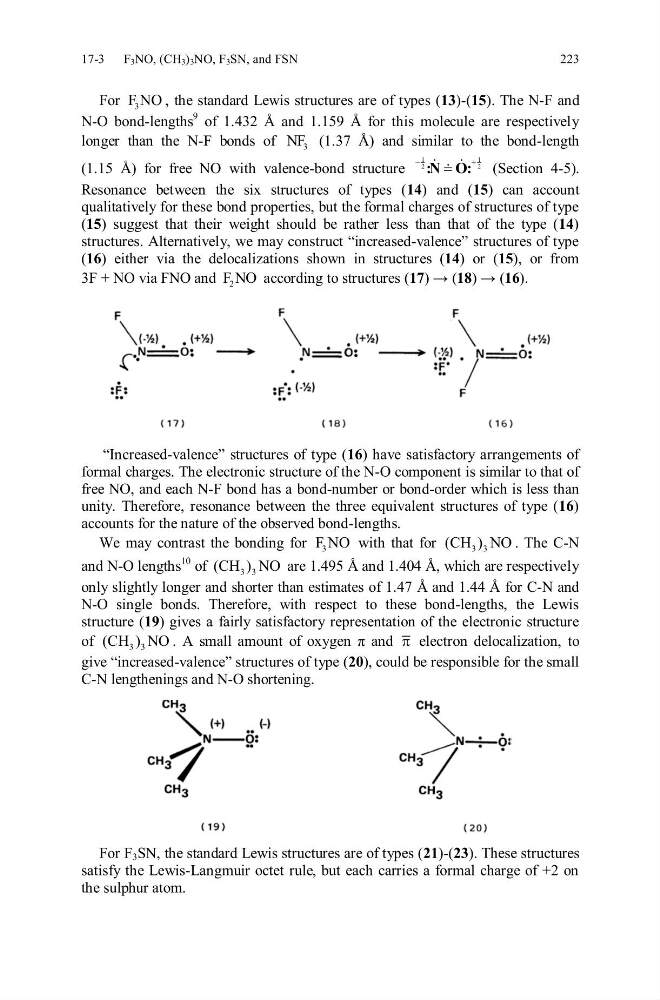
structures. Alternatively, we may construct “increased-valence” structures of type
(16) either via the delocalizations shown in structures (14) or (15), or from
3F + NO via FNO and 2
F NO according to structures (17) → (18) → (16).
“Increased-valence” structures of type (16) have satisfactory arrangements of
formal charges. The electronic structure of the N-O component is similar to that of
free NO, and each N-F bond has a bond-number or bond-order which is less than
unity. Therefore, resonance between the three equivalent structures of type (16)
accounts for the nature of the observed bond-lengths.
We may contrast the bonding for 3
F NO with that for
3 3
(CH ) NO . The C-N
and N-O lengths
10 of
3 3
(CH ) NO are 1.495 Å and 1.404 Å, which are respectively
only slightly longer and shorter than estimates of 1.47 Å and 1.44 Å for C-N and
N-O single bonds. Therefore, with respect to these bond-lengths, the Lewis
structure (19) gives a fairly satisfactory representation of the electronic structure
of
3 3
(CH ) NO . A small amount of oxygen π and electron delocalization, to
give “increased-valence” structures of type (20), could be responsible for the small
C-N lengthenings and N-O shortening.
For F 3 SN, the standard Lewis structures are of types (21)-(23). These structures
satisfy the Lewis-Langmuir octet rule, but each carries a formal charge of +2 on
the sulphur atom.
F3NO, (CH3)3NO, F3SN, and FSN
223
For 3
F , the standard Lewis structures are of types (13)-(15). The N-F and
N-O bond-lengths
9 of 1.432 Å and 1.159 Å for this molecule are respectively
longer than the N-F bonds of
3
NF (1.37 Å) and similar to the bond-length
(1.15 Å) for free NO with valence-bond structure
1
1
2
2
:N O: (Section 4-5).
Resonance between the six structures of types (14) and (15) can account
qualitatively for these bond properties, but the formal charges of structures of type
(15) suggest that their weight should be rather less than that of the type (14)
structures. Alternatively, we may construct “increased-valence” structures of type
(16) either via the delocalizations shown in structures (14) or (15), or from
3F + NO via FNO and 2
F NO according to structures (17) → (18) → (16).
“Increased-valence” structures of type (16) have satisfactory arrangements of
formal charges. The electronic structure of the N-O component is similar to that of
free NO, and each N-F bond has a bond-number or bond-order which is less than
unity. Therefore, resonance between the three equivalent structures of type (16)
accounts for the nature of the observed bond-lengths.
We may contrast the bonding for 3
F NO with that for
3 3
(CH ) NO . The C-N
and N-O lengths
10 of
3 3
(CH ) NO are 1.495 Å and 1.404 Å, which are respectively
only slightly longer and shorter than estimates of 1.47 Å and 1.44 Å for C-N and
N-O single bonds. Therefore, with respect to these bond-lengths, the Lewis
structure (19) gives a fairly satisfactory representation of the electronic structure
of
3 3
(CH ) NO . A small amount of oxygen π and electron delocalization, to
give “increased-valence” structures of type (20), could be responsible for the small
C-N lengthenings and N-O shortening.
For F 3 SN, the standard Lewis structures are of types (21)-(23). These structures
satisfy the Lewis-Langmuir octet rule, but each carries a formal charge of +2 on
the sulphur atom.