

222
Chapter 17 Some Tetrahedral Molecules
structures have S-O double-bonds, but because they retain S-F single-bonds, they
cannot account for the observed lengthening of the S-F bonds relative to those of
single bonds.
In contrast to what is the case for F 2 SO, the bond-lengths for isoelectronic
(CH 3 ) 2 SO (C-S = 1.80 Å, S-O = 1.48 Å)
7 suggest that a sulphur 3d orbital does
participate in S-O bonding as a hybridization function. The S-O bond-length is
shorter than a single-bond (1.70 Å), but the C-S bond-lengths are essentially those
of C-S single-bonds (cf. 1.82 Å for CH 3 SH)
8 . Resonance between valence-bond
structures (1) and (2), each of which has two C-S single-bonds, accounts for the
observed bond-lengths. In Section 11-3, we have concluded that CH 3 groups cannot provide much stabilization of Pauling “3-electron bonds” for 4-electron
3-centre bonding units in neutral molecules, and therefore the delocalization of
oxygen π and electrons of structure (1) to generate “increased-valence”
structure (3) must occur only to a small extent; otherwise the C-S bonds of
(CH 3 ) 2 SO would be rather longer than single bonds.
17-3 F 3 NO, (CH 3 ) 3 NO, F 3 SN, and FSN
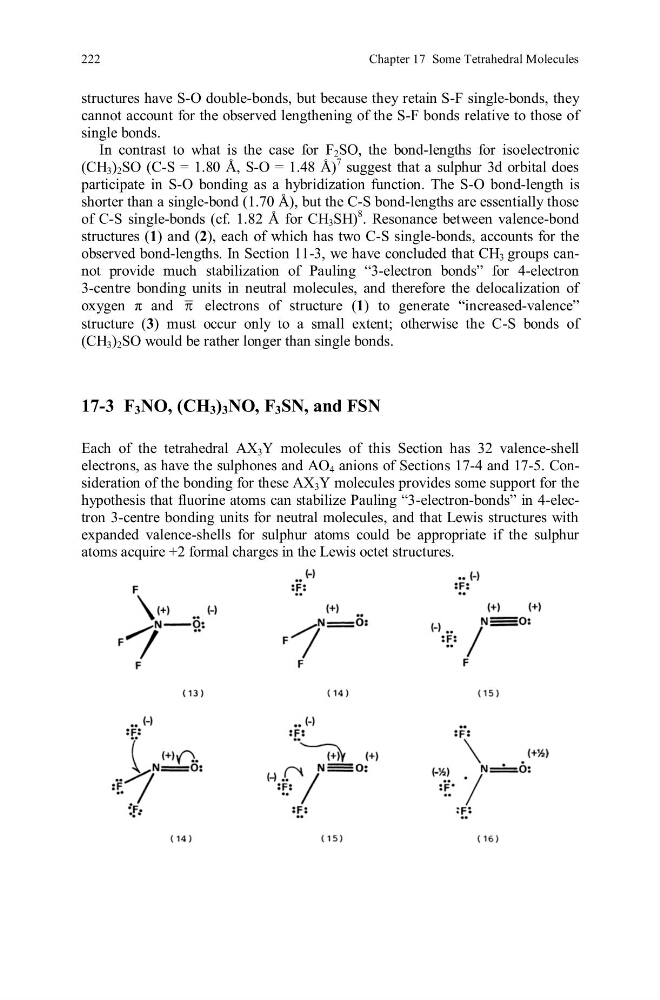
Each of the tetrahedral AX 3 Y molecules of this Section has 32 valence-shell
electrons, as have the sulphones and AO 4 anions of Sections 17-4 and 17-5. Consideration of the bonding for these AX 3 Y molecules provides some support for the
hypothesis that fluorine atoms can stabilize Pauling “3-electron-bonds” in 4-electron 3-centre bonding units for neutral molecules, and that Lewis structures with
expanded valence-shells for sulphur atoms could be appropriate if the sulphur
atoms acquire +2 formal charges in the Lewis octet structures.
Chapter 17 Some Tetrahedral Molecules
structures have S-O double-bonds, but because they retain S-F single-bonds, they
cannot account for the observed lengthening of the S-F bonds relative to those of
single bonds.
In contrast to what is the case for F 2 SO, the bond-lengths for isoelectronic
(CH 3 ) 2 SO (C-S = 1.80 Å, S-O = 1.48 Å)
7 suggest that a sulphur 3d orbital does
participate in S-O bonding as a hybridization function. The S-O bond-length is
shorter than a single-bond (1.70 Å), but the C-S bond-lengths are essentially those
of C-S single-bonds (cf. 1.82 Å for CH 3 SH)
8 . Resonance between valence-bond
structures (1) and (2), each of which has two C-S single-bonds, accounts for the
observed bond-lengths. In Section 11-3, we have concluded that CH 3 groups cannot provide much stabilization of Pauling “3-electron bonds” for 4-electron
3-centre bonding units in neutral molecules, and therefore the delocalization of
oxygen π and electrons of structure (1) to generate “increased-valence”
structure (3) must occur only to a small extent; otherwise the C-S bonds of
(CH 3 ) 2 SO would be rather longer than single bonds.
17-3 F 3 NO, (CH 3 ) 3 NO, F 3 SN, and FSN
Each of the tetrahedral AX 3 Y molecules of this Section has 32 valence-shell
electrons, as have the sulphones and AO 4 anions of Sections 17-4 and 17-5. Consideration of the bonding for these AX 3 Y molecules provides some support for the
hypothesis that fluorine atoms can stabilize Pauling “3-electron-bonds” in 4-electron 3-centre bonding units for neutral molecules, and that Lewis structures with
expanded valence-shells for sulphur atoms could be appropriate if the sulphur
atoms acquire +2 formal charges in the Lewis octet structures.