

17-2
F2SO, F2SS, and (CH3)2SO
221
of structure (1) into the sulphur 3d-orbital to form structure (2) then helps
reduce the magnitudes of the atomic formal charges.
(b) The sulphur (or other second-row) atom is involved in the formation of four
electron pair σ-bonds in a standard octet structure – for example structure (4)
for
2
4
SO
. This is equivalent to saying that either the sulphur oxidation state
(or number) is +6 or that the sulphur formal charge is +2 in the octet structure.
These hypotheses are speculative, and exceptions to them exist. Therefore, the
discussion for some of this chapter should be viewed more as involving orientation, rather than as definitive accounts of the bonding. The role of 3d-orbitals in
bonding for second-row atoms has been discussed by numerous workers – see for
example Refs. 1-6 – and the reader is referred to them for further details.
17-2 F 2 SO, F 2 SS, and (CH 3 ) 2 SO
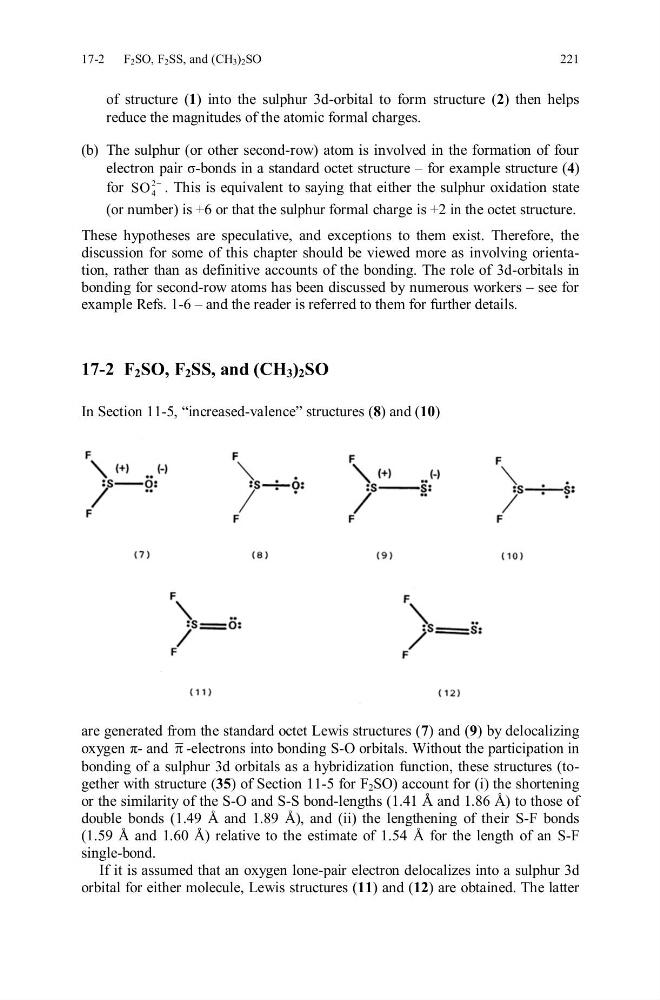
In Section 11-5, “increased-valence” structures (8) and (10)
are generated from the standard octet Lewis structures (7) and (9) by delocalizing
oxygen π- and -electrons into bonding S-O orbitals. Without the participation in
bonding of a sulphur 3d orbitals as a hybridization function, these structures (together with structure (35) of Section 11-5 for F 2 SO) account for (i) the shortening
or the similarity of the S-O and S-S bond-lengths (1.41 Å and 1.86 Å) to those of
double bonds (1.49 Å and 1.89 Å), and (ii) the lengthening of their S-F bonds
(1.59 Å and 1.60 Å) relative to the estimate of 1.54 Å for the length of an S-F
single-bond.
If it is assumed that an oxygen lone-pair electron delocalizes into a sulphur 3d
orbital for either molecule, Lewis structures (11) and (12) are obtained. The latter
F2SO, F2SS, and (CH3)2SO
221
of structure (1) into the sulphur 3d-orbital to form structure (2) then helps
reduce the magnitudes of the atomic formal charges.
(b) The sulphur (or other second-row) atom is involved in the formation of four
electron pair σ-bonds in a standard octet structure – for example structure (4)
for
2
4
SO
. This is equivalent to saying that either the sulphur oxidation state
(or number) is +6 or that the sulphur formal charge is +2 in the octet structure.
These hypotheses are speculative, and exceptions to them exist. Therefore, the
discussion for some of this chapter should be viewed more as involving orientation, rather than as definitive accounts of the bonding. The role of 3d-orbitals in
bonding for second-row atoms has been discussed by numerous workers – see for
example Refs. 1-6 – and the reader is referred to them for further details.
17-2 F 2 SO, F 2 SS, and (CH 3 ) 2 SO
In Section 11-5, “increased-valence” structures (8) and (10)
are generated from the standard octet Lewis structures (7) and (9) by delocalizing
oxygen π- and -electrons into bonding S-O orbitals. Without the participation in
bonding of a sulphur 3d orbitals as a hybridization function, these structures (together with structure (35) of Section 11-5 for F 2 SO) account for (i) the shortening
or the similarity of the S-O and S-S bond-lengths (1.41 Å and 1.86 Å) to those of
double bonds (1.49 Å and 1.89 Å), and (ii) the lengthening of their S-F bonds
(1.59 Å and 1.60 Å) relative to the estimate of 1.54 Å for the length of an S-F
single-bond.
If it is assumed that an oxygen lone-pair electron delocalizes into a sulphur 3d
orbital for either molecule, Lewis structures (11) and (12) are obtained. The latter