

17-4
Sulphones XYSO2
225
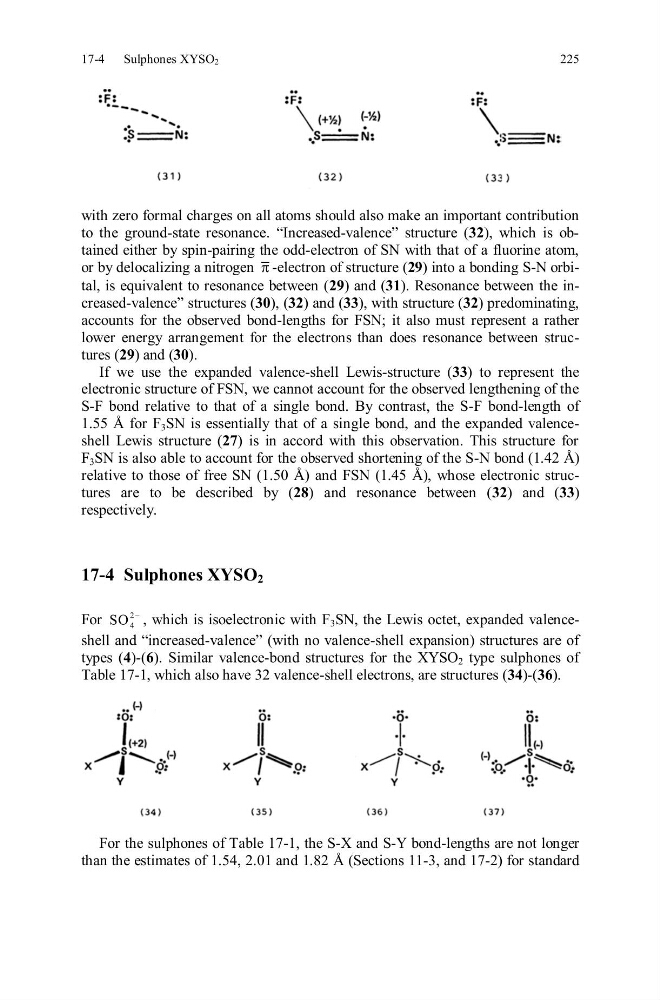
with zero formal charges on all atoms should also make an important contribution
to the ground-state resonance. “Increased-valence” structure (32), which is obtained either by spin-pairing the odd-electron of SN with that of a fluorine atom,
or by delocalizing a nitrogen -electron of structure (29) into a bonding S-N orbital, is equivalent to resonance between (29) and (31). Resonance between the increased-valence” structures (30), (32) and (33), with structure (32) predominating,
accounts for the observed bond-lengths for FSN; it also must represent a rather
lower energy arrangement for the electrons than does resonance between structures (29) and (30).
If we use the expanded valence-shell Lewis-structure (33) to represent the
electronic structure of FSN, we cannot account for the observed lengthening of the
S-F bond relative to that of a single bond. By contrast, the S-F bond-length of
1.55 Å for F 3 SN is essentially that of a single bond, and the expanded valenceshell Lewis structure (27) is in accord with this observation. This structure for
F 3 SN is also able to account for the observed shortening of the S-N bond (1.42 Å)
relative to those of free SN (1.50 Å) and FSN (1.45 Å), whose electronic structures are to be described by (28) and resonance between (32) and (33)
respectively.
17-4 Sulphones XYSO 2
For
2
4
SO
, which is isoelectronic with F 3 SN, the Lewis octet, expanded valenceshell and “increased-valence” (with no valence-shell expansion) structures are of
types (4)-(6). Similar valence-bond structures for the XYSO 2 type sulphones of
Table 17-1, which also have 32 valence-shell electrons, are structures (34)-(36).
For the sulphones of Table 17-1, the S-X and S-Y bond-lengths are not longer
than the estimates of 1.54, 2.01 and 1.82 Å (Sections 11-3, and 17-2) for standard
Sulphones XYSO2
225
with zero formal charges on all atoms should also make an important contribution
to the ground-state resonance. “Increased-valence” structure (32), which is obtained either by spin-pairing the odd-electron of SN with that of a fluorine atom,
or by delocalizing a nitrogen -electron of structure (29) into a bonding S-N orbital, is equivalent to resonance between (29) and (31). Resonance between the increased-valence” structures (30), (32) and (33), with structure (32) predominating,
accounts for the observed bond-lengths for FSN; it also must represent a rather
lower energy arrangement for the electrons than does resonance between structures (29) and (30).
If we use the expanded valence-shell Lewis-structure (33) to represent the
electronic structure of FSN, we cannot account for the observed lengthening of the
S-F bond relative to that of a single bond. By contrast, the S-F bond-length of
1.55 Å for F 3 SN is essentially that of a single bond, and the expanded valenceshell Lewis structure (27) is in accord with this observation. This structure for
F 3 SN is also able to account for the observed shortening of the S-N bond (1.42 Å)
relative to those of free SN (1.50 Å) and FSN (1.45 Å), whose electronic structures are to be described by (28) and resonance between (32) and (33)
respectively.
17-4 Sulphones XYSO 2
For
2
4
SO
, which is isoelectronic with F 3 SN, the Lewis octet, expanded valenceshell and “increased-valence” (with no valence-shell expansion) structures are of
types (4)-(6). Similar valence-bond structures for the XYSO 2 type sulphones of
Table 17-1, which also have 32 valence-shell electrons, are structures (34)-(36).
For the sulphones of Table 17-1, the S-X and S-Y bond-lengths are not longer
than the estimates of 1.54, 2.01 and 1.82 Å (Sections 11-3, and 17-2) for standard