

Chapter 16 Classical Valence-Bond Structures and Quinquevalent Nitrogen Atoms
215
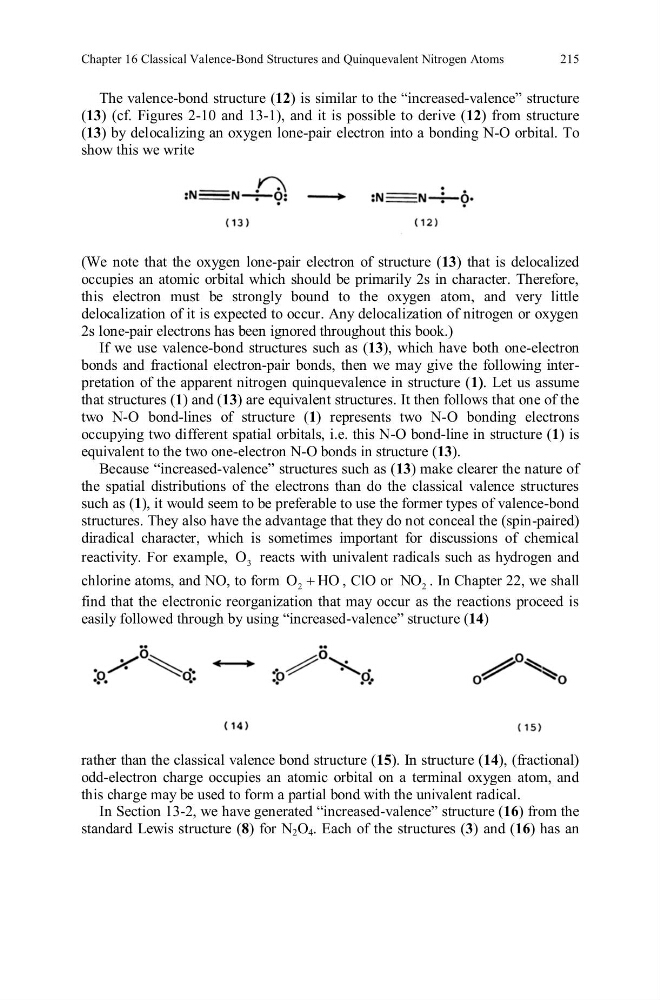
The valence-bond structure (12) is similar to the “increased-valence” structure
(13) (cf. Figures 2-10 and 13-1), and it is possible to derive (12) from structure
(13) by delocalizing an oxygen lone-pair electron into a bonding N-O orbital. To
show this we write
(We note that the oxygen lone-pair electron of structure (13) that is delocalized
occupies an atomic orbital which should be primarily 2s in character. Therefore,
this electron must be strongly bound to the oxygen atom, and very little
delocalization of it is expected to occur. Any delocalization of nitrogen or oxygen
2s lone-pair electrons has been ignored throughout this book.)
If we use valence-bond structures such as (13), which have both one-electron
bonds and fractional electron-pair bonds, then we may give the following interpretation of the apparent nitrogen quinquevalence in structure (1). Let us assume
that structures (1) and (13) are equivalent structures. It then follows that one of the
two N-O bond-lines of structure (1) represents two N-O bonding electrons
occupying two different spatial orbitals, i.e. this N-O bond-line in structure (1) is
equivalent to the two one-electron N-O bonds in structure (13).
Because “increased-valence” structures such as (13) make clearer the nature of
the spatial distributions of the electrons than do the classical valence structures
such as (1), it would seem to be preferable to use the former types of valence-bond
structures. They also have the advantage that they do not conceal the (spin-paired)
diradical character, which is sometimes important for discussions of chemical
reactivity. For example, 3
O reacts with univalent radicals such as hydrogen and
chlorine atoms, and NO, to form 2
O HO
, ClO or
2
NO . In Chapter 22, we shall
find that the electronic reorganization that may occur as the reactions proceed is
easily followed through by using “increased-valence” structure (14)
rather than the classical valence bond structure (15). In structure (14), (fractional)
odd-electron charge occupies an atomic orbital on a terminal oxygen atom, and
this charge may be used to form a partial bond with the univalent radical.
In Section 13-2, we have generated “increased-valence” structure (16) from the
standard Lewis structure (8) for N 2 O 4 . Each of the structures (3) and (16) has an
215
The valence-bond structure (12) is similar to the “increased-valence” structure
(13) (cf. Figures 2-10 and 13-1), and it is possible to derive (12) from structure
(13) by delocalizing an oxygen lone-pair electron into a bonding N-O orbital. To
show this we write
(We note that the oxygen lone-pair electron of structure (13) that is delocalized
occupies an atomic orbital which should be primarily 2s in character. Therefore,
this electron must be strongly bound to the oxygen atom, and very little
delocalization of it is expected to occur. Any delocalization of nitrogen or oxygen
2s lone-pair electrons has been ignored throughout this book.)
If we use valence-bond structures such as (13), which have both one-electron
bonds and fractional electron-pair bonds, then we may give the following interpretation of the apparent nitrogen quinquevalence in structure (1). Let us assume
that structures (1) and (13) are equivalent structures. It then follows that one of the
two N-O bond-lines of structure (1) represents two N-O bonding electrons
occupying two different spatial orbitals, i.e. this N-O bond-line in structure (1) is
equivalent to the two one-electron N-O bonds in structure (13).
Because “increased-valence” structures such as (13) make clearer the nature of
the spatial distributions of the electrons than do the classical valence structures
such as (1), it would seem to be preferable to use the former types of valence-bond
structures. They also have the advantage that they do not conceal the (spin-paired)
diradical character, which is sometimes important for discussions of chemical
reactivity. For example, 3
O reacts with univalent radicals such as hydrogen and
chlorine atoms, and NO, to form 2
O HO
, ClO or
2
NO . In Chapter 22, we shall
find that the electronic reorganization that may occur as the reactions proceed is
easily followed through by using “increased-valence” structure (14)
rather than the classical valence bond structure (15). In structure (14), (fractional)
odd-electron charge occupies an atomic orbital on a terminal oxygen atom, and
this charge may be used to form a partial bond with the univalent radical.
In Section 13-2, we have generated “increased-valence” structure (16) from the
standard Lewis structure (8) for N 2 O 4 . Each of the structures (3) and (16) has an