

214
Chapter 16 Classical Valence-Bond Structures and Quinquevalent Nitrogen Atoms
for an excited state of 2
N , in 1944, Samuel
16 derived the valence-bond structure
, which has two unpaired electrons. Samuel then paired these electrons
with two unpaired electrons of an oxygen atom to form two N-O covalent bonds,
i.e. he wrote
In 1945, Wheland
17 defended the Lewis structures (i.e structures (4)-(6)), and
suggested that N 2 O could be formed by combination of the excited NO
configuration
2
1
2
2
* 1
2
* 1
x
x
y
y
( 2s) ( 2s) ( 2p) ( ) ( ) ( ) ( )
(2)
with a nitrogen atom. From this NO configuration, Wheland obtained the valencebond structure
+
·N—O:
– , which enabled him to retain the nitrogen quadrivalence
in the Lewis structure (4). In another paper, Samuel implied that the excited NO
configuration corresponded to the valence-bond structure
, which
generates nitrogen quinquevalence in the reaction
On replying to Wheland’s paper, Samuel gave some additional justification for
using the
valence-bond structure
18
.
It seems now that both Samuel and Wheland held the widespread opinion that
valence-bond structures for diamagnetic molecules must only have electron-pair
bonds. Samuel and Wheland had attempted to transform the molecular orbital
configurations for N 2 and NO so that they would obtain electron-pair bonds for
N 2 O. But neither worker used the correct procedure to obtain valence-bond
structures from diatomic molecular orbital configurations with one or more singlyoccupied anti-bonding molecular orbitals. The technique that should be used was
developed by Linnett in 1956
19
, and then by Green and Linnett in 1960
20 , and it
has formed the primary Pauling “3-electron bond” basis for the increased-valence
theory we use in this book. When this theory is applied to the excited 2
N and NO
configurations of Eqs. (1) and (2), we obtain the valence-bond structures
and
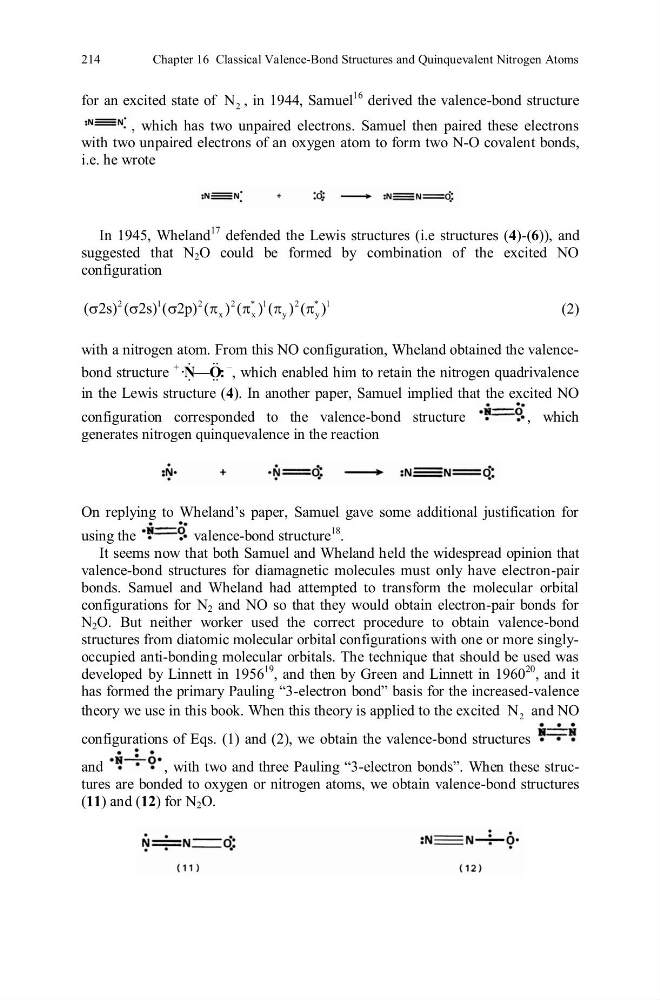
, with two and three Pauling “3-electron bonds”. When these structures are bonded to oxygen or nitrogen atoms, we obtain valence-bond structures
(11) and (12) for N 2 O.
Chapter 16 Classical Valence-Bond Structures and Quinquevalent Nitrogen Atoms
for an excited state of 2
N , in 1944, Samuel
16 derived the valence-bond structure
, which has two unpaired electrons. Samuel then paired these electrons
with two unpaired electrons of an oxygen atom to form two N-O covalent bonds,
i.e. he wrote
In 1945, Wheland
17 defended the Lewis structures (i.e structures (4)-(6)), and
suggested that N 2 O could be formed by combination of the excited NO
configuration
2
1
2
2
* 1
2
* 1
x
x
y
y
( 2s) ( 2s) ( 2p) ( ) ( ) ( ) ( )
(2)
with a nitrogen atom. From this NO configuration, Wheland obtained the valencebond structure
+
·N—O:
– , which enabled him to retain the nitrogen quadrivalence
in the Lewis structure (4). In another paper, Samuel implied that the excited NO
configuration corresponded to the valence-bond structure
, which
generates nitrogen quinquevalence in the reaction
On replying to Wheland’s paper, Samuel gave some additional justification for
using the
valence-bond structure
18
.
It seems now that both Samuel and Wheland held the widespread opinion that
valence-bond structures for diamagnetic molecules must only have electron-pair
bonds. Samuel and Wheland had attempted to transform the molecular orbital
configurations for N 2 and NO so that they would obtain electron-pair bonds for
N 2 O. But neither worker used the correct procedure to obtain valence-bond
structures from diatomic molecular orbital configurations with one or more singlyoccupied anti-bonding molecular orbitals. The technique that should be used was
developed by Linnett in 1956
19
, and then by Green and Linnett in 1960
20 , and it
has formed the primary Pauling “3-electron bond” basis for the increased-valence
theory we use in this book. When this theory is applied to the excited 2
N and NO
configurations of Eqs. (1) and (2), we obtain the valence-bond structures
and
, with two and three Pauling “3-electron bonds”. When these structures are bonded to oxygen or nitrogen atoms, we obtain valence-bond structures
(11) and (12) for N 2 O.