

Chapter 16 Classical Valence-Bond Structures and Quinquevalent Nitrogen Atoms
213
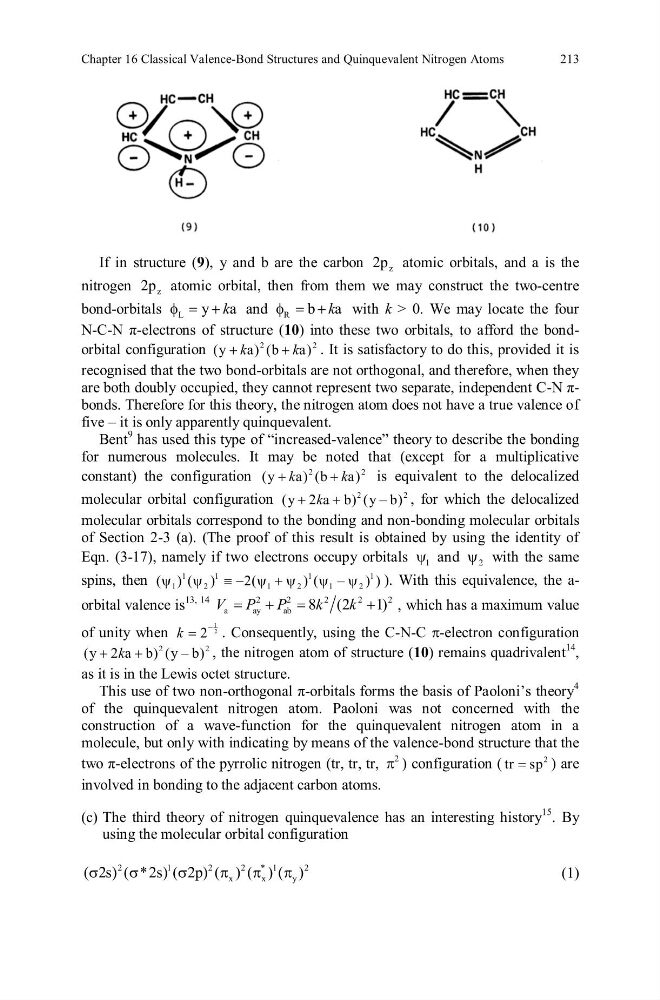
If in structure (9), y and b are the carbon
z
2p atomic orbitals, and a is the
nitrogen
z
2p atomic orbital, then from them we may construct the two-centre
bond-orbitals L y a
k and R b a
k
with k > 0. We may locate the four
N-C-N π-electrons of structure (10) into these two orbitals, to afford the bondorbital configuration
2
2
(y a) (b a)
k
k
. It is satisfactory to do this, provided it is
recognised that the two bond-orbitals are not orthogonal, and therefore, when they
are both doubly occupied, they cannot represent two separate, independent C-N πbonds. Therefore for this theory, the nitrogen atom does not have a true valence of
five – it is only apparently quinquevalent.
Bent
9 has used this type of “increased-valence” theory to describe the bonding
for numerous molecules. It may be noted that (except for a multiplicative
constant) the configuration
2
2
(y a) (b a)
k
k
is equivalent to the delocalized
molecular orbital configuration
2
2
(y 2 a b) (y – b)
k
, for which the delocalized
molecular orbitals correspond to the bonding and non-bonding molecular orbitals
of Section 2-3 (a). (The proof of this result is obtained by using the identity of
Eqn. (3-17), namely if two electrons occupy orbitals 1
and 2
with the same
spins, then
1
1
1
1
1
2
1
2
1
2
( ) ( )
2(
) ( – ) )
). With this equivalence, the aorbital valence is
13, 14
2
2
2
2
2
a
ay
ab
8 (2
1)
V P P
k
k
, which has a maximum value
of unity when
1
2
2
k
. Consequently, using the C-N-C -electron configuration
2
2
(y 2 a b) (y – b)
k
, the nitrogen atom of structure (10) remains quadrivalent
14
,
as it is in the Lewis octet structure.
This use of two non-orthogonal π-orbitals forms the basis of Paoloni’s theory
4
of the quinquevalent nitrogen atom. Paoloni was not concerned with the
construction of a wave-function for the quinquevalent nitrogen atom in a
molecule, but only with indicating by means of the valence-bond structure that the
two π-electrons of the pyrrolic nitrogen (tr, tr, tr,
2
) configuration (
2
tr sp
) are
involved in bonding to the adjacent carbon atoms.
(c) The third theory of nitrogen quinquevalence has an interesting history
15 . By
using the molecular orbital configuration
2
1
2
2
* 1
2
x
x
y
( 2s) ( * 2s) ( 2p) ( ) ( ) ( )
(1)
213
If in structure (9), y and b are the carbon
z
2p atomic orbitals, and a is the
nitrogen
z
2p atomic orbital, then from them we may construct the two-centre
bond-orbitals L y a
k and R b a
k
with k > 0. We may locate the four
N-C-N π-electrons of structure (10) into these two orbitals, to afford the bondorbital configuration
2
2
(y a) (b a)
k
k
. It is satisfactory to do this, provided it is
recognised that the two bond-orbitals are not orthogonal, and therefore, when they
are both doubly occupied, they cannot represent two separate, independent C-N πbonds. Therefore for this theory, the nitrogen atom does not have a true valence of
five – it is only apparently quinquevalent.
Bent
9 has used this type of “increased-valence” theory to describe the bonding
for numerous molecules. It may be noted that (except for a multiplicative
constant) the configuration
2
2
(y a) (b a)
k
k
is equivalent to the delocalized
molecular orbital configuration
2
2
(y 2 a b) (y – b)
k
, for which the delocalized
molecular orbitals correspond to the bonding and non-bonding molecular orbitals
of Section 2-3 (a). (The proof of this result is obtained by using the identity of
Eqn. (3-17), namely if two electrons occupy orbitals 1
and 2
with the same
spins, then
1
1
1
1
1
2
1
2
1
2
( ) ( )
2(
) ( – ) )
). With this equivalence, the aorbital valence is
13, 14
2
2
2
2
2
a
ay
ab
8 (2
1)
V P P
k
k
, which has a maximum value
of unity when
1
2
2
k
. Consequently, using the C-N-C -electron configuration
2
2
(y 2 a b) (y – b)
k
, the nitrogen atom of structure (10) remains quadrivalent
14
,
as it is in the Lewis octet structure.
This use of two non-orthogonal π-orbitals forms the basis of Paoloni’s theory
4
of the quinquevalent nitrogen atom. Paoloni was not concerned with the
construction of a wave-function for the quinquevalent nitrogen atom in a
molecule, but only with indicating by means of the valence-bond structure that the
two π-electrons of the pyrrolic nitrogen (tr, tr, tr,
2
) configuration (
2
tr sp
) are
involved in bonding to the adjacent carbon atoms.
(c) The third theory of nitrogen quinquevalence has an interesting history
15 . By
using the molecular orbital configuration
2
1
2
2
* 1
2
x
x
y
( 2s) ( * 2s) ( 2p) ( ) ( ) ( )
(1)