

212
Chapter 16 Classical Valence-Bond Structures and Quinquevalent Nitrogen Atoms
In these latter structures, the valencies of N
– , N, and N
+ are 2, 3 and 4, respectively. We may note that each of the structures (1), (2) and (3) seems to have
one more bond than have the corresponding Lewis structures, and therefore we
might also designate structures (1), (2) and (3) as “increased-valence” structures.
Alternatively, we may say that the quinquevalent nitrogen atom has increased its
valence relative to the maximum of four which is allowed in the Lewis theory.
Sometimes, the valence-bond structures such as (1), (2) and (3) are designated as
“classical valence structures”, and we shall refer to them as such here.
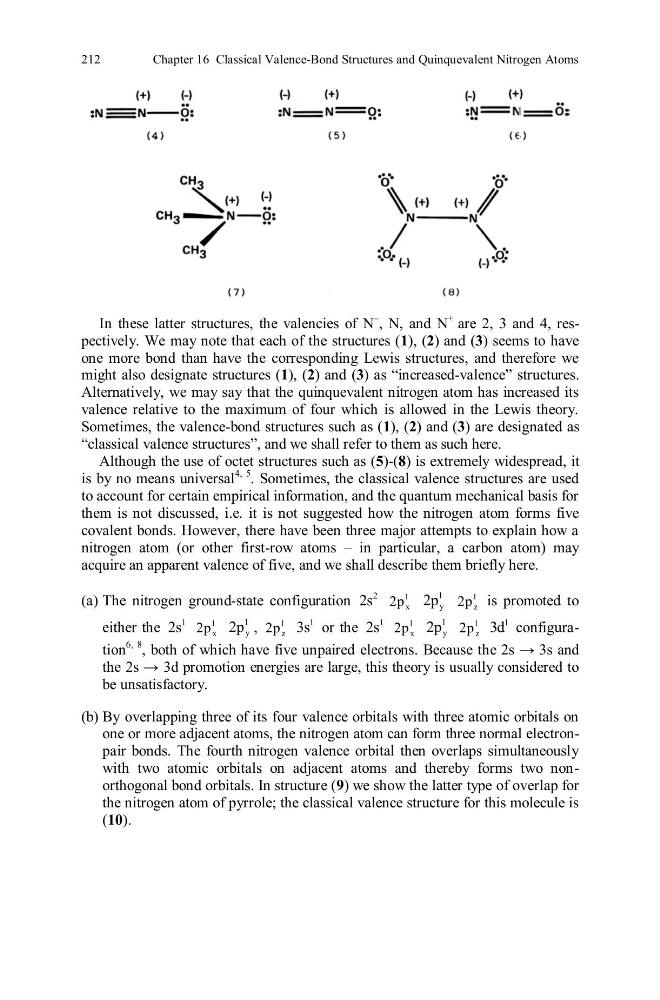
Although the use of octet structures such as (5)-(8) is extremely widespread, it
is by no means universal
4, 5
. Sometimes, the classical valence structures are used
to account for certain empirical information, and the quantum mechanical basis for
them is not discussed, i.e. it is not suggested how the nitrogen atom forms five
covalent bonds. However, there have been three major attempts to explain how a
nitrogen atom (or other first-row atoms – in particular, a carbon atom) may
acquire an apparent valence of five, and we shall describe them briefly here.
(a) The nitrogen ground-state configuration
2
2s
1
x
2p
1
y
2p
1
z
2p is promoted to
either the
1
2s
1
x
2p
1
y
2p ,
1
z
2p
1
3s or the
1
2s
1
x
2p
1
y
2p
1
z
2p
1
3d configuration
6, 8
, both of which have five unpaired electrons. Because the 2s → 3s and
the 2s → 3d promotion energies are large, this theory is usually considered to
be unsatisfactory.
(b) By overlapping three of its four valence orbitals with three atomic orbitals on
one or more adjacent atoms, the nitrogen atom can form three normal electronpair bonds. The fourth nitrogen valence orbital then overlaps simultaneously
with two atomic orbitals on adjacent atoms and thereby forms two nonorthogonal bond orbitals. In structure (9) we show the latter type of overlap for
the nitrogen atom of pyrrole; the classical valence structure for this molecule is
(10).
Chapter 16 Classical Valence-Bond Structures and Quinquevalent Nitrogen Atoms
In these latter structures, the valencies of N
– , N, and N
+ are 2, 3 and 4, respectively. We may note that each of the structures (1), (2) and (3) seems to have
one more bond than have the corresponding Lewis structures, and therefore we
might also designate structures (1), (2) and (3) as “increased-valence” structures.
Alternatively, we may say that the quinquevalent nitrogen atom has increased its
valence relative to the maximum of four which is allowed in the Lewis theory.
Sometimes, the valence-bond structures such as (1), (2) and (3) are designated as
“classical valence structures”, and we shall refer to them as such here.
Although the use of octet structures such as (5)-(8) is extremely widespread, it
is by no means universal
4, 5
. Sometimes, the classical valence structures are used
to account for certain empirical information, and the quantum mechanical basis for
them is not discussed, i.e. it is not suggested how the nitrogen atom forms five
covalent bonds. However, there have been three major attempts to explain how a
nitrogen atom (or other first-row atoms – in particular, a carbon atom) may
acquire an apparent valence of five, and we shall describe them briefly here.
(a) The nitrogen ground-state configuration
2
2s
1
x
2p
1
y
2p
1
z
2p is promoted to
either the
1
2s
1
x
2p
1
y
2p ,
1
z
2p
1
3s or the
1
2s
1
x
2p
1
y
2p
1
z
2p
1
3d configuration
6, 8
, both of which have five unpaired electrons. Because the 2s → 3s and
the 2s → 3d promotion energies are large, this theory is usually considered to
be unsatisfactory.
(b) By overlapping three of its four valence orbitals with three atomic orbitals on
one or more adjacent atoms, the nitrogen atom can form three normal electronpair bonds. The fourth nitrogen valence orbital then overlaps simultaneously
with two atomic orbitals on adjacent atoms and thereby forms two nonorthogonal bond orbitals. In structure (9) we show the latter type of overlap for
the nitrogen atom of pyrrole; the classical valence structure for this molecule is
(10).