

Chapter 16 Classical Valence-Bond Structures
and Quinquevalent Nitrogen Atoms
For a number of electron-excess molecules that involve atoms of first-row
elements (in particular, nitrogen atoms), an older type of “increased-valence”
structure is sometimes used to represent their electronic structures. Since the
1860s and until the introduction of the Lewis-Langmuir octet theory, nitrogen
atoms were often represented with valencies of 3 or 5 in valence-bond structures.
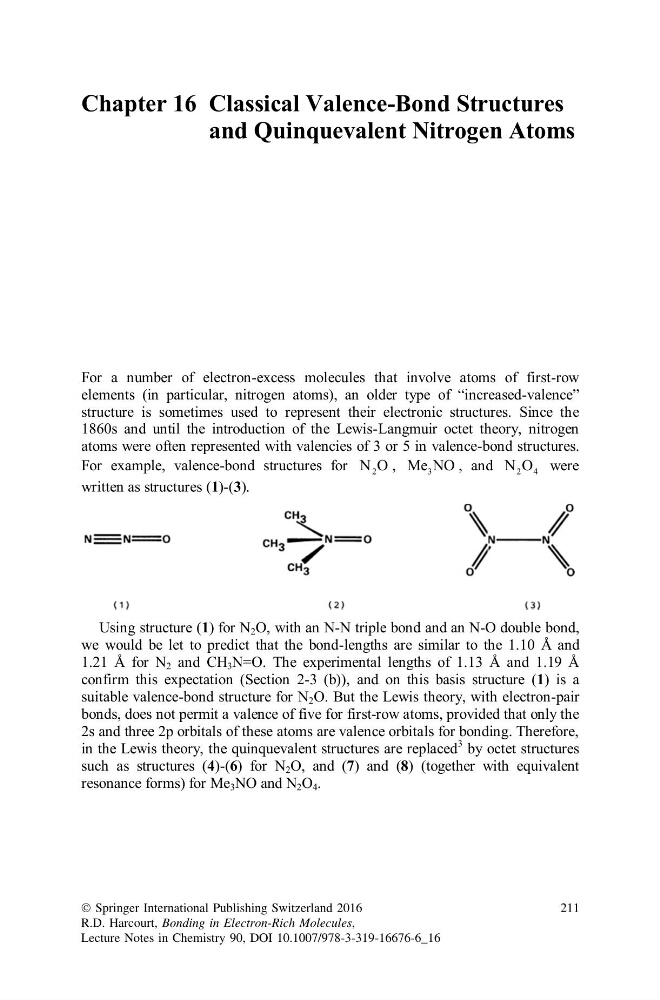
For example, valence-bond structures for
2
N O ,
3
Me NO , and
2 4
N O were
written as structures (1)-(3).
Using structure (1) for N 2 O, with an N-N triple bond and an N-O double bond,
we would be let to predict that the bond-lengths are similar to the 1.10 Å and
1.21 Å for N 2 and CH 3 N=O. The experimental lengths of 1.13 Å and 1.19 Å
confirm this expectation (Section 2-3 (b)), and on this basis structure (1) is a
suitable valence-bond structure for N 2 O. But the Lewis theory, with electron-pair
bonds, does not permit a valence of five for first-row atoms, provided that only the
2s and three 2p orbitals of these atoms are valence orbitals for bonding. Therefore,
in the Lewis theory, the quinquevalent structures are replaced
3 by octet structures
such as structures (4)-(6) for N 2 O, and (7) and (8) (together with equivalent
resonance forms) for Me 3 NO and N 2 O 4 .
Ó Springer International Publishing Switzerland 2016
R.D. Harcourt, Bonding in Electron-Rich Molecules,
Lecture Notes in Chemistry 90, DOI 10.1007/978-3-319-16676-6_16
211
and Quinquevalent Nitrogen Atoms
For a number of electron-excess molecules that involve atoms of first-row
elements (in particular, nitrogen atoms), an older type of “increased-valence”
structure is sometimes used to represent their electronic structures. Since the
1860s and until the introduction of the Lewis-Langmuir octet theory, nitrogen
atoms were often represented with valencies of 3 or 5 in valence-bond structures.
For example, valence-bond structures for
2
N O ,
3
Me NO , and
2 4
N O were
written as structures (1)-(3).
Using structure (1) for N 2 O, with an N-N triple bond and an N-O double bond,
we would be let to predict that the bond-lengths are similar to the 1.10 Å and
1.21 Å for N 2 and CH 3 N=O. The experimental lengths of 1.13 Å and 1.19 Å
confirm this expectation (Section 2-3 (b)), and on this basis structure (1) is a
suitable valence-bond structure for N 2 O. But the Lewis theory, with electron-pair
bonds, does not permit a valence of five for first-row atoms, provided that only the
2s and three 2p orbitals of these atoms are valence orbitals for bonding. Therefore,
in the Lewis theory, the quinquevalent structures are replaced
3 by octet structures
such as structures (4)-(6) for N 2 O, and (7) and (8) (together with equivalent
resonance forms) for Me 3 NO and N 2 O 4 .
Ó Springer International Publishing Switzerland 2016
R.D. Harcourt, Bonding in Electron-Rich Molecules,
Lecture Notes in Chemistry 90, DOI 10.1007/978-3-319-16676-6_16
211