

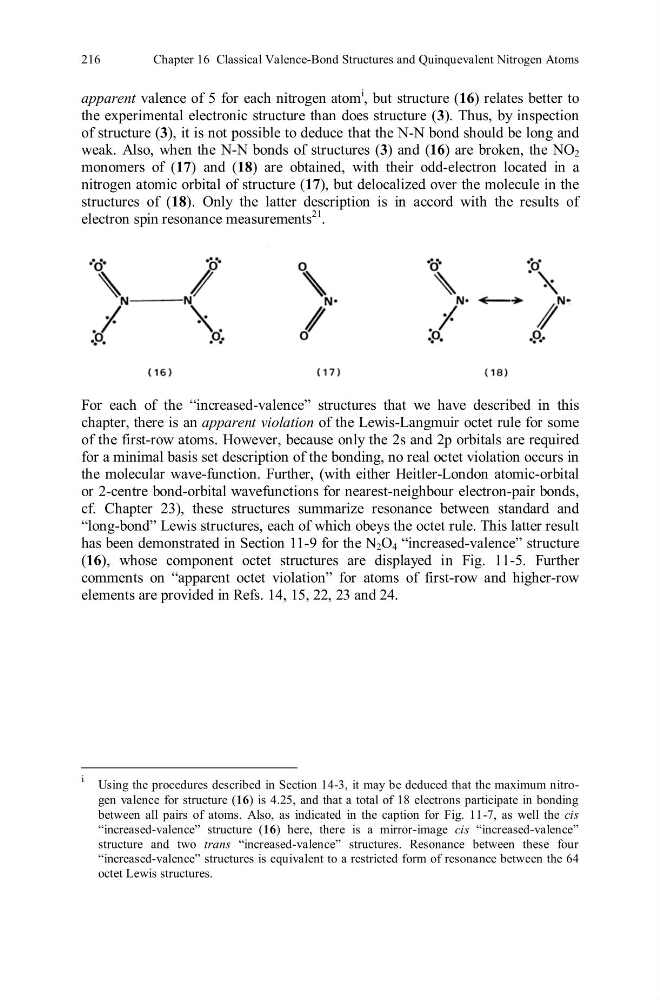
apparent valence of 5 for each nitrogen atom
i
, but structure (16) relates better to
the experimental electronic structure than does structure (3). Thus, by inspection
of structure (3), it is not possible to deduce that the N-N bond should be long and
weak. Also, when the N-N bonds of structures (3) and (16) are broken, the NO 2
monomers of (17) and (18) are obtained, with their odd-electron located in a
nitrogen atomic orbital of structure (17), but delocalized over the molecule in the
structures of (18). Only the latter description is in accord with the results of
electron spin resonance measurements
21
.
For each of the “increased-valence” structures that we have described in this
chapter, there is an apparent violation of the Lewis-Langmuir octet rule for some
of the first-row atoms. However, because only the 2s and 2p orbitals are required
for a minimal basis set description of the bonding, no real octet violation occurs in
the molecular wave-function. Further, (with either Heitler-London atomic-orbital
or 2-centre bond-orbital wavefunctions for nearest-neighbour electron-pair bonds,
cf. Chapter 23), these structures summarize resonance between standard and
“long-bond” Lewis structures, each of which obeys the octet rule. This latter result
has been demonstrated in Section 11-9 for the N 2 O 4 “increased-valence” structure
(16), whose component octet structures are displayed in Fig. 11-5. Further
comments on “apparent octet violation” for atoms of first-row and higher-row
elements are provided in Refs. 14, 15, 22, 23 and 24.
i Using the procedures described in Section 14-3, it may be deduced that the maximum nitrogen valence for structure (16) is 4.25, and that a total of 18 electrons participate in bonding
between all pairs of atoms. Also, as indicated in the caption for Fig. 11-7, as well the cis
“increased-valence” structure (16) here, there is a mirror-image cis “increased-valence”
structure and two trans “increased-valence” structures. Resonance between these four
“increased-valence” structures is equivalent to a restricted form of resonance between the 64
octet Lewis structures.
216
Chapter 16 Classical Valence-Bond Structures and Quinquevalent Nitrogen Atoms
i
, but structure (16) relates better to
the experimental electronic structure than does structure (3). Thus, by inspection
of structure (3), it is not possible to deduce that the N-N bond should be long and
weak. Also, when the N-N bonds of structures (3) and (16) are broken, the NO 2
monomers of (17) and (18) are obtained, with their odd-electron located in a
nitrogen atomic orbital of structure (17), but delocalized over the molecule in the
structures of (18). Only the latter description is in accord with the results of
electron spin resonance measurements
21
.
For each of the “increased-valence” structures that we have described in this
chapter, there is an apparent violation of the Lewis-Langmuir octet rule for some
of the first-row atoms. However, because only the 2s and 2p orbitals are required
for a minimal basis set description of the bonding, no real octet violation occurs in
the molecular wave-function. Further, (with either Heitler-London atomic-orbital
or 2-centre bond-orbital wavefunctions for nearest-neighbour electron-pair bonds,
cf. Chapter 23), these structures summarize resonance between standard and
“long-bond” Lewis structures, each of which obeys the octet rule. This latter result
has been demonstrated in Section 11-9 for the N 2 O 4 “increased-valence” structure
(16), whose component octet structures are displayed in Fig. 11-5. Further
comments on “apparent octet violation” for atoms of first-row and higher-row
elements are provided in Refs. 14, 15, 22, 23 and 24.
i Using the procedures described in Section 14-3, it may be deduced that the maximum nitrogen valence for structure (16) is 4.25, and that a total of 18 electrons participate in bonding
between all pairs of atoms. Also, as indicated in the caption for Fig. 11-7, as well the cis
“increased-valence” structure (16) here, there is a mirror-image cis “increased-valence”
structure and two trans “increased-valence” structures. Resonance between these four
“increased-valence” structures is equivalent to a restricted form of resonance between the 64
octet Lewis structures.
216
Chapter 16 Classical Valence-Bond Structures and Quinquevalent Nitrogen Atoms