

14-3
Atomic Valencies for “Increased-Valence” Structures
199
in which ab
P is the bond-order for the A · B
component (Table 3-3) of “increased-valence” structure (1).
By summing ay
V and ab
V of Eqs. (12) and (16) the total A-atom valence of
Eqn. (17) is obtained.
2
2
2
2 2
a
ay
ab
/ (1
) 2 / (1
)
V V V
k
k
k
k
(17)
For 1 k
, a 1
V i.e. the A-atom valence for “increased-valence” structure
(1) exceeds the value of unity that occurs in the standard Lewis structure (15).
Similar procedures may be used to deduce that the B-atom valence for structure
(1) is given by Eqn. (18). .
2
2
2 2
b
by
ba
1/ (1
) 2 / (1
)
V V V
k
k
k
(18)
Because the Y-atom valence for structure (1) (namely y
ya
yb
V V
V
) must always
equal unity, the sum of the atomic valencies for structure (1) is given by Eqn. (19).
V(total) =
2
2 2
y
2 4 / (1
)
a
b
V V V
k
k
(19)
V(total) has a maximum value of 3 when k = 1, which is in accord with the
earlier deduction (Section 11-1) that a maximum of three electrons may
simultaneously participate in fractional Y-A, Y-B and A-B bonding.
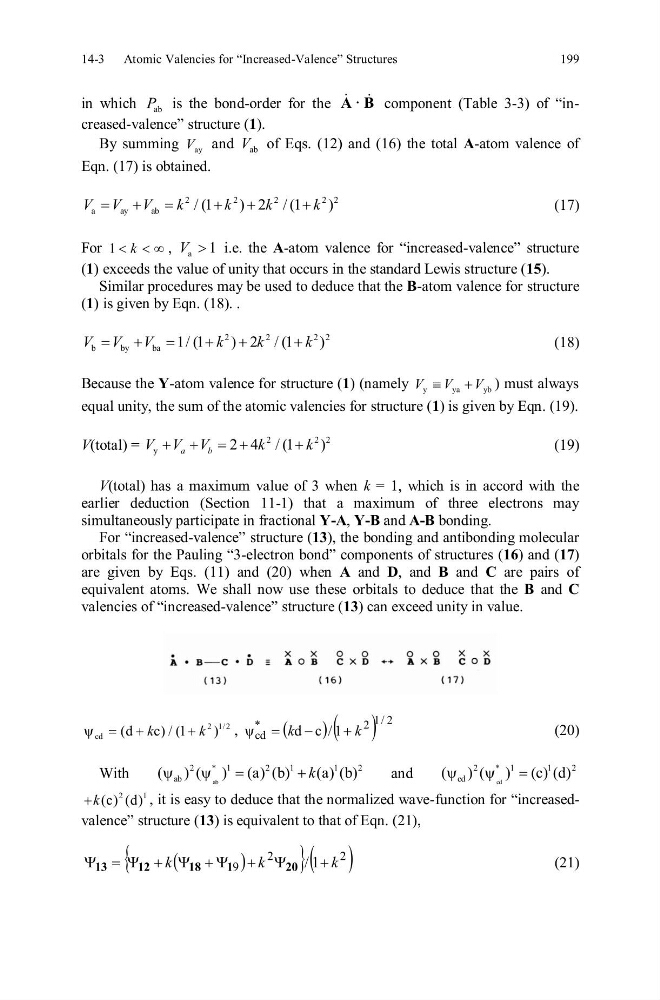
For “increased-valence” structure (13), the bonding and antibonding molecular
orbitals for the Pauling “3-electron bond” components of structures (16) and (17)
are given by Eqs. (11) and (20) when A and D, and B and C are pairs of
equivalent atoms. We shall now use these orbitals to deduce that the B and C
valencies of “increased-valence” structure (13) can exceed unity in value.
2 1/ 2
cd
(d c) / (1
)
k
k
,
2
/
1
2
*
cd
1
/
c
d
ψ
k
k
(20)
With
ab
2
* 1
2
1
1
2
ab
( ) ( ) (a) (b)
(a) (b)
k
and
cd
2
* 1
1
2
cd
( ) ( ) (c) (d)
2
1
(c) (d)
k
, it is easy to deduce that the normalized wave-function for “increasedvalence” structure (13) is equivalent to that of Eqn. (21),
2
2
9
1
/ k
k
k
20
1
18
12
13
(21)
Atomic Valencies for “Increased-Valence” Structures
199
in which ab
P is the bond-order for the A · B
component (Table 3-3) of “increased-valence” structure (1).
By summing ay
V and ab
V of Eqs. (12) and (16) the total A-atom valence of
Eqn. (17) is obtained.
2
2
2
2 2
a
ay
ab
/ (1
) 2 / (1
)
V V V
k
k
k
k
(17)
For 1 k
, a 1
V i.e. the A-atom valence for “increased-valence” structure
(1) exceeds the value of unity that occurs in the standard Lewis structure (15).
Similar procedures may be used to deduce that the B-atom valence for structure
(1) is given by Eqn. (18). .
2
2
2 2
b
by
ba
1/ (1
) 2 / (1
)
V V V
k
k
k
(18)
Because the Y-atom valence for structure (1) (namely y
ya
yb
V V
V
) must always
equal unity, the sum of the atomic valencies for structure (1) is given by Eqn. (19).
V(total) =
2
2 2
y
2 4 / (1
)
a
b
V V V
k
k
(19)
V(total) has a maximum value of 3 when k = 1, which is in accord with the
earlier deduction (Section 11-1) that a maximum of three electrons may
simultaneously participate in fractional Y-A, Y-B and A-B bonding.
For “increased-valence” structure (13), the bonding and antibonding molecular
orbitals for the Pauling “3-electron bond” components of structures (16) and (17)
are given by Eqs. (11) and (20) when A and D, and B and C are pairs of
equivalent atoms. We shall now use these orbitals to deduce that the B and C
valencies of “increased-valence” structure (13) can exceed unity in value.
2 1/ 2
cd
(d c) / (1
)
k
k
,
2
/
1
2
*
cd
1
/
c
d
ψ
k
k
(20)
With
ab
2
* 1
2
1
1
2
ab
( ) ( ) (a) (b)
(a) (b)
k
and
cd
2
* 1
1
2
cd
( ) ( ) (c) (d)
2
1
(c) (d)
k
, it is easy to deduce that the normalized wave-function for “increasedvalence” structure (13) is equivalent to that of Eqn. (21),
2
2
9
1
/ k
k
k
20
1
18
12
13
(21)