

200
Chapter 14 Delocalization of a Lone-Pair Electron into a Vacant Antibonding Orbital
in which
2
1
, 18
, 19
and 20
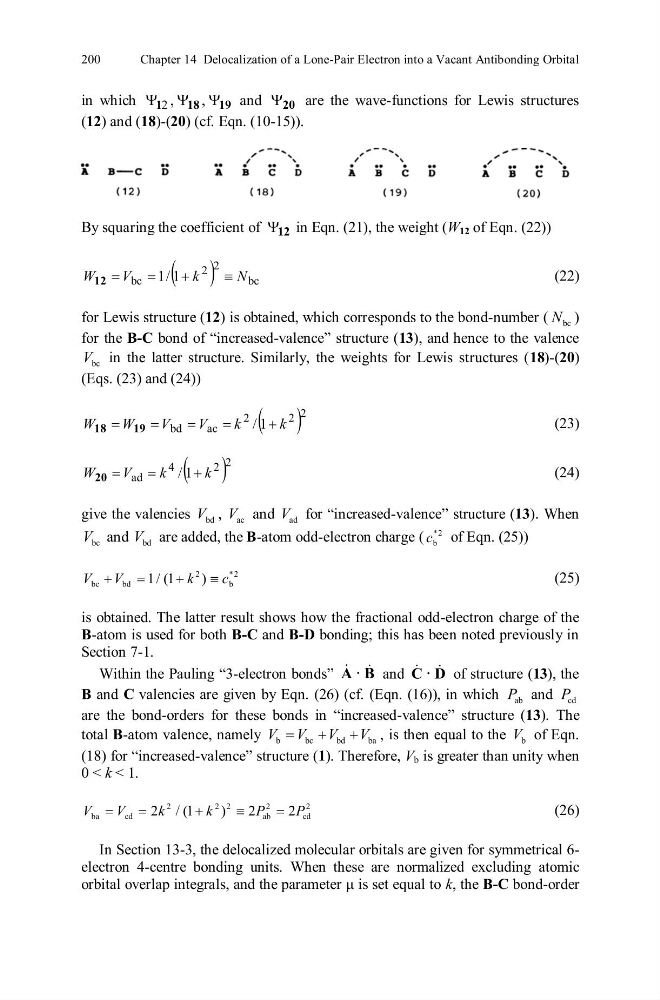
are the wave-functions for Lewis structures
(12) and (18)-(20) (cf. Eqn. (10-15)).
By squaring the coefficient of 12
in Eqn. (21), the weight (W 12 of Eqn. (22))
bc
2
2
bc
1
/
1
N
k
V
W
12
(22)
for Lewis structure (12) is obtained, which corresponds to the bond-number ( bc
N )
for the B-C bond of “increased-valence” structure (13), and hence to the valence
bc
V in the latter structure. Similarly, the weights for Lewis structures (18)-(20)
(Eqs. (23) and (24))
2
2
2
ac
bd
1
/
k
k
V
V
W
W
19
18
(23)
2
2
4
ad
1
/
k
k
V
W
20
(24)
give the valencies bd
V , ac
V and ad
V for “increased-valence” structure (13). When
bc
V and bd
V are added, the B-atom odd-electron charge (
*2
b
c of Eqn. (25))
2
* 2
bc
bd
b
1 / (1
)
V
V
k
c
(25)
is obtained. The latter result shows how the fractional odd-electron charge of the
B-atom is used for both B-C and B-D bonding; this has been noted previously in
Section 7-1.
Within the Pauling “3-electron bonds”
A · B and C · D
of structure (13), the
B and C valencies are given by Eqn. (26) (cf. (Eqn. (16)), in which ab
P and cd
P
are the bond-orders for these bonds in “increased-valence” structure (13). The
total B-atom valence, namely b
bc
bd
ba
V V V V
, is then equal to the b
V of Eqn.
(18) for “increased-valence” structure (1). Therefore, V b is greater than unity when
0 < k < 1.
2
2 2
2
2
ba
cd
ab
cd
2 / (1
)
2
2
V
V
k
k
P
P
(26)
In Section 13-3, the delocalized molecular orbitals are given for symmetrical 6electron 4-centre bonding units. When these are normalized excluding atomic
orbital overlap integrals, and the parameter μ is set equal to k, the B-C bond-order
Chapter 14 Delocalization of a Lone-Pair Electron into a Vacant Antibonding Orbital
in which
2
1
, 18
, 19
and 20
are the wave-functions for Lewis structures
(12) and (18)-(20) (cf. Eqn. (10-15)).
By squaring the coefficient of 12
in Eqn. (21), the weight (W 12 of Eqn. (22))
bc
2
2
bc
1
/
1
N
k
V
W
12
(22)
for Lewis structure (12) is obtained, which corresponds to the bond-number ( bc
N )
for the B-C bond of “increased-valence” structure (13), and hence to the valence
bc
V in the latter structure. Similarly, the weights for Lewis structures (18)-(20)
(Eqs. (23) and (24))
2
2
2
ac
bd
1
/
k
k
V
V
W
W
19
18
(23)
2
2
4
ad
1
/
k
k
V
W
20
(24)
give the valencies bd
V , ac
V and ad
V for “increased-valence” structure (13). When
bc
V and bd
V are added, the B-atom odd-electron charge (
*2
b
c of Eqn. (25))
2
* 2
bc
bd
b
1 / (1
)
V
V
k
c
(25)
is obtained. The latter result shows how the fractional odd-electron charge of the
B-atom is used for both B-C and B-D bonding; this has been noted previously in
Section 7-1.
Within the Pauling “3-electron bonds”
A · B and C · D
of structure (13), the
B and C valencies are given by Eqn. (26) (cf. (Eqn. (16)), in which ab
P and cd
P
are the bond-orders for these bonds in “increased-valence” structure (13). The
total B-atom valence, namely b
bc
bd
ba
V V V V
, is then equal to the b
V of Eqn.
(18) for “increased-valence” structure (1). Therefore, V b is greater than unity when
0 < k < 1.
2
2 2
2
2
ba
cd
ab
cd
2 / (1
)
2
2
V
V
k
k
P
P
(26)
In Section 13-3, the delocalized molecular orbitals are given for symmetrical 6electron 4-centre bonding units. When these are normalized excluding atomic
orbital overlap integrals, and the parameter μ is set equal to k, the B-C bond-order