

198
Chapter 14 Delocalization of a Lone-Pair Electron into a Vacant Antibonding Orbital
ay
V must therefore correspond to the A-atom odd-electron charge, which is
calculated from the square of the coefficient of the a orbital in
*
ab
. We
thereby obtain
2
2
ay
/ (1
)
V
k
k
(12)
b) Because structure (1) is equivalent to resonance between Lewis structures (14)
and (15), and (14) has no Y-A bond, ay
V must correspond to the weight for
structure (15) in this resonance. In Section 3-11, we have deduced that
1
2
ab
2
* 1
2
1
1
2
ab
2
( ) ( ) {(a) (b)
(a) (b) }/ (1
)
k
k
(13)
from which it follows that
(14)
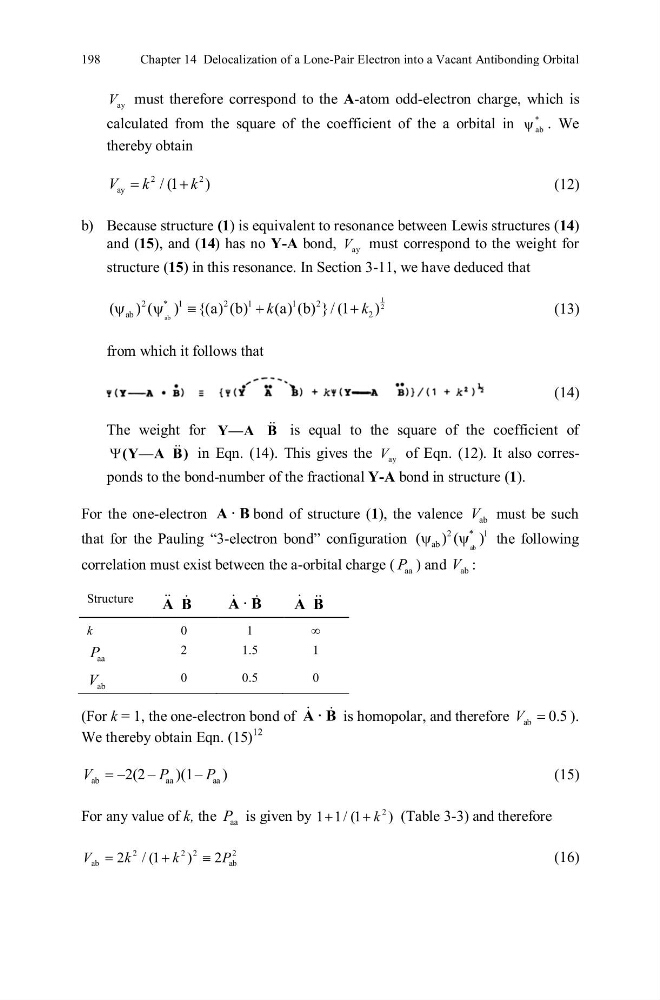
The weight for
Y—A B is equal to the square of the coefficient of
(Y—A B)
in Eqn. (14). This gives the ay
V of Eqn. (12). It also corresponds to the bond-number of the fractional Y-A bond in structure (1).
For the one-electron A · B bond of structure (1), the valence ab
V must be such
that for the Pauling “3-electron bond” configuration
ab
2
* 1
ab
( ) ( )
the following
correlation must exist between the a-orbital charge ( aa
P ) and ab
V :
Structure
A B
A · B
A B
k
0
1
∞
aa
P
2
1.5
1
ab
V
0
0.5
0
(For k = 1, the one-electron bond of A · B
is homopolar, and therefore ab 0.5
V
).
We thereby obtain Eqn. (15)
12
ab
aa
aa
2(2 – )(1– )
V
P
P
(15)
For any value of k, the aa
P is given by
2
1 1 / (1
)
k
(Table 3-3) and therefore
2
2 2
2
ab
ab
2 / (1
)
2
V
k
k
P
(16)
Chapter 14 Delocalization of a Lone-Pair Electron into a Vacant Antibonding Orbital
ay
V must therefore correspond to the A-atom odd-electron charge, which is
calculated from the square of the coefficient of the a orbital in
*
ab
. We
thereby obtain
2
2
ay
/ (1
)
V
k
k
(12)
b) Because structure (1) is equivalent to resonance between Lewis structures (14)
and (15), and (14) has no Y-A bond, ay
V must correspond to the weight for
structure (15) in this resonance. In Section 3-11, we have deduced that
1
2
ab
2
* 1
2
1
1
2
ab
2
( ) ( ) {(a) (b)
(a) (b) }/ (1
)
k
k
(13)
from which it follows that
(14)
The weight for
Y—A B is equal to the square of the coefficient of
(Y—A B)
in Eqn. (14). This gives the ay
V of Eqn. (12). It also corresponds to the bond-number of the fractional Y-A bond in structure (1).
For the one-electron A · B bond of structure (1), the valence ab
V must be such
that for the Pauling “3-electron bond” configuration
ab
2
* 1
ab
( ) ( )
the following
correlation must exist between the a-orbital charge ( aa
P ) and ab
V :
Structure
A B
A · B
A B
k
0
1
∞
aa
P
2
1.5
1
ab
V
0
0.5
0
(For k = 1, the one-electron bond of A · B
is homopolar, and therefore ab 0.5
V
).
We thereby obtain Eqn. (15)
12
ab
aa
aa
2(2 – )(1– )
V
P
P
(15)
For any value of k, the aa
P is given by
2
1 1 / (1
)
k
(Table 3-3) and therefore
2
2 2
2
ab
ab
2 / (1
)
2
V
k
k
P
(16)