

14-3
Atomic Valencies for “Increased-Valence” Structures
197
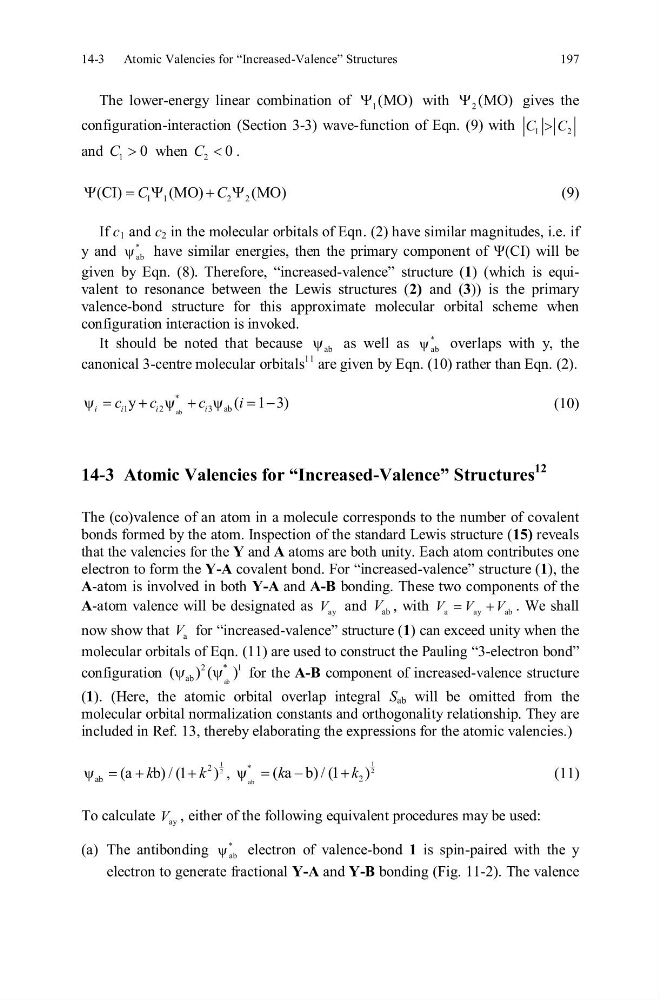
The lower-energy linear combination of 1 (MO)
with
2 (MO)
gives the
configuration-interaction (Section 3-3) wave-function of Eqn. (9) with 1
2
C
C
and 1 0
C when 2 0
C .
1 1
2
2
(CI)
( O)
(MO)
C
C
(9)
If c 1 and c 2 in the molecular orbitals of Eqn. (2) have similar magnitudes, i.e. if
y and
*
ab
have similar energies, then the primary component of Ψ(CI) will be
given by Eqn. (8). Therefore, “increased-valence” structure (1) (which is equivalent to resonance between the Lewis structures (2) and (3)) is the primary
valence-bond structure for this approximate molecular orbital scheme when
configuration interaction is invoked.
It should be noted that because ab
as well as
*
ab
overlaps with y, the
canonical 3-centre molecular orbitals
11 are given by Eqn. (10) rather than Eqn. (2).
ab
*
1
2
3 ab
y
( 1 3)
i
i
i
i
c
c
c
i
(10)
14-3 Atomic Valencies for “Increased-Valence” Structures
12
The (co)valence of an atom in a molecule corresponds to the number of covalent
bonds formed by the atom. Inspection of the standard Lewis structure (15) reveals
that the valencies for the Y and A atoms are both unity. Each atom contributes one
electron to form the Y-A covalent bond. For “increased-valence” structure (1), the
A-atom is involved in both Y-A and A-B bonding. These two components of the
A-atom valence will be designated as ay
V and ab
V , with a
ay
ab
V V
V
. We shall
now show that a
V for “increased-valence” structure (1) can exceed unity when the
molecular orbitals of Eqn. (11) are used to construct the Pauling “3-electron bond”
configuration
ab
2
* 1
ab
( ) ( )
for the A-B component of increased-valence structure
(1). (Here, the atomic orbital overlap integral S ab will be omitted from the
molecular orbital normalization constants and orthogonality relationship. They are
included in Ref. 13, thereby elaborating the expressions for the atomic valencies.)
1
2
2
ab
(a b) / (1
)
k
k
,
1
2
ab
*
2
( a – b) / (1
)
k
k
(11)
To calculate ay
V , either of the following equivalent procedures may be used:
(a) The antibonding
*
ab
electron of valence-bond 1 is spin-paired with the y
electron to generate fractional Y-A and Y-B bonding (Fig. 11-2). The valence
Atomic Valencies for “Increased-Valence” Structures
197
The lower-energy linear combination of 1 (MO)
with
2 (MO)
gives the
configuration-interaction (Section 3-3) wave-function of Eqn. (9) with 1
2
C
C
and 1 0
C when 2 0
C .
1 1
2
2
(CI)
( O)
(MO)
C
C
(9)
If c 1 and c 2 in the molecular orbitals of Eqn. (2) have similar magnitudes, i.e. if
y and
*
ab
have similar energies, then the primary component of Ψ(CI) will be
given by Eqn. (8). Therefore, “increased-valence” structure (1) (which is equivalent to resonance between the Lewis structures (2) and (3)) is the primary
valence-bond structure for this approximate molecular orbital scheme when
configuration interaction is invoked.
It should be noted that because ab
as well as
*
ab
overlaps with y, the
canonical 3-centre molecular orbitals
11 are given by Eqn. (10) rather than Eqn. (2).
ab
*
1
2
3 ab
y
( 1 3)
i
i
i
i
c
c
c
i
(10)
14-3 Atomic Valencies for “Increased-Valence” Structures
12
The (co)valence of an atom in a molecule corresponds to the number of covalent
bonds formed by the atom. Inspection of the standard Lewis structure (15) reveals
that the valencies for the Y and A atoms are both unity. Each atom contributes one
electron to form the Y-A covalent bond. For “increased-valence” structure (1), the
A-atom is involved in both Y-A and A-B bonding. These two components of the
A-atom valence will be designated as ay
V and ab
V , with a
ay
ab
V V
V
. We shall
now show that a
V for “increased-valence” structure (1) can exceed unity when the
molecular orbitals of Eqn. (11) are used to construct the Pauling “3-electron bond”
configuration
ab
2
* 1
ab
( ) ( )
for the A-B component of increased-valence structure
(1). (Here, the atomic orbital overlap integral S ab will be omitted from the
molecular orbital normalization constants and orthogonality relationship. They are
included in Ref. 13, thereby elaborating the expressions for the atomic valencies.)
1
2
2
ab
(a b) / (1
)
k
k
,
1
2
ab
*
2
( a – b) / (1
)
k
k
(11)
To calculate ay
V , either of the following equivalent procedures may be used:
(a) The antibonding
*
ab
electron of valence-bond 1 is spin-paired with the y
electron to generate fractional Y-A and Y-B bonding (Fig. 11-2). The valence