

196
Chapter 14 Delocalization of a Lone-Pair Electron into a Vacant Antibonding Orbital
(c) Williams
7 has indicated that Lucken’s theory might pertain to many saturated
systems – for example, to account for the shortening of the C-F bonds and the
lengthening of the C-H bond of
3
CF H .
(d) Spratley and Pimentel
8 have described the relative extent of interaction of
fluorine or hydrogen atomic orbitals with antibonding N-O or O-O π* orbitals
of FNO, HNO, 2 2
F O and 2 2
H O .
(e) Pearson’s
9 molecular orbital description of S N 2 reactions involves the interaction of a lone-pair orbital of the nucleophile B with the antibonding C-Cl σ*
orbital of
3
CH Cl
.
(f) Drago and Corden
10 have reviewed the spin-pairing model of the bonding of
2
O to Co(II), Cr(II), Mn(II) and Fe(II) complexes, with a 1
-type molecular
orbital to describe the spin-pairing. The y and
ab
*
are the metal d, and an
antibonding
OO
*
orbital of ground-state 2
O .
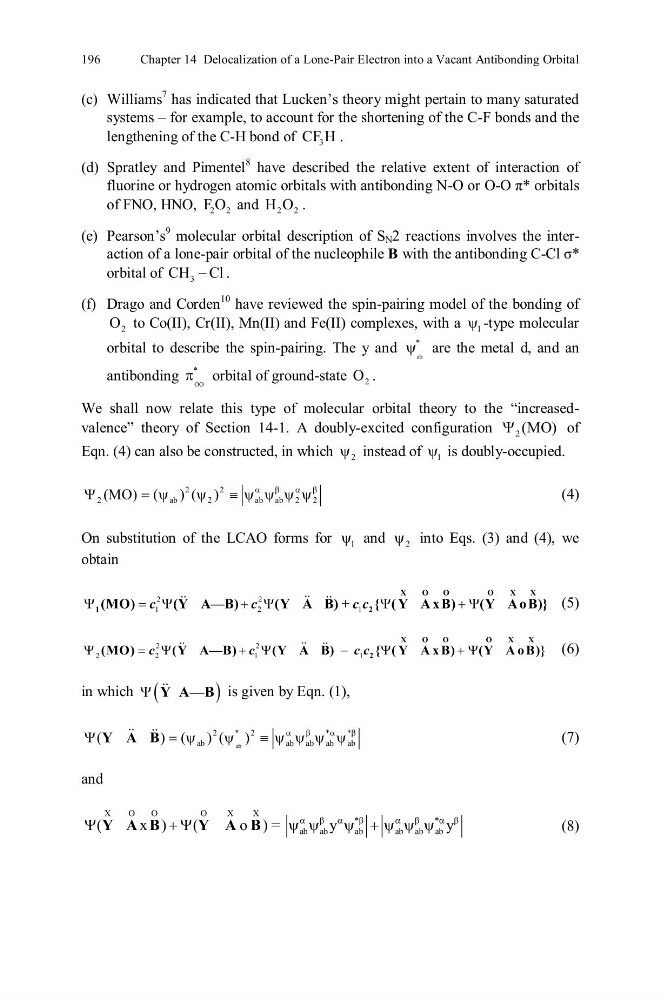
We shall now relate this type of molecular orbital theory to the “increasedvalence” theory of Section 14-1. A doubly-excited configuration
2 (MO)
of
Eqn. (4) can also be constructed, in which 2
instead of 1
is doubly-occupied.
2
2
2
ab
2
ab ab 2
2
(MO) ( ) ( )
(4)
On substitution of the LCAO forms for 1
and 2
into Eqs. (3) and (4), we
obtain
2
2
1
2
1
X
O
O
O
X
X
1
2
(MO)
(Y A—B)
(Y A B) +
{ ( Y A x B)
(Y A o B)}
c
c
c c
(5)
2
2
2
2
1
1
X
O
O
O
X
X
2
(MO)
(Y A—B)
(Y A B)
{ ( Y A x B)
(Y A o B)}
c
c
c c
(6)
in which
Y A—B
is given by Eqn. (1),
ab
2
* 2
*
*
ab
ab ab ab
ab
(
) ( ) ( )
Y A B
(7)
and
X
O
O
O
X
X
*
*
ab ab
ab
ab ab ab
(
x )
(
o ) =
y
y
Y A B
Y A B
(8)
Chapter 14 Delocalization of a Lone-Pair Electron into a Vacant Antibonding Orbital
(c) Williams
7 has indicated that Lucken’s theory might pertain to many saturated
systems – for example, to account for the shortening of the C-F bonds and the
lengthening of the C-H bond of
3
CF H .
(d) Spratley and Pimentel
8 have described the relative extent of interaction of
fluorine or hydrogen atomic orbitals with antibonding N-O or O-O π* orbitals
of FNO, HNO, 2 2
F O and 2 2
H O .
(e) Pearson’s
9 molecular orbital description of S N 2 reactions involves the interaction of a lone-pair orbital of the nucleophile B with the antibonding C-Cl σ*
orbital of
3
CH Cl
.
(f) Drago and Corden
10 have reviewed the spin-pairing model of the bonding of
2
O to Co(II), Cr(II), Mn(II) and Fe(II) complexes, with a 1
-type molecular
orbital to describe the spin-pairing. The y and
ab
*
are the metal d, and an
antibonding
OO
*
orbital of ground-state 2
O .
We shall now relate this type of molecular orbital theory to the “increasedvalence” theory of Section 14-1. A doubly-excited configuration
2 (MO)
of
Eqn. (4) can also be constructed, in which 2
instead of 1
is doubly-occupied.
2
2
2
ab
2
ab ab 2
2
(MO) ( ) ( )
(4)
On substitution of the LCAO forms for 1
and 2
into Eqs. (3) and (4), we
obtain
2
2
1
2
1
X
O
O
O
X
X
1
2
(MO)
(Y A—B)
(Y A B) +
{ ( Y A x B)
(Y A o B)}
c
c
c c
(5)
2
2
2
2
1
1
X
O
O
O
X
X
2
(MO)
(Y A—B)
(Y A B)
{ ( Y A x B)
(Y A o B)}
c
c
c c
(6)
in which
Y A—B
is given by Eqn. (1),
ab
2
* 2
*
*
ab
ab ab ab
ab
(
) ( ) ( )
Y A B
(7)
and
X
O
O
O
X
X
*
*
ab ab
ab
ab ab ab
(
x )
(
o ) =
y
y
Y A B
Y A B
(8)