

14-2
Approximate Molecular Orbital Theory for 4-Electron 3-Centre Bonding Units
195
14-2 Approximate Molecular Orbital Theory for 4-Electron
3-Centre Bonding Units
An approximate 3-centre molecular orbital theory has been used frequently to
describe non-symmetrical 4-electron 3-centre bonding units. It involves the construction of an (approximate) 3-centre molecular orbital by linearly combining the
Y lone-pair orbital with the vacant antibonding A-B orbital of the Lewis structure
(4). This gives a 3-centre molecular orbital formulation for the phenomenon of
lone-pair delocalization into an antibonding orbital (cf. Sections 7-2 and 7-4 for
6-electron 4-centre bonding).
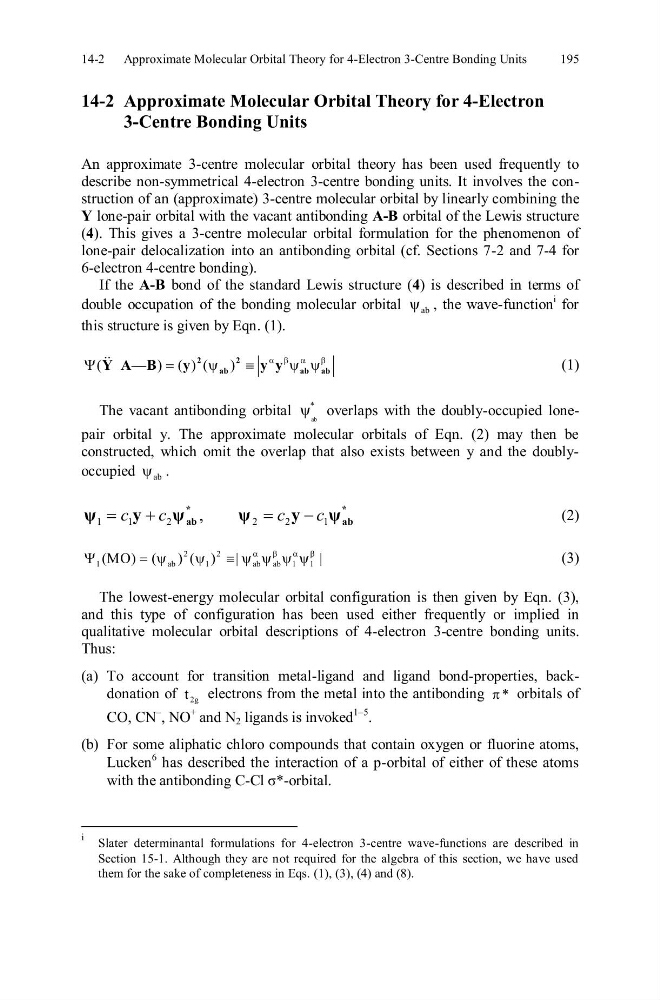
If the A-B bond of the standard Lewis structure (4) is described in terms of
double occupation of the bonding molecular orbital ab
, the wave-function
i for
this structure is given by Eqn. (1).
(
) ( ) (
)
2
2
ab
ab ab
Y A—B
y
y y
(1)
The vacant antibonding orbital
ab
*
overlaps with the doubly-occupied lonepair orbital y. The approximate molecular orbitals of Eqn. (2) may then be
constructed, which omit the overlap that also exists between y and the doublyoccupied ab
.
1
1
2
2
2
1
,
c
c
c
c
*
*
ab
ab
ψ
y
ψ
ψ
y
ψ
(2)
2
2
1
ab
1
ab ab 1
1
(MO) ( ) ( ) |
|
(3)
The lowest-energy molecular orbital configuration is then given by Eqn. (3),
and this type of configuration has been used either frequently or implied in
qualitative molecular orbital descriptions of 4-electron 3-centre bonding units.
Thus:
(a) To account for transition metal-ligand and ligand bond-properties, backdonation of 2g
t electrons from the metal into the antibonding *
orbitals of
CO, CN
– , NO
+ and N 2 ligands is invoked
1–5 .
(b) For some aliphatic chloro compounds that contain oxygen or fluorine atoms,
Lucken
6 has described the interaction of a p-orbital of either of these atoms
with the antibonding C-Cl σ*-orbital.
i Slater determinantal formulations for 4-electron 3-centre wave-functions are described in
Section 15-1. Although they are not required for the algebra of this section, we have used
them for the sake of completeness in Eqs. (1), (3), (4) and (8).
Approximate Molecular Orbital Theory for 4-Electron 3-Centre Bonding Units
195
14-2 Approximate Molecular Orbital Theory for 4-Electron
3-Centre Bonding Units
An approximate 3-centre molecular orbital theory has been used frequently to
describe non-symmetrical 4-electron 3-centre bonding units. It involves the construction of an (approximate) 3-centre molecular orbital by linearly combining the
Y lone-pair orbital with the vacant antibonding A-B orbital of the Lewis structure
(4). This gives a 3-centre molecular orbital formulation for the phenomenon of
lone-pair delocalization into an antibonding orbital (cf. Sections 7-2 and 7-4 for
6-electron 4-centre bonding).
If the A-B bond of the standard Lewis structure (4) is described in terms of
double occupation of the bonding molecular orbital ab
, the wave-function
i for
this structure is given by Eqn. (1).
(
) ( ) (
)
2
2
ab
ab ab
Y A—B
y
y y
(1)
The vacant antibonding orbital
ab
*
overlaps with the doubly-occupied lonepair orbital y. The approximate molecular orbitals of Eqn. (2) may then be
constructed, which omit the overlap that also exists between y and the doublyoccupied ab
.
1
1
2
2
2
1
,
c
c
c
c
*
*
ab
ab
ψ
y
ψ
ψ
y
ψ
(2)
2
2
1
ab
1
ab ab 1
1
(MO) ( ) ( ) |
|
(3)
The lowest-energy molecular orbital configuration is then given by Eqn. (3),
and this type of configuration has been used either frequently or implied in
qualitative molecular orbital descriptions of 4-electron 3-centre bonding units.
Thus:
(a) To account for transition metal-ligand and ligand bond-properties, backdonation of 2g
t electrons from the metal into the antibonding *
orbitals of
CO, CN
– , NO
+ and N 2 ligands is invoked
1–5 .
(b) For some aliphatic chloro compounds that contain oxygen or fluorine atoms,
Lucken
6 has described the interaction of a p-orbital of either of these atoms
with the antibonding C-Cl σ*-orbital.
i Slater determinantal formulations for 4-electron 3-centre wave-functions are described in
Section 15-1. Although they are not required for the algebra of this section, we have used
them for the sake of completeness in Eqs. (1), (3), (4) and (8).