

194
Chapter 14 Delocalization of a Lone-Pair Electron into a Vacant Antibonding Orbital
In this chapter, we have used both Heitler-London and molecular orbital
descriptions of electron-pair bonds on different occasions. For example, a doubly
occupied bonding molecular orbital (namely
2
ab
( )
) has been used to describe the
electron-pair A-B bond of the standard Lewis structure (4), but when we
delocalize a Y electron of structure (4) into the antibonding A-B orbital
ab
*
( )
, the
resulting wave-function (neglecting electron spin and indistinguishability)
ab
1
* 1
2
1
1
1
1
ab
ab
(y) ( ) ( ) constant (y) (a) ( ) (b)
indicates that the (fractional) Y-A bond of “increased-valence” structure 1 must
have a Heitler-London type wave-function arising from the
1
1
(y) (a) configuration.
If one wishes to use only Heitler-London wave-functions for all electron-pair
bonds, as indicated above when considering Coulson-Fischer A-B orbitals, we can
still speak of the delocalization of a Y electron of structure (4) into the
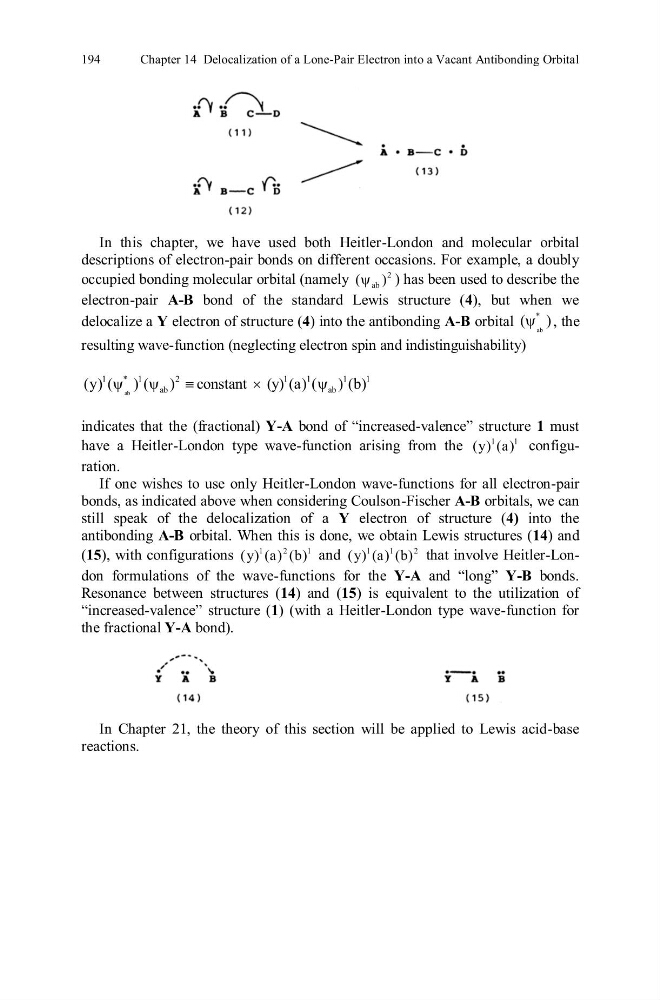
antibonding A-B orbital. When this is done, we obtain Lewis structures (14) and
(15), with configurations
1
2
1
(y) (a) (b) and
1
1
2
(y) (a) (b) that involve Heitler-London formulations of the wave-functions for the Y-A and “long” Y-B bonds.
Resonance between structures (14) and (15) is equivalent to the utilization of
“increased-valence” structure (1) (with a Heitler-London type wave-function for
the fractional Y-A bond).
In Chapter 21, the theory of this section will be applied to Lewis acid-base
reactions.
Chapter 14 Delocalization of a Lone-Pair Electron into a Vacant Antibonding Orbital
In this chapter, we have used both Heitler-London and molecular orbital
descriptions of electron-pair bonds on different occasions. For example, a doubly
occupied bonding molecular orbital (namely
2
ab
( )
) has been used to describe the
electron-pair A-B bond of the standard Lewis structure (4), but when we
delocalize a Y electron of structure (4) into the antibonding A-B orbital
ab
*
( )
, the
resulting wave-function (neglecting electron spin and indistinguishability)
ab
1
* 1
2
1
1
1
1
ab
ab
(y) ( ) ( ) constant (y) (a) ( ) (b)
indicates that the (fractional) Y-A bond of “increased-valence” structure 1 must
have a Heitler-London type wave-function arising from the
1
1
(y) (a) configuration.
If one wishes to use only Heitler-London wave-functions for all electron-pair
bonds, as indicated above when considering Coulson-Fischer A-B orbitals, we can
still speak of the delocalization of a Y electron of structure (4) into the
antibonding A-B orbital. When this is done, we obtain Lewis structures (14) and
(15), with configurations
1
2
1
(y) (a) (b) and
1
1
2
(y) (a) (b) that involve Heitler-London formulations of the wave-functions for the Y-A and “long” Y-B bonds.
Resonance between structures (14) and (15) is equivalent to the utilization of
“increased-valence” structure (1) (with a Heitler-London type wave-function for
the fractional Y-A bond).
In Chapter 21, the theory of this section will be applied to Lewis acid-base
reactions.