

14-1
Delocalization of a Lone-Pair Electron into a Vacant Antibonding Orbital
193
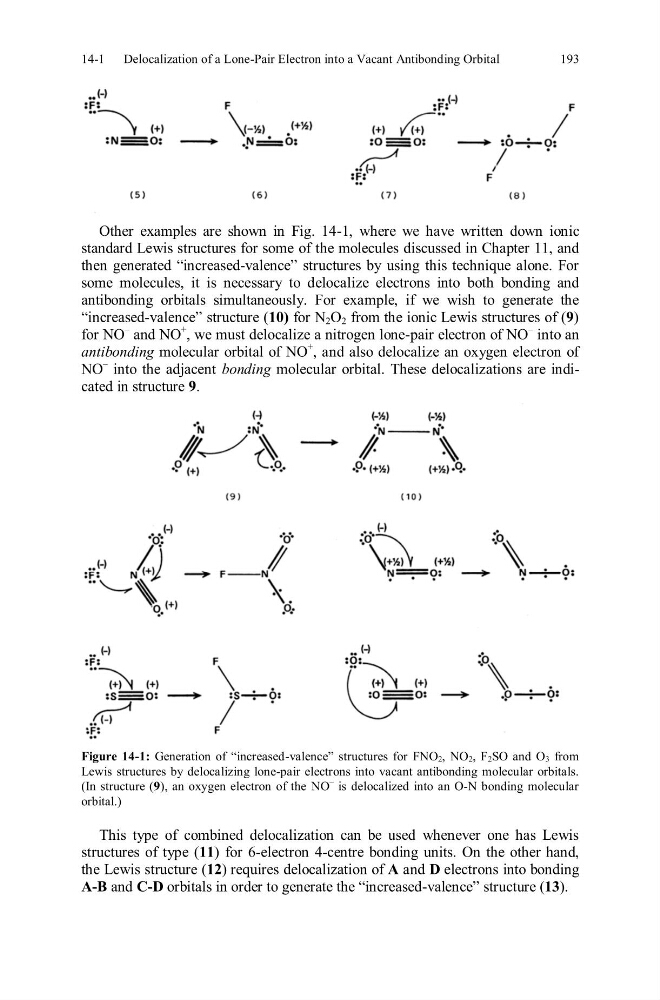
Other examples are shown in Fig. 14-1, where we have written down ionic
standard Lewis structures for some of the molecules discussed in Chapter 11, and
then generated “increased-valence” structures by using this technique alone. For
some molecules, it is necessary to delocalize electrons into both bonding and
antibonding orbitals simultaneously. For example, if we wish to generate the
“increased-valence” structure (10) for N 2 O 2 from the ionic Lewis structures of (9)
for NO
– and NO
+
, we must delocalize a nitrogen lone-pair electron of NO
– into an
antibonding molecular orbital of NO
+
, and also delocalize an oxygen electron of
NO
– into the adjacent bonding molecular orbital. These delocalizations are indicated in structure 9.
Figure 14-1: Generation of “increased-valence” structures for FNO2, NO2, F2SO and O3 from
Lewis structures by delocalizing lone-pair electrons into vacant antibonding molecular orbitals.
(In structure (9), an oxygen electron of the NO
– is delocalized into an O-N bonding molecular
orbital.)
This type of combined delocalization can be used whenever one has Lewis
structures of type (11) for 6-electron 4-centre bonding units. On the other hand,
the Lewis structure (12) requires delocalization of A and D electrons into bonding
A-B and C-D orbitals in order to generate the “increased-valence” structure (13).
Delocalization of a Lone-Pair Electron into a Vacant Antibonding Orbital
193
Other examples are shown in Fig. 14-1, where we have written down ionic
standard Lewis structures for some of the molecules discussed in Chapter 11, and
then generated “increased-valence” structures by using this technique alone. For
some molecules, it is necessary to delocalize electrons into both bonding and
antibonding orbitals simultaneously. For example, if we wish to generate the
“increased-valence” structure (10) for N 2 O 2 from the ionic Lewis structures of (9)
for NO
– and NO
+
, we must delocalize a nitrogen lone-pair electron of NO
– into an
antibonding molecular orbital of NO
+
, and also delocalize an oxygen electron of
NO
– into the adjacent bonding molecular orbital. These delocalizations are indicated in structure 9.
Figure 14-1: Generation of “increased-valence” structures for FNO2, NO2, F2SO and O3 from
Lewis structures by delocalizing lone-pair electrons into vacant antibonding molecular orbitals.
(In structure (9), an oxygen electron of the NO
– is delocalized into an O-N bonding molecular
orbital.)
This type of combined delocalization can be used whenever one has Lewis
structures of type (11) for 6-electron 4-centre bonding units. On the other hand,
the Lewis structure (12) requires delocalization of A and D electrons into bonding
A-B and C-D orbitals in order to generate the “increased-valence” structure (13).