

192
Chapter 14 Delocalization of a Lone-Pair Electron into a Vacant Antibonding Orbital
In Section 3-6, we have demonstrated that a wave-function for a Pauling “3electron bond” structure A · B
can be expressed as either
ab
2
* 1
ab
( ) ( )
or
1
1
1
ab
(a) ( ) (b)
, (
ab
a
b
or
ab
a
b
), in which
ab
a b
k
and
ab
*
* a – b
k
are bonding and antibonding molecular orbitals, and a and b are
overlapping atomic orbitals. For the Pauling “3-electron bond” structures
O
O
A
B
and
X
X
A B of structures (2) and (3), the antibonding
ab
*
electron of the molecular orbital configuration
ab
2
* 1
ab
( ) ( )
must have an z
s spin quantum number of
–½ and +½, respectively.
This equivalence that exists between
ab
2
* 1
ab
( ) ( )
and
1
1
1
ab
(a) ( ) (b)
indicates
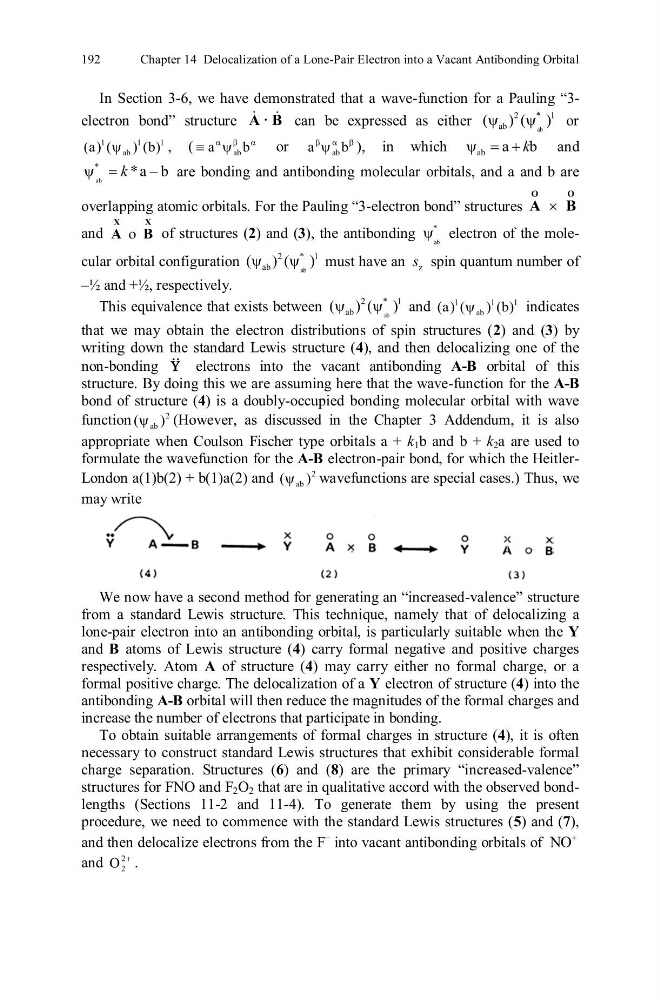
that we may obtain the electron distributions of spin structures (2) and (3) by
writing down the standard Lewis structure (4), and then delocalizing one of the
non-bonding electrons into the vacant antibonding A-B orbital of this
structure. By doing this we are assuming here that the wave-function for the A-B
bond of structure (4) is a doubly-occupied bonding molecular orbital with wave
function
2
ab
( )
(However, as discussed in the Chapter 3 Addendum, it is also
appropriate when Coulson Fischer type orbitals a + k 1 b and b + k 2 a are used to
formulate the wavefunction for the A-B electron-pair bond, for which the HeitlerLondon a(1)b(2) + b(1)a(2) and
2
ab
( )
wavefunctions are special cases.) Thus, we
may write
We now have a second method for generating an “increased-valence” structure
from a standard Lewis structure. This technique, namely that of delocalizing a
lone-pair electron into an antibonding orbital, is particularly suitable when the Υ
and B atoms of Lewis structure (4) carry formal negative and positive charges
respectively. Atom A of structure (4) may carry either no formal charge, or a
formal positive charge. The delocalization of a Y electron of structure (4) into the
antibonding A-B orbital will then reduce the magnitudes of the formal charges and
increase the number of electrons that participate in bonding.
To obtain suitable arrangements of formal charges in structure (4), it is often
necessary to construct standard Lewis structures that exhibit considerable formal
charge separation. Structures (6) and (8) are the primary “increased-valence”
structures for FNO and F 2 O 2 that are in qualitative accord with the observed bondlengths (Sections 11-2 and 11-4). To generate them by using the present
procedure, we need to commence with the standard Lewis structures (5) and (7),
and then delocalize electrons from the F
– into vacant antibonding orbitals of NO
and
2
2
O
.
Chapter 14 Delocalization of a Lone-Pair Electron into a Vacant Antibonding Orbital
In Section 3-6, we have demonstrated that a wave-function for a Pauling “3electron bond” structure A · B
can be expressed as either
ab
2
* 1
ab
( ) ( )
or
1
1
1
ab
(a) ( ) (b)
, (
ab
a
b
or
ab
a
b
), in which
ab
a b
k
and
ab
*
* a – b
k
are bonding and antibonding molecular orbitals, and a and b are
overlapping atomic orbitals. For the Pauling “3-electron bond” structures
O
O
A
B
and
X
X
A B of structures (2) and (3), the antibonding
ab
*
electron of the molecular orbital configuration
ab
2
* 1
ab
( ) ( )
must have an z
s spin quantum number of
–½ and +½, respectively.
This equivalence that exists between
ab
2
* 1
ab
( ) ( )
and
1
1
1
ab
(a) ( ) (b)
indicates
that we may obtain the electron distributions of spin structures (2) and (3) by
writing down the standard Lewis structure (4), and then delocalizing one of the
non-bonding electrons into the vacant antibonding A-B orbital of this
structure. By doing this we are assuming here that the wave-function for the A-B
bond of structure (4) is a doubly-occupied bonding molecular orbital with wave
function
2
ab
( )
(However, as discussed in the Chapter 3 Addendum, it is also
appropriate when Coulson Fischer type orbitals a + k 1 b and b + k 2 a are used to
formulate the wavefunction for the A-B electron-pair bond, for which the HeitlerLondon a(1)b(2) + b(1)a(2) and
2
ab
( )
wavefunctions are special cases.) Thus, we
may write
We now have a second method for generating an “increased-valence” structure
from a standard Lewis structure. This technique, namely that of delocalizing a
lone-pair electron into an antibonding orbital, is particularly suitable when the Υ
and B atoms of Lewis structure (4) carry formal negative and positive charges
respectively. Atom A of structure (4) may carry either no formal charge, or a
formal positive charge. The delocalization of a Y electron of structure (4) into the
antibonding A-B orbital will then reduce the magnitudes of the formal charges and
increase the number of electrons that participate in bonding.
To obtain suitable arrangements of formal charges in structure (4), it is often
necessary to construct standard Lewis structures that exhibit considerable formal
charge separation. Structures (6) and (8) are the primary “increased-valence”
structures for FNO and F 2 O 2 that are in qualitative accord with the observed bondlengths (Sections 11-2 and 11-4). To generate them by using the present
procedure, we need to commence with the standard Lewis structures (5) and (7),
and then delocalize electrons from the F
– into vacant antibonding orbitals of NO
and
2
2
O
.