

180
Chapter 13 “Increased-Valence” Structures for N-Centre Bonding Units
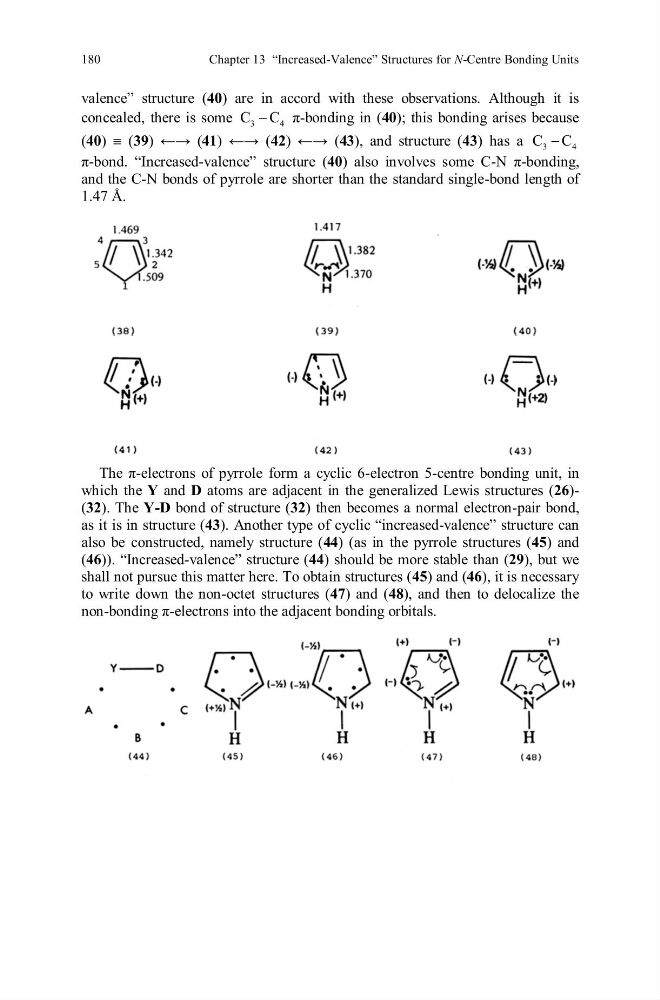
valence” structure (40) are in accord with these observations. Although it is
concealed, there is some 3
4
C C
π-bonding in (40); this bonding arises because
(40) (39) ←→ (41) ←→ (42) ←→ (43), and structure (43) has a 3
4
C C
π-bond. “Increased-valence” structure (40) also involves some C-N π-bonding,
and the C-N bonds of pyrrole are shorter than the standard single-bond length of
1.47 Å.
The π-electrons of pyrrole form a cyclic 6-electron 5-centre bonding unit, in
which the Y and D atoms are adjacent in the generalized Lewis structures (26)(32). The Y-D bond of structure (32) then becomes a normal electron-pair bond,
as it is in structure (43). Another type of cyclic “increased-valence” structure can
also be constructed, namely structure (44) (as in the pyrrole structures (45) and
(46)). “Increased-valence” structure (44) should be more stable than (29), but we
shall not pursue this matter here. To obtain structures (45) and (46), it is necessary
to write down the non-octet structures (47) and (48), and then to delocalize the
non-bonding π-electrons into the adjacent bonding orbitals.
Chapter 13 “Increased-Valence” Structures for N-Centre Bonding Units
valence” structure (40) are in accord with these observations. Although it is
concealed, there is some 3
4
C C
π-bonding in (40); this bonding arises because
(40) (39) ←→ (41) ←→ (42) ←→ (43), and structure (43) has a 3
4
C C
π-bond. “Increased-valence” structure (40) also involves some C-N π-bonding,
and the C-N bonds of pyrrole are shorter than the standard single-bond length of
1.47 Å.
The π-electrons of pyrrole form a cyclic 6-electron 5-centre bonding unit, in
which the Y and D atoms are adjacent in the generalized Lewis structures (26)(32). The Y-D bond of structure (32) then becomes a normal electron-pair bond,
as it is in structure (43). Another type of cyclic “increased-valence” structure can
also be constructed, namely structure (44) (as in the pyrrole structures (45) and
(46)). “Increased-valence” structure (44) should be more stable than (29), but we
shall not pursue this matter here. To obtain structures (45) and (46), it is necessary
to write down the non-octet structures (47) and (48), and then to delocalize the
non-bonding π-electrons into the adjacent bonding orbitals.