

13-6
6-Electron 5-Centre Bonding Units: C3O2, Succinimide, and Pyrrole
179
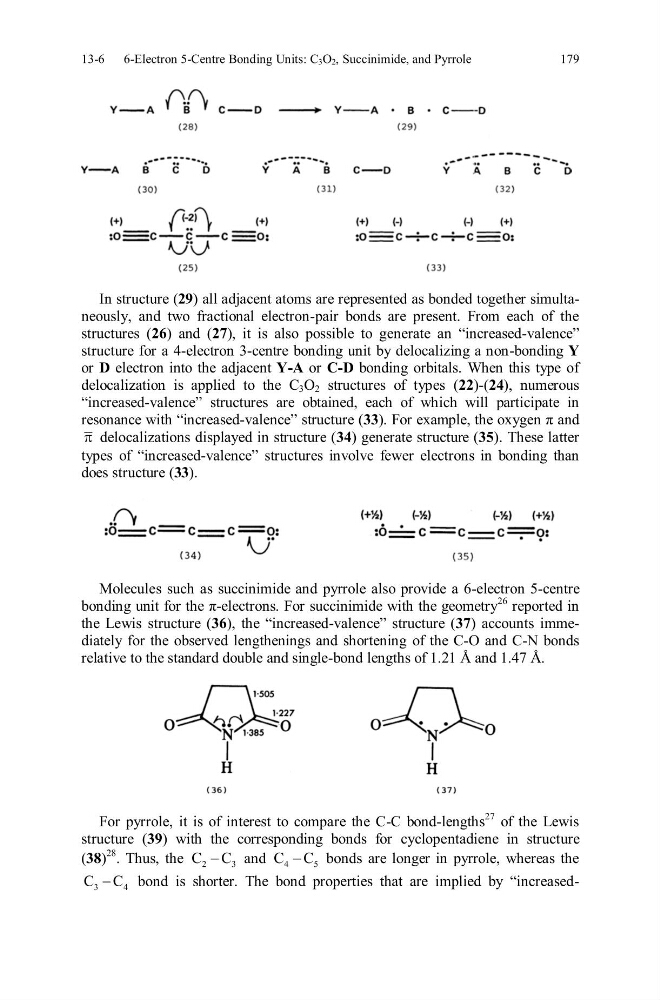
In structure (29) all adjacent atoms are represented as bonded together simultaneously, and two fractional electron-pair bonds are present. From each of the
structures (26) and (27), it is also possible to generate an “increased-valence”
structure for a 4-electron 3-centre bonding unit by delocalizing a non-bonding Y
or D electron into the adjacent Y-A or C-D bonding orbitals. When this type of
delocalization is applied to the C 3 O 2 structures of types (22)-(24), numerous
“increased-valence” structures are obtained, each of which will participate in
resonance with “increased-valence” structure (33). For example, the oxygen π and
delocalizations displayed in structure (34) generate structure (35). These latter
types of “increased-valence” structures involve fewer electrons in bonding than
does structure (33).
Molecules such as succinimide and pyrrole also provide a 6-electron 5-centre
bonding unit for the π-electrons. For succinimide with the geometry
26 reported in
the Lewis structure (36), the “increased-valence” structure (37) accounts immediately for the observed lengthenings and shortening of the C-O and C-N bonds
relative to the standard double and single-bond lengths of 1.21 Å and 1.47 Å.
For pyrrole, it is of interest to compare the C-C bond-lengths
27 of the Lewis
structure (39) with the corresponding bonds for cyclopentadiene in structure
(38)
28 . Thus, the 2
3
C C
and 4
5
C C
bonds are longer in pyrrole, whereas the
3
4
C C
bond is shorter. The bond properties that are implied by “increased-
6-Electron 5-Centre Bonding Units: C3O2, Succinimide, and Pyrrole
179
In structure (29) all adjacent atoms are represented as bonded together simultaneously, and two fractional electron-pair bonds are present. From each of the
structures (26) and (27), it is also possible to generate an “increased-valence”
structure for a 4-electron 3-centre bonding unit by delocalizing a non-bonding Y
or D electron into the adjacent Y-A or C-D bonding orbitals. When this type of
delocalization is applied to the C 3 O 2 structures of types (22)-(24), numerous
“increased-valence” structures are obtained, each of which will participate in
resonance with “increased-valence” structure (33). For example, the oxygen π and
delocalizations displayed in structure (34) generate structure (35). These latter
types of “increased-valence” structures involve fewer electrons in bonding than
does structure (33).
Molecules such as succinimide and pyrrole also provide a 6-electron 5-centre
bonding unit for the π-electrons. For succinimide with the geometry
26 reported in
the Lewis structure (36), the “increased-valence” structure (37) accounts immediately for the observed lengthenings and shortening of the C-O and C-N bonds
relative to the standard double and single-bond lengths of 1.21 Å and 1.47 Å.
For pyrrole, it is of interest to compare the C-C bond-lengths
27 of the Lewis
structure (39) with the corresponding bonds for cyclopentadiene in structure
(38)
28 . Thus, the 2
3
C C
and 4
5
C C
bonds are longer in pyrrole, whereas the
3
4
C C
bond is shorter. The bond properties that are implied by “increased-