

13-7
8-Electron 6-Centre Bonding Unites
181
13-7 8-Electron 6-Centre Bonding Unites: Diformylhydrazine,
N-alkyl sydnones and Dehydrodithizone
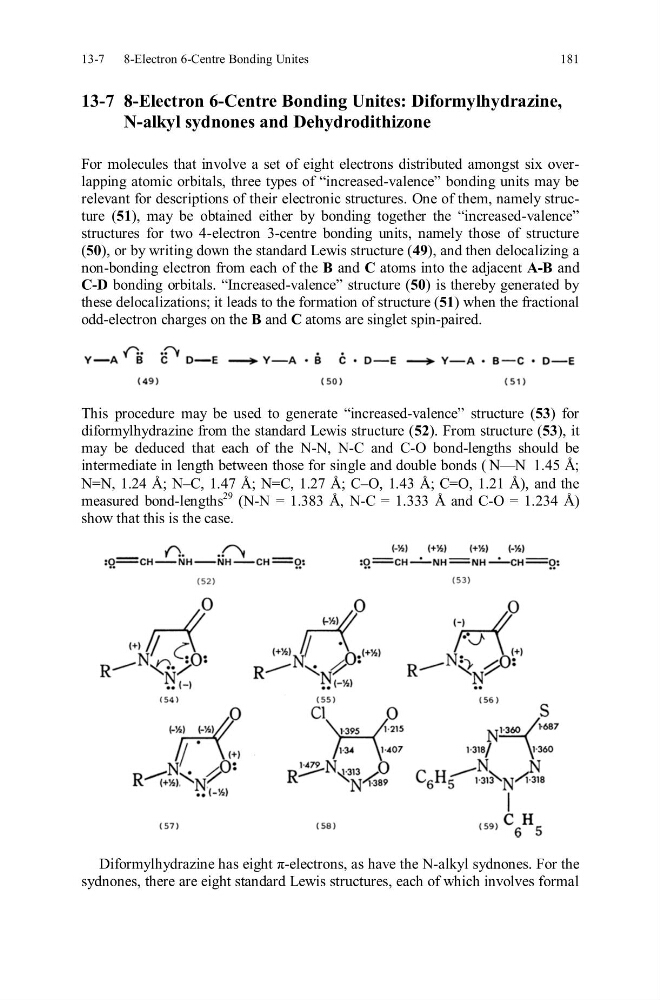
For molecules that involve a set of eight electrons distributed amongst six overlapping atomic orbitals, three types of “increased-valence” bonding units may be
relevant for descriptions of their electronic structures. One of them, namely structure (51), may be obtained either by bonding together the “increased-valence”
structures for two 4-electron 3-centre bonding units, namely those of structure
(50), or by writing down the standard Lewis structure (49), and then delocalizing a
non-bonding electron from each of the B and C atoms into the adjacent A-B and
C-D bonding orbitals. “Increased-valence” structure (50) is thereby generated by
these delocalizations; it leads to the formation of structure (51) when the fractional
odd-electron charges on the B and C atoms are singlet spin-paired.
This procedure may be used to generate “increased-valence” structure (53) for
diformylhydrazine from the standard Lewis structure (52). From structure (53), it
may be deduced that each of the N-N, N-C and C-O bond-lengths should be
intermediate in length between those for single and double bonds ( N—N 1.45 Å;
N=N, 1.24 Å; N–C, 1.47 Å; N=C, 1.27 Å; C–O, 1.43 Å; C=O, 1.21 Å), and the
measured bond-lengths
29 (N-N = 1.383 Å, N-C = 1.333 Å and C-O = 1.234 Å)
show that this is the case.
Diformylhydrazine has eight π-electrons, as have the N-alkyl sydnones. For the
sydnones, there are eight standard Lewis structures, each of which involves formal
8-Electron 6-Centre Bonding Unites
181
13-7 8-Electron 6-Centre Bonding Unites: Diformylhydrazine,
N-alkyl sydnones and Dehydrodithizone
For molecules that involve a set of eight electrons distributed amongst six overlapping atomic orbitals, three types of “increased-valence” bonding units may be
relevant for descriptions of their electronic structures. One of them, namely structure (51), may be obtained either by bonding together the “increased-valence”
structures for two 4-electron 3-centre bonding units, namely those of structure
(50), or by writing down the standard Lewis structure (49), and then delocalizing a
non-bonding electron from each of the B and C atoms into the adjacent A-B and
C-D bonding orbitals. “Increased-valence” structure (50) is thereby generated by
these delocalizations; it leads to the formation of structure (51) when the fractional
odd-electron charges on the B and C atoms are singlet spin-paired.
This procedure may be used to generate “increased-valence” structure (53) for
diformylhydrazine from the standard Lewis structure (52). From structure (53), it
may be deduced that each of the N-N, N-C and C-O bond-lengths should be
intermediate in length between those for single and double bonds ( N—N 1.45 Å;
N=N, 1.24 Å; N–C, 1.47 Å; N=C, 1.27 Å; C–O, 1.43 Å; C=O, 1.21 Å), and the
measured bond-lengths
29 (N-N = 1.383 Å, N-C = 1.333 Å and C-O = 1.234 Å)
show that this is the case.
Diformylhydrazine has eight π-electrons, as have the N-alkyl sydnones. For the
sydnones, there are eight standard Lewis structures, each of which involves formal