

1-1 Atomic Orbitals
3
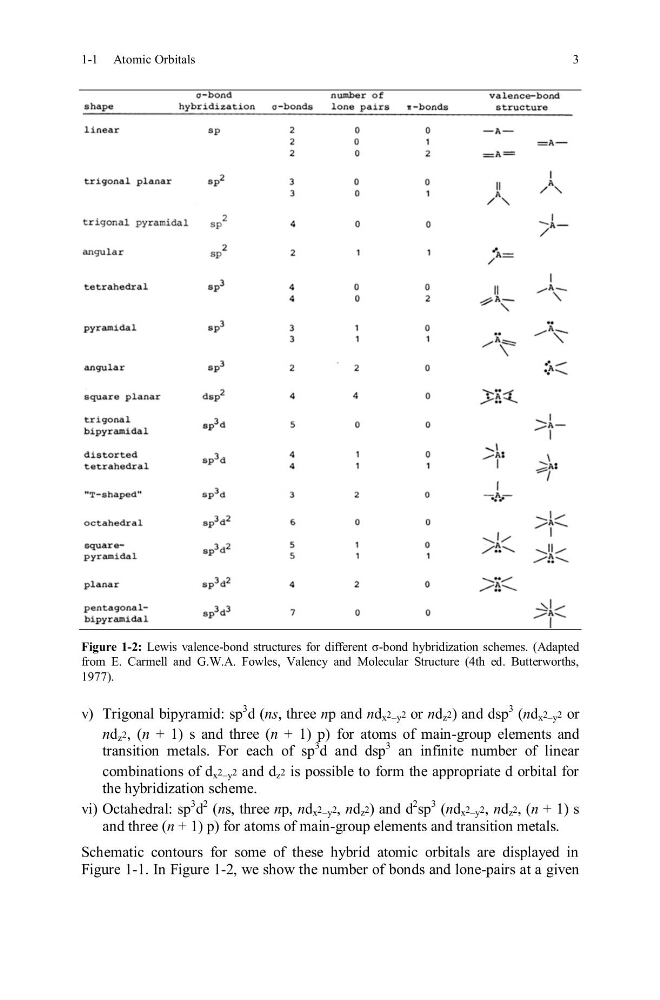
Figure 1-2: Lewis valence-bond structures for different σ-bond hybridization schemes. (Adapted
from E. Carmell and G.W.A. Fowles, Valency and Molecular Structure (4th ed. Butterworths,
1977).
v) Trigonal bipyramid: sp
3 d (ns, three np and nd x 2 –y 2 or nd z 2) and dsp
3 (nd x 2 –y 2 or
nd z 2, (n + 1) s and three (n + 1) p) for atoms of main-group elements and
transition metals. For each of sp
3 d and dsp
3 an infinite number of linear
combinations of d x 2 –y 2 and d z 2 is possible to form the appropriate d orbital for
the hybridization scheme.
vi) Octahedral: sp
3 d
2 (ns, three np, nd x 2 –y 2, nd z 2) and d
2 sp
3 (nd x 2 –y 2, nd z 2, (n + 1) s
and three (n + 1) p) for atoms of main-group elements and transition metals.
Schematic contours for some of these hybrid atomic orbitals are displayed in
Figure 1-1. In Figure 1-2, we show the number of bonds and lone-pairs at a given
3
Figure 1-2: Lewis valence-bond structures for different σ-bond hybridization schemes. (Adapted
from E. Carmell and G.W.A. Fowles, Valency and Molecular Structure (4th ed. Butterworths,
1977).
v) Trigonal bipyramid: sp
3 d (ns, three np and nd x 2 –y 2 or nd z 2) and dsp
3 (nd x 2 –y 2 or
nd z 2, (n + 1) s and three (n + 1) p) for atoms of main-group elements and
transition metals. For each of sp
3 d and dsp
3 an infinite number of linear
combinations of d x 2 –y 2 and d z 2 is possible to form the appropriate d orbital for
the hybridization scheme.
vi) Octahedral: sp
3 d
2 (ns, three np, nd x 2 –y 2, nd z 2) and d
2 sp
3 (nd x 2 –y 2, nd z 2, (n + 1) s
and three (n + 1) p) for atoms of main-group elements and transition metals.
Schematic contours for some of these hybrid atomic orbitals are displayed in
Figure 1-1. In Figure 1-2, we show the number of bonds and lone-pairs at a given