

2
Chapter 1 Atomic Orbitals, Electron Spin, Linear Combinations
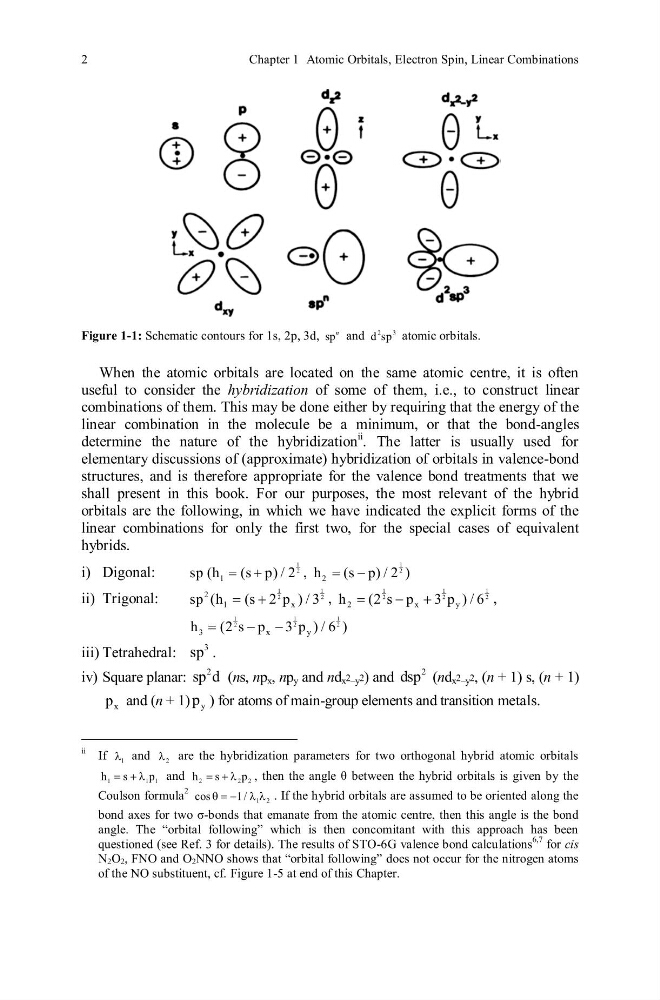
Figure 1-1: Schematic contours for 1s, 2p, 3d, sp
n and
2
3
d sp atomic orbitals.
When the atomic orbitals are located on the same atomic centre, it is often
useful to consider the hybridization of some of them, i.e., to construct linear
combinations of them. This may be done either by requiring that the energy of the
linear combination in the molecule be a minimum, or that the bond-angles
determine the nature of the hybridization
ii
. The latter is usually used for
elementary discussions of (approximate) hybridization of orbitals in valence-bond
structures, and is therefore appropriate for the valence bond treatments that we
shall present in this book. For our purposes, the most relevant of the hybrid
orbitals are the following, in which we have indicated the explicit forms of the
linear combinations for only the first two, for the special cases of equivalent
hybrids.
i) Digonal:
1
2
1
sp (h (s p) / 2
,
1
2
2
h
(s p) / 2 )
ii) Trigonal:
1
1
2
2
2
1
x
sp (h (s 2 p ) / 3
,
1
1
1
2
2
2
2
x
y
h
(2 s p 3 p ) / 6
,
1
1
1
2
2
2
3
x
y
h
(2 s p 3 p ) / 6 )
iii) Tetrahedral:
3
sp .
iv) Square planar:
2
sp d (ns, np x , np y and nd x 2 –y 2) and
2
dsp (nd x 2 –y 2, (n + 1) s, (n + 1)
x
p and (n + 1) y
p ) for atoms of main-group elements and transition metals.
ii
If 1
and 2
are the hybridization parameters for two orthogonal hybrid atomic orbitals
1
1 1
h s
p
and 2
2 2
h s
p
, then the angle θ between the hybrid orbitals is given by the
Coulson formula
2
1 2
cos
1 /
. If the hybrid orbitals are assumed to be oriented along the
bond axes for two σ-bonds that emanate from the atomic centre, then this angle is the bond
angle. The “orbital following” which is then concomitant with this approach has been
questioned (see Ref. 3 for details). The results of STO-6G valence bond calculations
6,7 for cis
N2O2, FNO and O2NNO shows that “orbital following” does not occur for the nitrogen atoms
of the NO substituent, cf. Figure 1-5 at end of this Chapter.
Chapter 1 Atomic Orbitals, Electron Spin, Linear Combinations
Figure 1-1: Schematic contours for 1s, 2p, 3d, sp
n and
2
3
d sp atomic orbitals.
When the atomic orbitals are located on the same atomic centre, it is often
useful to consider the hybridization of some of them, i.e., to construct linear
combinations of them. This may be done either by requiring that the energy of the
linear combination in the molecule be a minimum, or that the bond-angles
determine the nature of the hybridization
ii
. The latter is usually used for
elementary discussions of (approximate) hybridization of orbitals in valence-bond
structures, and is therefore appropriate for the valence bond treatments that we
shall present in this book. For our purposes, the most relevant of the hybrid
orbitals are the following, in which we have indicated the explicit forms of the
linear combinations for only the first two, for the special cases of equivalent
hybrids.
i) Digonal:
1
2
1
sp (h (s p) / 2
,
1
2
2
h
(s p) / 2 )
ii) Trigonal:
1
1
2
2
2
1
x
sp (h (s 2 p ) / 3
,
1
1
1
2
2
2
2
x
y
h
(2 s p 3 p ) / 6
,
1
1
1
2
2
2
3
x
y
h
(2 s p 3 p ) / 6 )
iii) Tetrahedral:
3
sp .
iv) Square planar:
2
sp d (ns, np x , np y and nd x 2 –y 2) and
2
dsp (nd x 2 –y 2, (n + 1) s, (n + 1)
x
p and (n + 1) y
p ) for atoms of main-group elements and transition metals.
ii
If 1
and 2
are the hybridization parameters for two orthogonal hybrid atomic orbitals
1
1 1
h s
p
and 2
2 2
h s
p
, then the angle θ between the hybrid orbitals is given by the
Coulson formula
2
1 2
cos
1 /
. If the hybrid orbitals are assumed to be oriented along the
bond axes for two σ-bonds that emanate from the atomic centre, then this angle is the bond
angle. The “orbital following” which is then concomitant with this approach has been
questioned (see Ref. 3 for details). The results of STO-6G valence bond calculations
6,7 for cis
N2O2, FNO and O2NNO shows that “orbital following” does not occur for the nitrogen atoms
of the NO substituent, cf. Figure 1-5 at end of this Chapter.