

4
Chapter 1 Atomic Orbitals, Electron Spin, Linear Combinations
atom when these hybridization schemes are appropriate for the formation of σbonds.
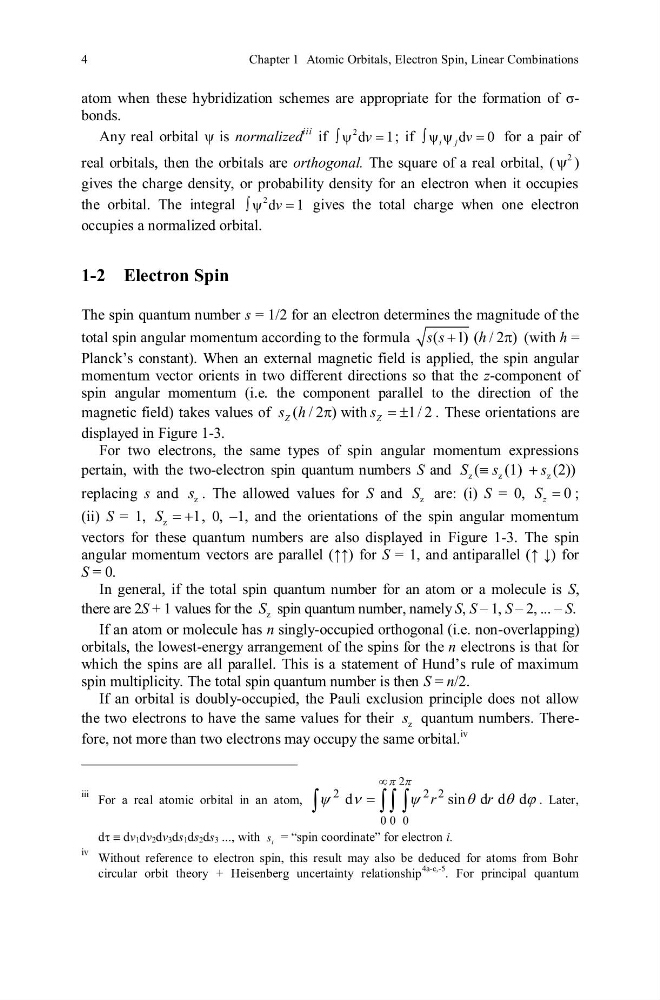
Any real orbital ψ is normalized
iii if
2 d 1
v
; if
d 0
i
j v
for a pair of
real orbitals, then the orbitals are orthogonal. The square of a real orbital, (
2
)
gives the charge density, or probability density for an electron when it occupies
the orbital. The integral
2 d 1
v
gives the total charge when one electron
occupies a normalized orbital.
1-2 Electron Spin
The spin quantum number s = 1/2 for an electron determines the magnitude of the
total spin angular momentum according to the formula
( 1) ( / 2 )
s s
h
(with h =
Planck’s constant). When an external magnetic field is applied, the spin angular
momentum vector orients in two different directions so that the z-component of
spin angular momentum (i.e. the component parallel to the direction of the
magnetic field) takes values of ( / 2 )
Z
s h with
1 / 2
Z
s
. These orientations are
displayed in Figure 1-3.
For two electrons, the same types of spin angular momentum expressions
pertain, with the two-electron spin quantum numbers S and z
z
z
(
(1)
(2))
S
s
s
replacing s and z
s . The allowed values for S and z
S are: (i) S = 0,
0
z
S ;
(ii) S = 1, z
1
S , 0, –1, and the orientations of the spin angular momentum
vectors for these quantum numbers are also displayed in Figure 1-3. The spin
angular momentum vectors are parallel (↑↑) for S = 1, and antiparallel (↑ ↓) for
S = 0.
In general, if the total spin quantum number for an atom or a molecule is S,
there are 2S + 1 values for the z
S spin quantum number, namely S, S – 1, S – 2, ... – S.
If an atom or molecule has n singly-occupied orthogonal (i.e. non-overlapping)
orbitals, the lowest-energy arrangement of the spins for the n electrons is that for
which the spins are all parallel. This is a statement of Hund’s rule of maximum
spin multiplicity. The total spin quantum number is then S = n/2.
If an orbital is doubly-occupied, the Pauli exclusion principle does not allow
the two electrons to have the same values for their z
s quantum numbers. Therefore, not more than two electrons may occupy the same orbital.
iv
iii For a real atomic orbital in an atom,
0 0
2
0
2
2
2
d
d
d
sin
d
r
r
. Later,
d dv1dv2dv3ds1ds2ds3 ..., with i
s = “spin coordinate” for electron i.
iv Without reference to electron spin, this result may also be deduced for atoms from Bohr
circular orbit theory + Heisenberg uncertainty relationship
4a-c,-5
. For principal quantum
Chapter 1 Atomic Orbitals, Electron Spin, Linear Combinations
atom when these hybridization schemes are appropriate for the formation of σbonds.
Any real orbital ψ is normalized
iii if
2 d 1
v
; if
d 0
i
j v
for a pair of
real orbitals, then the orbitals are orthogonal. The square of a real orbital, (
2
)
gives the charge density, or probability density for an electron when it occupies
the orbital. The integral
2 d 1
v
gives the total charge when one electron
occupies a normalized orbital.
1-2 Electron Spin
The spin quantum number s = 1/2 for an electron determines the magnitude of the
total spin angular momentum according to the formula
( 1) ( / 2 )
s s
h
(with h =
Planck’s constant). When an external magnetic field is applied, the spin angular
momentum vector orients in two different directions so that the z-component of
spin angular momentum (i.e. the component parallel to the direction of the
magnetic field) takes values of ( / 2 )
Z
s h with
1 / 2
Z
s
. These orientations are
displayed in Figure 1-3.
For two electrons, the same types of spin angular momentum expressions
pertain, with the two-electron spin quantum numbers S and z
z
z
(
(1)
(2))
S
s
s
replacing s and z
s . The allowed values for S and z
S are: (i) S = 0,
0
z
S ;
(ii) S = 1, z
1
S , 0, –1, and the orientations of the spin angular momentum
vectors for these quantum numbers are also displayed in Figure 1-3. The spin
angular momentum vectors are parallel (↑↑) for S = 1, and antiparallel (↑ ↓) for
S = 0.
In general, if the total spin quantum number for an atom or a molecule is S,
there are 2S + 1 values for the z
S spin quantum number, namely S, S – 1, S – 2, ... – S.
If an atom or molecule has n singly-occupied orthogonal (i.e. non-overlapping)
orbitals, the lowest-energy arrangement of the spins for the n electrons is that for
which the spins are all parallel. This is a statement of Hund’s rule of maximum
spin multiplicity. The total spin quantum number is then S = n/2.
If an orbital is doubly-occupied, the Pauli exclusion principle does not allow
the two electrons to have the same values for their z
s quantum numbers. Therefore, not more than two electrons may occupy the same orbital.
iv
iii For a real atomic orbital in an atom,
0 0
2
0
2
2
2
d
d
d
sin
d
r
r
. Later,
d dv1dv2dv3ds1ds2ds3 ..., with i
s = “spin coordinate” for electron i.
iv Without reference to electron spin, this result may also be deduced for atoms from Bohr
circular orbit theory + Heisenberg uncertainty relationship
4a-c,-5
. For principal quantum