

156
Chapter 11 Pauling “3-Electron Bonds” and “Increased-Valence” Structures
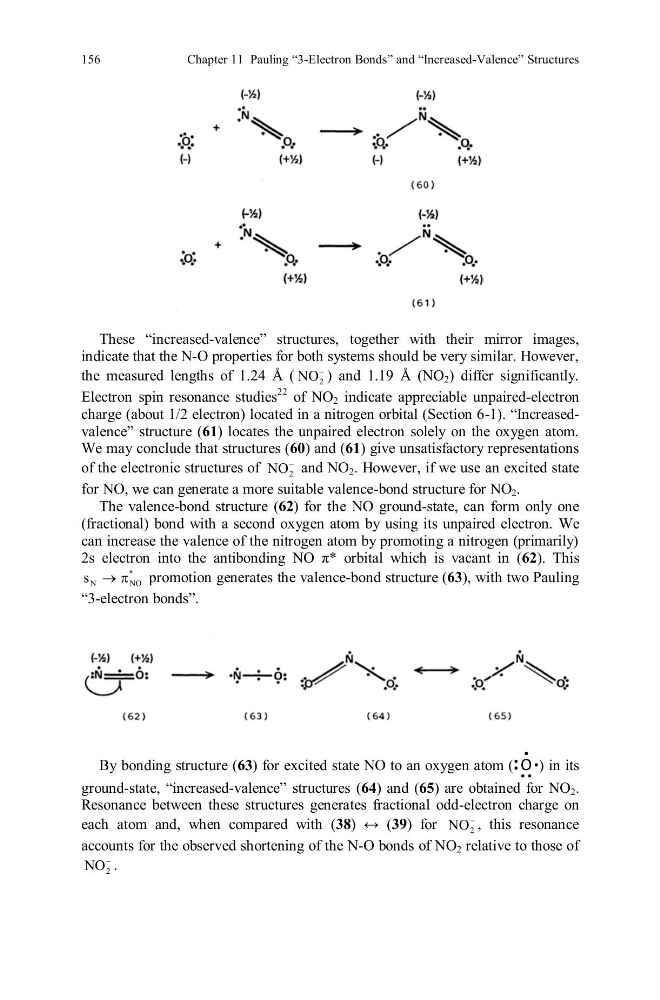
These “increased-valence” structures, together with their mirror images,
indicate that the N-O properties for both systems should be very similar. However,
the measured lengths of 1.24 Å (
2
NO
) and 1.19 Å (NO 2 ) differ significantly.
Electron spin resonance studies
22 of NO 2 indicate appreciable unpaired-electron
charge (about 1/2 electron) located in a nitrogen orbital (Section 6-1). “Increasedvalence” structure (61) locates the unpaired electron solely on the oxygen atom.
We may conclude that structures (60) and (61) give unsatisfactory representations
of the electronic structures of
2
NO
and NO 2 . However, if we use an excited state
for NO, we can generate a more suitable valence-bond structure for NO 2 .
The valence-bond structure (62) for the NO ground-state, can form only one
(fractional) bond with a second oxygen atom by using its unpaired electron. We
can increase the valence of the nitrogen atom by promoting a nitrogen (primarily)
2s electron into the antibonding NO π* orbital which is vacant in (62). This
*
N
NO
s promotion generates the valence-bond structure (63), with two Pauling
“3-electron bonds”.
By bonding structure (63) for excited state NO to an oxygen atom (
) in its
ground-state, “increased-valence” structures (64) and (65) are obtained for NO 2 .
Resonance between these structures generates fractional odd-electron charge on
each atom and, when compared with (38) ↔ (39) for
2
NO
, this resonance
accounts for the observed shortening of the N-O bonds of NO 2 relative to those of
2
NO
.
O
.
:
:
.
Chapter 11 Pauling “3-Electron Bonds” and “Increased-Valence” Structures
These “increased-valence” structures, together with their mirror images,
indicate that the N-O properties for both systems should be very similar. However,
the measured lengths of 1.24 Å (
2
NO
) and 1.19 Å (NO 2 ) differ significantly.
Electron spin resonance studies
22 of NO 2 indicate appreciable unpaired-electron
charge (about 1/2 electron) located in a nitrogen orbital (Section 6-1). “Increasedvalence” structure (61) locates the unpaired electron solely on the oxygen atom.
We may conclude that structures (60) and (61) give unsatisfactory representations
of the electronic structures of
2
NO
and NO 2 . However, if we use an excited state
for NO, we can generate a more suitable valence-bond structure for NO 2 .
The valence-bond structure (62) for the NO ground-state, can form only one
(fractional) bond with a second oxygen atom by using its unpaired electron. We
can increase the valence of the nitrogen atom by promoting a nitrogen (primarily)
2s electron into the antibonding NO π* orbital which is vacant in (62). This
*
N
NO
s promotion generates the valence-bond structure (63), with two Pauling
“3-electron bonds”.
By bonding structure (63) for excited state NO to an oxygen atom (
) in its
ground-state, “increased-valence” structures (64) and (65) are obtained for NO 2 .
Resonance between these structures generates fractional odd-electron charge on
each atom and, when compared with (38) ↔ (39) for
2
NO
, this resonance
accounts for the observed shortening of the N-O bonds of NO 2 relative to those of
2
NO
.
O
.
:
:
.