

11-9 NO2,
-
2
NO , ClO2,
-
2
SO and SO3
155
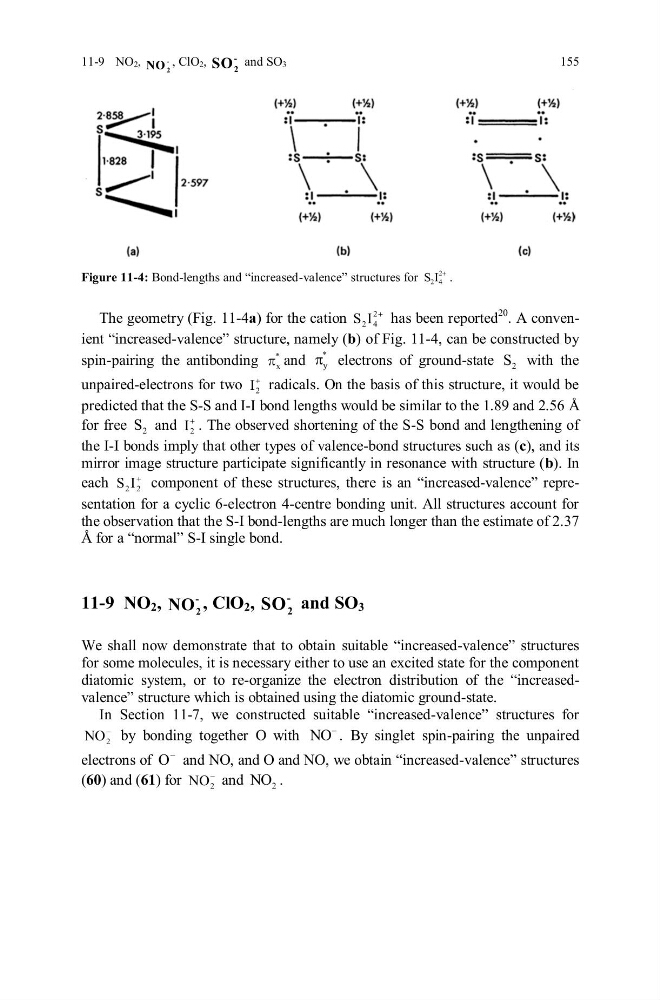
Figure 11-4: Bond-lengths and “increased-valence” structures for
2
2 4
S I
.
The geometry (Fig. 11-4a) for the cation
2
2 4
S I
has been reported
20 . A convenient “increased-valence” structure, namely (b) of Fig. 11-4, can be constructed by
spin-pairing the antibonding
*
x
and
*
y
electrons of ground-state 2
S with the
unpaired-electrons for two 2
I
radicals. On the basis of this structure, it would be
predicted that the S-S and I-I bond lengths would be similar to the 1.89 and 2.56 Å
for free 2
S and 2
I
. The observed shortening of the S-S bond and lengthening of
the I-I bonds imply that other types of valence-bond structures such as (c), and its
mirror image structure participate significantly in resonance with structure (b). In
each 2 2
S I
component of these structures, there is an “increased-valence” representation for a cyclic 6-electron 4-centre bonding unit. All structures account for
the observation that the S-I bond-lengths are much longer than the estimate of 2.37
Å for a “normal” S-I single bond.
11-9 NO 2 ,
-
2
NO , ClO 2 ,
-
2
SO and SO 3
We shall now demonstrate that to obtain suitable “increased-valence” structures
for some molecules, it is necessary either to use an excited state for the component
diatomic system, or to re-organize the electron distribution of the “increasedvalence” structure which is obtained using the diatomic ground-state.
In Section 11-7, we constructed suitable “increased-valence” structures for
2
NO
by bonding together O with NO
. By singlet spin-pairing the unpaired
electrons of O
and NO, and O and NO, we obtain “increased-valence” structures
(60) and (61) for
2
NO
and
2
NO .
-
2
NO , ClO2,
-
2
SO and SO3
155
Figure 11-4: Bond-lengths and “increased-valence” structures for
2
2 4
S I
.
The geometry (Fig. 11-4a) for the cation
2
2 4
S I
has been reported
20 . A convenient “increased-valence” structure, namely (b) of Fig. 11-4, can be constructed by
spin-pairing the antibonding
*
x
and
*
y
electrons of ground-state 2
S with the
unpaired-electrons for two 2
I
radicals. On the basis of this structure, it would be
predicted that the S-S and I-I bond lengths would be similar to the 1.89 and 2.56 Å
for free 2
S and 2
I
. The observed shortening of the S-S bond and lengthening of
the I-I bonds imply that other types of valence-bond structures such as (c), and its
mirror image structure participate significantly in resonance with structure (b). In
each 2 2
S I
component of these structures, there is an “increased-valence” representation for a cyclic 6-electron 4-centre bonding unit. All structures account for
the observation that the S-I bond-lengths are much longer than the estimate of 2.37
Å for a “normal” S-I single bond.
11-9 NO 2 ,
-
2
NO , ClO 2 ,
-
2
SO and SO 3
We shall now demonstrate that to obtain suitable “increased-valence” structures
for some molecules, it is necessary either to use an excited state for the component
diatomic system, or to re-organize the electron distribution of the “increasedvalence” structure which is obtained using the diatomic ground-state.
In Section 11-7, we constructed suitable “increased-valence” structures for
2
NO
by bonding together O with NO
. By singlet spin-pairing the unpaired
electrons of O
and NO, and O and NO, we obtain “increased-valence” structures
(60) and (61) for
2
NO
and
2
NO .