

154
Chapter 11 Pauling “3-Electron Bonds” and “Increased-Valence” Structures
Both cis and trans conformers for ONNO are known
9
, with cis more stable than
trans. The additional stability of the cis conformer is associated with cis O-O
overlap
10 ; in valence-bond theory, this occurs primarily via the oxygen 2p -
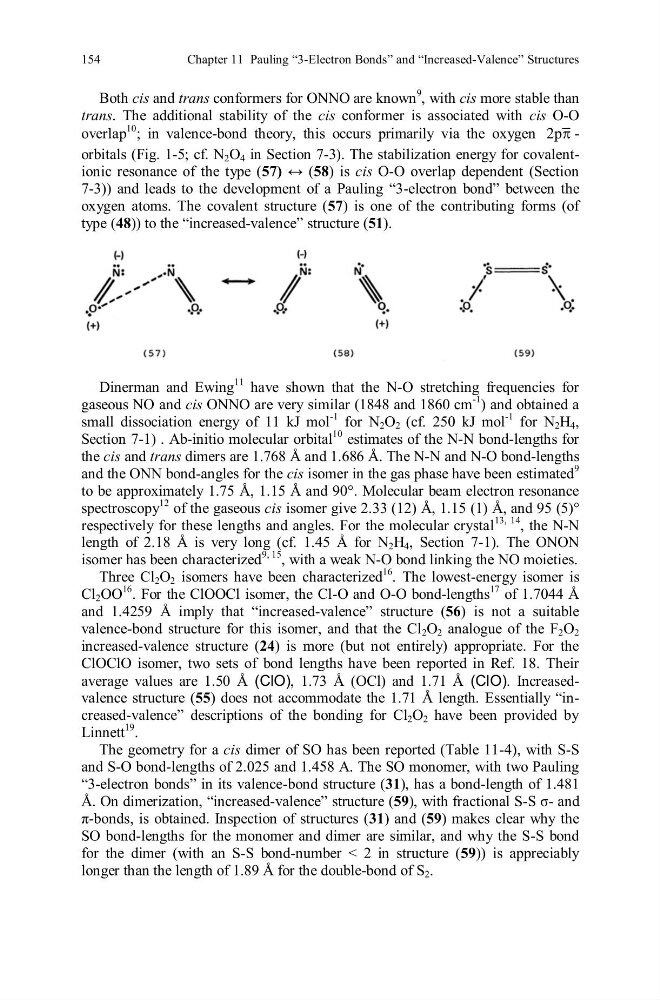
orbitals (Fig. 1-5; cf. N 2 O 4 in Section 7-3). The stabilization energy for covalentionic resonance of the type (57) ↔ (58) is cis O-O overlap dependent (Section
7-3)) and leads to the development of a Pauling “3-electron bond” between the
oxygen atoms. The covalent structure (57) is one of the contributing forms (of
type (48)) to the “increased-valence” structure (51).
Dinerman and Ewing
11 have shown that the N-O stretching frequencies for
gaseous NO and cis ONNO are very similar (1848 and 1860 cm
-1 ) and obtained a
small dissociation energy of 11 kJ mol
-1 for N 2 O 2 (cf. 250 kJ mol
-1 for N 2 H 4 ,
Section 7-1) . Ab-initio molecular orbital
10 estimates of the N-N bond-lengths for
the cis and trans dimers are 1.768 Å and 1.686 Å. The N-N and N-O bond-lengths
and the ONN bond-angles for the cis isomer in the gas phase have been estimated
9
to be approximately 1.75 Å, 1.15 Å and 90°. Molecular beam electron resonance
spectroscopy
12 of the gaseous cis isomer give 2.33 (12) Å, 1.15 (1) Å, and 95 (5)°
respectively for these lengths and angles. For the molecular crystal
13, 14
, the N-N
length of 2.18 Å is very long (cf. 1.45 Å for N 2 H 4 , Section 7-1). The ONON
isomer has been characterized
9, 15
, with a weak N-O bond linking the NO moieties.
Three Cl 2 O 2 isomers have been characterized
16
. The lowest-energy isomer is
Cl 2 OO
16 . For the ClOOCl isomer, the Cl-O and O-O bond-lengths
17 of 1.7044 Å
and 1.4259 Å imply that “increased-valence” structure (56) is not a suitable
valence-bond structure for this isomer, and that the Cl 2 O 2 analogue of the F 2 O 2
increased-valence structure (24) is more (but not entirely) appropriate. For the
ClOClO isomer, two sets of bond lengths have been reported in Ref. 18. Their
average values are 1.50 Å (ClO), 1.73 Å (OCl) and 1.71 Å (ClO). Increasedvalence structure (55) does not accommodate the 1.71 Å length. Essentially “increased-valence” descriptions of the bonding for Cl 2 O 2 have been provided by
Linnett
19 .
The geometry for a cis dimer of SO has been reported (Table 11-4), with S-S
and S-O bond-lengths of 2.025 and 1.458 A. The SO monomer, with two Pauling
“3-electron bonds” in its valence-bond structure (31), has a bond-length of 1.481
Å. On dimerization, “increased-valence” structure (59), with fractional S-S σ- and
π-bonds, is obtained. Inspection of structures (31) and (59) makes clear why the
SO bond-lengths for the monomer and dimer are similar, and why the S-S bond
for the dimer (with an S-S bond-number < 2 in structure (59)) is appreciably
longer than the length of 1.89 Å for the double-bond of S 2 .
Chapter 11 Pauling “3-Electron Bonds” and “Increased-Valence” Structures
Both cis and trans conformers for ONNO are known
9
, with cis more stable than
trans. The additional stability of the cis conformer is associated with cis O-O
overlap
10 ; in valence-bond theory, this occurs primarily via the oxygen 2p -
orbitals (Fig. 1-5; cf. N 2 O 4 in Section 7-3). The stabilization energy for covalentionic resonance of the type (57) ↔ (58) is cis O-O overlap dependent (Section
7-3)) and leads to the development of a Pauling “3-electron bond” between the
oxygen atoms. The covalent structure (57) is one of the contributing forms (of
type (48)) to the “increased-valence” structure (51).
Dinerman and Ewing
11 have shown that the N-O stretching frequencies for
gaseous NO and cis ONNO are very similar (1848 and 1860 cm
-1 ) and obtained a
small dissociation energy of 11 kJ mol
-1 for N 2 O 2 (cf. 250 kJ mol
-1 for N 2 H 4 ,
Section 7-1) . Ab-initio molecular orbital
10 estimates of the N-N bond-lengths for
the cis and trans dimers are 1.768 Å and 1.686 Å. The N-N and N-O bond-lengths
and the ONN bond-angles for the cis isomer in the gas phase have been estimated
9
to be approximately 1.75 Å, 1.15 Å and 90°. Molecular beam electron resonance
spectroscopy
12 of the gaseous cis isomer give 2.33 (12) Å, 1.15 (1) Å, and 95 (5)°
respectively for these lengths and angles. For the molecular crystal
13, 14
, the N-N
length of 2.18 Å is very long (cf. 1.45 Å for N 2 H 4 , Section 7-1). The ONON
isomer has been characterized
9, 15
, with a weak N-O bond linking the NO moieties.
Three Cl 2 O 2 isomers have been characterized
16
. The lowest-energy isomer is
Cl 2 OO
16 . For the ClOOCl isomer, the Cl-O and O-O bond-lengths
17 of 1.7044 Å
and 1.4259 Å imply that “increased-valence” structure (56) is not a suitable
valence-bond structure for this isomer, and that the Cl 2 O 2 analogue of the F 2 O 2
increased-valence structure (24) is more (but not entirely) appropriate. For the
ClOClO isomer, two sets of bond lengths have been reported in Ref. 18. Their
average values are 1.50 Å (ClO), 1.73 Å (OCl) and 1.71 Å (ClO). Increasedvalence structure (55) does not accommodate the 1.71 Å length. Essentially “increased-valence” descriptions of the bonding for Cl 2 O 2 have been provided by
Linnett
19 .
The geometry for a cis dimer of SO has been reported (Table 11-4), with S-S
and S-O bond-lengths of 2.025 and 1.458 A. The SO monomer, with two Pauling
“3-electron bonds” in its valence-bond structure (31), has a bond-length of 1.481
Å. On dimerization, “increased-valence” structure (59), with fractional S-S σ- and
π-bonds, is obtained. Inspection of structures (31) and (59) makes clear why the
SO bond-lengths for the monomer and dimer are similar, and why the S-S bond
for the dimer (with an S-S bond-number < 2 in structure (59)) is appreciably
longer than the length of 1.89 Å for the double-bond of S 2 .