

11-8 Pauling “3-Electron Bonds” and 6-Electron 4-Centre Bonding
153
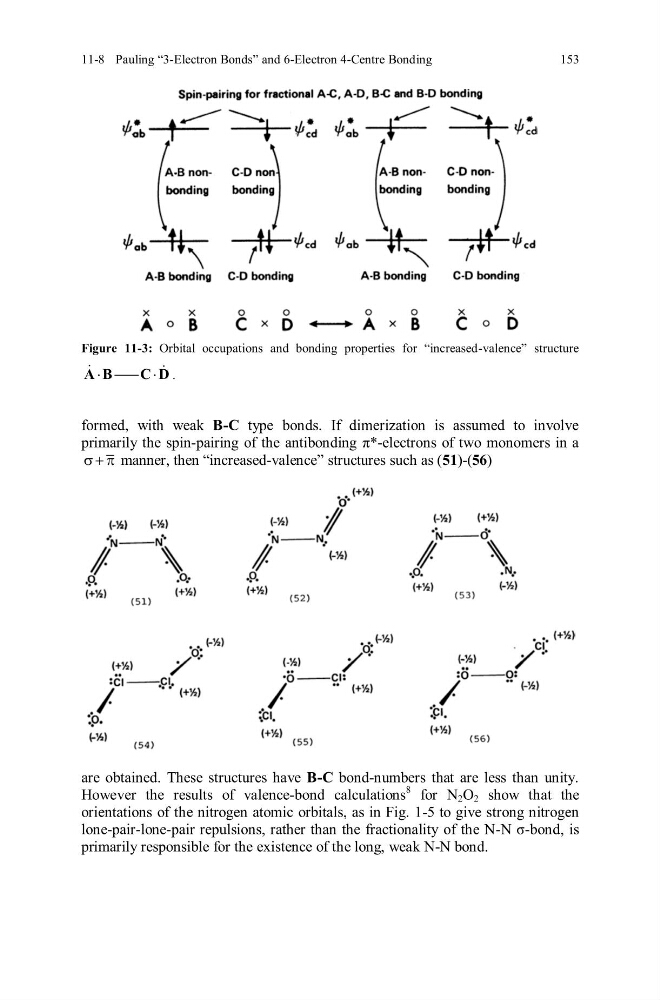
Figure 11-3: Orbital occupations and bonding properties for “increased-valence” structure
D
C
B
A
.
formed, with weak B-C type bonds. If dimerization is assumed to involve
primarily the spin-pairing of the antibonding π*-electrons of two monomers in a
manner, then “increased-valence” structures such as (51)-(56)
are obtained. These structures have B-C bond-numbers that are less than unity.
However the results of valence-bond calculations
8 for N 2 O 2 show that the
orientations of the nitrogen atomic orbitals, as in Fig. 1-5 to give strong nitrogen
lone-pair-lone-pair repulsions, rather than the fractionality of the N-N σ-bond, is
primarily responsible for the existence of the long, weak N-N bond.
153
Figure 11-3: Orbital occupations and bonding properties for “increased-valence” structure
D
C
B
A
.
formed, with weak B-C type bonds. If dimerization is assumed to involve
primarily the spin-pairing of the antibonding π*-electrons of two monomers in a
manner, then “increased-valence” structures such as (51)-(56)
are obtained. These structures have B-C bond-numbers that are less than unity.
However the results of valence-bond calculations
8 for N 2 O 2 show that the
orientations of the nitrogen atomic orbitals, as in Fig. 1-5 to give strong nitrogen
lone-pair-lone-pair repulsions, rather than the fractionality of the N-N σ-bond, is
primarily responsible for the existence of the long, weak N-N bond.