

152
Chapter 11 Pauling “3-Electron Bonds” and “Increased-Valence” Structures
The nitrite anion,
2
NO
, is isoelectronic with 3
O , and its N-O bond-lengths of
1.24 Å are about 0.04 Å longer than a “normal” N-O double bond. Resonance
between the “increased-valence” structures (38) and (39), in which atom A is a
nitrogen atom, reflects this observation. These structures may also be obtained by
spin-pairing the two unpaired electrons that are present for the ground-states of O
and NO
. The anion NO
is isoelectronic with 2
O , and therefore, its groundstate valence-bond structure
has two Pauling “3-electron bonds”.
11-8 Pauling “3-Electron Bonds” and 6-Electron 4-Centre
Bonding: N 2 O 2 , Cl 2 O 2 , S 2 O 2 and
2+
2 4
S I
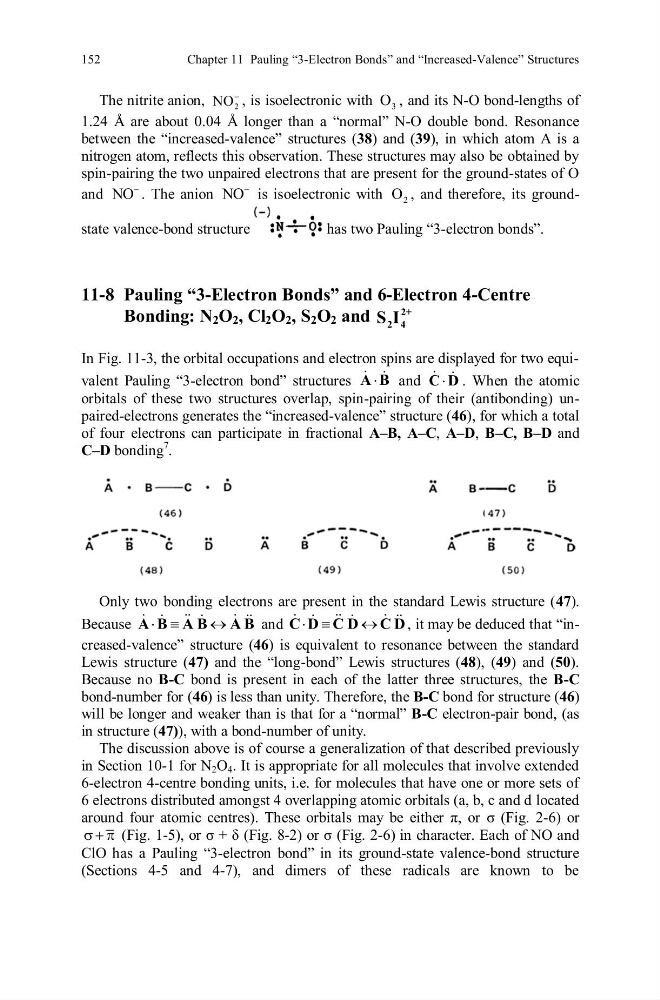
In Fig. 11-3, the orbital occupations and electron spins are displayed for two equivalent Pauling “3-electron bond” structures
B
A
and
D
C
. When the atomic
orbitals of these two structures overlap, spin-pairing of their (antibonding) unpaired-electrons generates the “increased-valence” structure (46), for which a total
of four electrons can participate in fractional A–B, A–C, A–D, B–C, B–D and
C–D bonding
7
.
Only two bonding electrons are present in the standard Lewis structure (47).
Because
B
A
B
A
B
A
and
D
C
D
C
D
C
, it may be deduced that “increased-valence” structure (46) is equivalent to resonance between the standard
Lewis structure (47) and the “long-bond” Lewis structures (48), (49) and (50).
Because no B-C bond is present in each of the latter three structures, the B-C
bond-number for (46) is less than unity. Therefore, the B-C bond for structure (46)
will be longer and weaker than is that for a “normal” B-C electron-pair bond, (as
in structure (47)), with a bond-number of unity.
The discussion above is of course a generalization of that described previously
in Section 10-1 for N 2 O 4 . It is appropriate for all molecules that involve extended
6-electron 4-centre bonding units, i.e. for molecules that have one or more sets of
6 electrons distributed amongst 4 overlapping atomic orbitals (a, b, c and d located
around four atomic centres). These orbitals may be either π, or σ (Fig. 2-6) or
(Fig. 1-5), or σ + δ (Fig. 8-2) or σ (Fig. 2-6) in character. Each of NO and
ClO has a Pauling “3-electron bond” in its ground-state valence-bond structure
(Sections 4-5 and 4-7), and dimers of these radicals are known to be
Chapter 11 Pauling “3-Electron Bonds” and “Increased-Valence” Structures
The nitrite anion,
2
NO
, is isoelectronic with 3
O , and its N-O bond-lengths of
1.24 Å are about 0.04 Å longer than a “normal” N-O double bond. Resonance
between the “increased-valence” structures (38) and (39), in which atom A is a
nitrogen atom, reflects this observation. These structures may also be obtained by
spin-pairing the two unpaired electrons that are present for the ground-states of O
and NO
. The anion NO
is isoelectronic with 2
O , and therefore, its groundstate valence-bond structure
has two Pauling “3-electron bonds”.
11-8 Pauling “3-Electron Bonds” and 6-Electron 4-Centre
Bonding: N 2 O 2 , Cl 2 O 2 , S 2 O 2 and
2+
2 4
S I
In Fig. 11-3, the orbital occupations and electron spins are displayed for two equivalent Pauling “3-electron bond” structures
B
A
and
D
C
. When the atomic
orbitals of these two structures overlap, spin-pairing of their (antibonding) unpaired-electrons generates the “increased-valence” structure (46), for which a total
of four electrons can participate in fractional A–B, A–C, A–D, B–C, B–D and
C–D bonding
7
.
Only two bonding electrons are present in the standard Lewis structure (47).
Because
B
A
B
A
B
A
and
D
C
D
C
D
C
, it may be deduced that “increased-valence” structure (46) is equivalent to resonance between the standard
Lewis structure (47) and the “long-bond” Lewis structures (48), (49) and (50).
Because no B-C bond is present in each of the latter three structures, the B-C
bond-number for (46) is less than unity. Therefore, the B-C bond for structure (46)
will be longer and weaker than is that for a “normal” B-C electron-pair bond, (as
in structure (47)), with a bond-number of unity.
The discussion above is of course a generalization of that described previously
in Section 10-1 for N 2 O 4 . It is appropriate for all molecules that involve extended
6-electron 4-centre bonding units, i.e. for molecules that have one or more sets of
6 electrons distributed amongst 4 overlapping atomic orbitals (a, b, c and d located
around four atomic centres). These orbitals may be either π, or σ (Fig. 2-6) or
(Fig. 1-5), or σ + δ (Fig. 8-2) or σ (Fig. 2-6) in character. Each of NO and
ClO has a Pauling “3-electron bond” in its ground-state valence-bond structure
(Sections 4-5 and 4-7), and dimers of these radicals are known to be