

11-7 O3, SO2, S2O and NO2
–
151
11-7 O 3 , SO 2 , S 2 O and NO 2
–
In Sections 11-2 to 11-5, atomic orbitals for the “increased-valence” bonding units
are of the (Fig. 1-5) type. The —
Y A bonds are (fractional) σ-bonds. We
shall now describe some examples of “increased-valence” structures that involve
—
Y A π-bonds as well as σ-bonds in the “increased-valence” bonding units. For
4-electron 3-centre π-bonding, the orbital overlap is displayed in Fig. 2-4.
Oxygen and sulphur atoms (
and
) have two unpaired electrons in their
ground-states. By spin-pairing these electrons with those of the Pauling “3electron bond” structures (23), (30) and (31) for the ground-states of O 2 , SO and
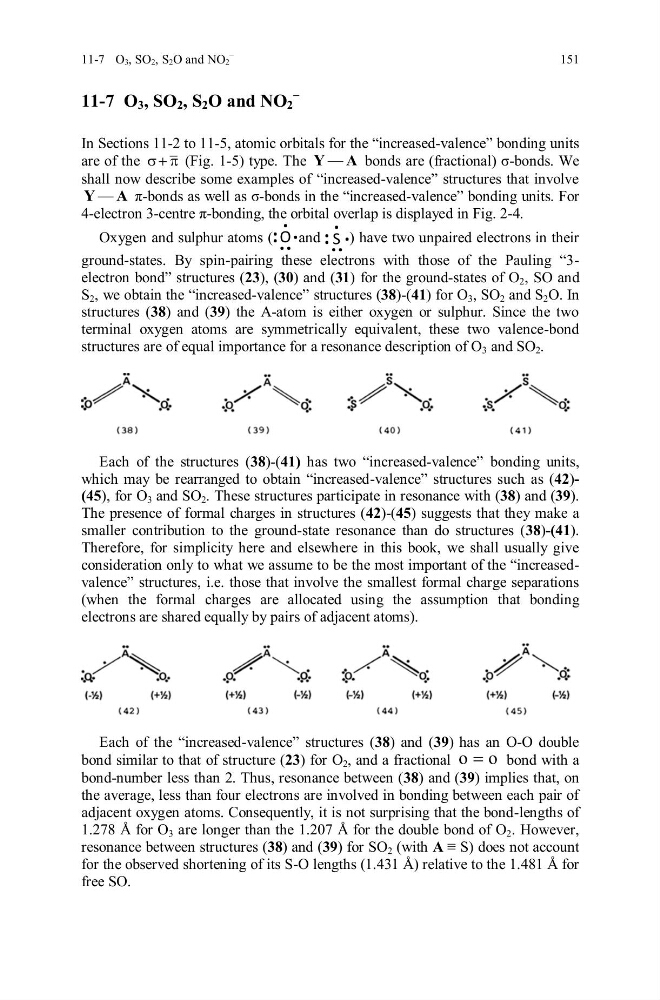
S 2 , we obtain the “increased-valence” structures (38)-(41) for O 3 , SO 2 and S 2 O. In
structures (38) and (39) the A-atom is either oxygen or sulphur. Since the two
terminal oxygen atoms are symmetrically equivalent, these two valence-bond
structures are of equal importance for a resonance description of O 3 and SO 2 .
Each of the structures (38)-(41) has two “increased-valence” bonding units,
which may be rearranged to obtain “increased-valence” structures such as (42)(45), for O 3 and SO 2 . These structures participate in resonance with (38) and (39).
The presence of formal charges in structures (42)-(45) suggests that they make a
smaller contribution to the ground-state resonance than do structures (38)-(41).
Therefore, for simplicity here and elsewhere in this book, we shall usually give
consideration only to what we assume to be the most important of the “increasedvalence” structures, i.e. those that involve the smallest formal charge separations
(when the formal charges are allocated using the assumption that bonding
electrons are shared equally by pairs of adjacent atoms).
Each of the “increased-valence” structures (38) and (39) has an O-O double
bond similar to that of structure (23) for O 2 , and a fractional o o
bond with a
bond-number less than 2. Thus, resonance between (38) and (39) implies that, on
the average, less than four electrons are involved in bonding between each pair of
adjacent oxygen atoms. Consequently, it is not surprising that the bond-lengths of
1.278 Å for O 3 are longer than the 1.207 Å for the double bond of O 2 . However,
resonance between structures (38) and (39) for SO 2 (with A ≡ S) does not account
for the observed shortening of its S-O lengths (1.431 Å) relative to the 1.481 Å for
free SO.
O
.
:
:
.
S
:
:
.
.
–
151
11-7 O 3 , SO 2 , S 2 O and NO 2
–
In Sections 11-2 to 11-5, atomic orbitals for the “increased-valence” bonding units
are of the (Fig. 1-5) type. The —
Y A bonds are (fractional) σ-bonds. We
shall now describe some examples of “increased-valence” structures that involve
—
Y A π-bonds as well as σ-bonds in the “increased-valence” bonding units. For
4-electron 3-centre π-bonding, the orbital overlap is displayed in Fig. 2-4.
Oxygen and sulphur atoms (
and
) have two unpaired electrons in their
ground-states. By spin-pairing these electrons with those of the Pauling “3electron bond” structures (23), (30) and (31) for the ground-states of O 2 , SO and
S 2 , we obtain the “increased-valence” structures (38)-(41) for O 3 , SO 2 and S 2 O. In
structures (38) and (39) the A-atom is either oxygen or sulphur. Since the two
terminal oxygen atoms are symmetrically equivalent, these two valence-bond
structures are of equal importance for a resonance description of O 3 and SO 2 .
Each of the structures (38)-(41) has two “increased-valence” bonding units,
which may be rearranged to obtain “increased-valence” structures such as (42)(45), for O 3 and SO 2 . These structures participate in resonance with (38) and (39).
The presence of formal charges in structures (42)-(45) suggests that they make a
smaller contribution to the ground-state resonance than do structures (38)-(41).
Therefore, for simplicity here and elsewhere in this book, we shall usually give
consideration only to what we assume to be the most important of the “increasedvalence” structures, i.e. those that involve the smallest formal charge separations
(when the formal charges are allocated using the assumption that bonding
electrons are shared equally by pairs of adjacent atoms).
Each of the “increased-valence” structures (38) and (39) has an O-O double
bond similar to that of structure (23) for O 2 , and a fractional o o
bond with a
bond-number less than 2. Thus, resonance between (38) and (39) implies that, on
the average, less than four electrons are involved in bonding between each pair of
adjacent oxygen atoms. Consequently, it is not surprising that the bond-lengths of
1.278 Å for O 3 are longer than the 1.207 Å for the double bond of O 2 . However,
resonance between structures (38) and (39) for SO 2 (with A ≡ S) does not account
for the observed shortening of its S-O lengths (1.431 Å) relative to the 1.481 Å for
free SO.
O
.
:
:
.
S
:
:
.
.