

148
Chapter 11 Pauling “3-Electron Bonds” and “Increased-Valence” Structures
empirical support in Sections 11-4 and 11-5. Another way to say this is that the
contribution of the “long-bond” structure (such as structure (20)) to the groundstate resonance is small. Roso
5 has calculated the following valence-bond wavefunction for HNO:
The coefficient of 0.07 for the “long-bond” structure provides theoretical
support for the unimportance of this structure.
As we have found for the nitrosyl halides, if a hydrogen atom or CH 3 is
replaced by the more-electronegative halogen atoms, the Pauling “3-electron
bond” of NO in the nitrosyl compound can be stabilized. For CF 3 NO, the
electronegativity of CF 3 should be intermediate between those of CH 3 and F.
Therefore, some stabilization of the Pauling “3-electron bond” for this molecule
may occur. The “increased-valence” structure 18 for CF 3 NO (with CF 3 replacing
CH 3 ) implies that the C-N bond is longer than a single-bond, and that the N-O
bond should be shorter than those of CH 3 NO and HNO. Both of these inferences
are in agreement with the observed bond-lengths of Table 11-1.
11-5 Some Dioxygenyl Compounds
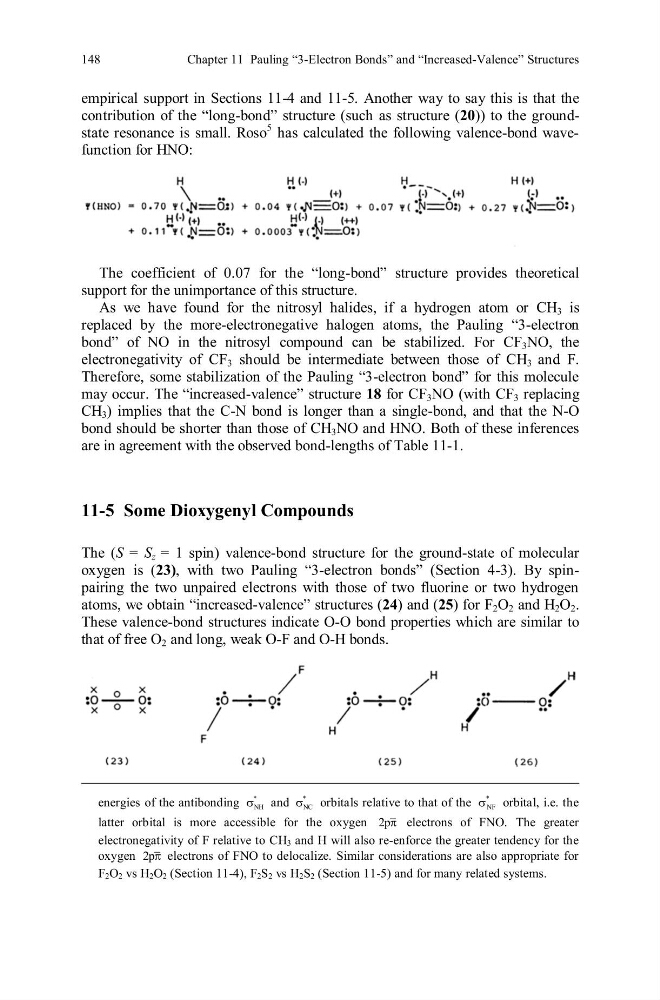
The (S = S z = 1 spin) valence-bond structure for the ground-state of molecular
oxygen is (23), with two Pauling “3-electron bonds” (Section 4-3). By spinpairing the two unpaired electrons with those of two fluorine or two hydrogen
atoms, we obtain “increased-valence” structures (24) and (25) for F 2 O 2 and H 2 O 2 .
These valence-bond structures indicate O-O bond properties which are similar to
that of free O 2 and long, weak O-F and O-H bonds.
energies of the antibonding
*
NH
and
*
NC
orbitals relative to that of the
*
NF
orbital, i.e. the
latter orbital is more accessible for the oxygen 2p electrons of FNO. The greater
electronegativity of F relative to CH3 and H will also re-enforce the greater tendency for the
oxygen 2p electrons of FNO to delocalize. Similar considerations are also appropriate for
F2O2 vs H2O2 (Section 11-4), F2S2 vs H2S2 (Section 11-5) and for many related systems.
Chapter 11 Pauling “3-Electron Bonds” and “Increased-Valence” Structures
empirical support in Sections 11-4 and 11-5. Another way to say this is that the
contribution of the “long-bond” structure (such as structure (20)) to the groundstate resonance is small. Roso
5 has calculated the following valence-bond wavefunction for HNO:
The coefficient of 0.07 for the “long-bond” structure provides theoretical
support for the unimportance of this structure.
As we have found for the nitrosyl halides, if a hydrogen atom or CH 3 is
replaced by the more-electronegative halogen atoms, the Pauling “3-electron
bond” of NO in the nitrosyl compound can be stabilized. For CF 3 NO, the
electronegativity of CF 3 should be intermediate between those of CH 3 and F.
Therefore, some stabilization of the Pauling “3-electron bond” for this molecule
may occur. The “increased-valence” structure 18 for CF 3 NO (with CF 3 replacing
CH 3 ) implies that the C-N bond is longer than a single-bond, and that the N-O
bond should be shorter than those of CH 3 NO and HNO. Both of these inferences
are in agreement with the observed bond-lengths of Table 11-1.
11-5 Some Dioxygenyl Compounds
The (S = S z = 1 spin) valence-bond structure for the ground-state of molecular
oxygen is (23), with two Pauling “3-electron bonds” (Section 4-3). By spinpairing the two unpaired electrons with those of two fluorine or two hydrogen
atoms, we obtain “increased-valence” structures (24) and (25) for F 2 O 2 and H 2 O 2 .
These valence-bond structures indicate O-O bond properties which are similar to
that of free O 2 and long, weak O-F and O-H bonds.
energies of the antibonding
*
NH
and
*
NC
orbitals relative to that of the
*
NF
orbital, i.e. the
latter orbital is more accessible for the oxygen 2p electrons of FNO. The greater
electronegativity of F relative to CH3 and H will also re-enforce the greater tendency for the
oxygen 2p electrons of FNO to delocalize. Similar considerations are also appropriate for
F2O2 vs H2O2 (Section 11-4), F2S2 vs H2S2 (Section 11-5) and for many related systems.