

11-6 Some S-O and S-S Compounds
149
For F 2 O 2 , structure (24) is a suitable valence-bond structure; the O-O bondlengths of O 2 and F 2 O 2 in Table 11-2 are similar, and the O-F bond-lengths of
1.575 Ǻ are much longer than the 1.42 Å for the single bonds of F 2 O. However,
the O-H bond-lengths of H 2 O 2 are almost identical with those of the single bonds
of H 2 O (0.96 Å), and the O-O bond-length is similar to that of the single bond of
2
2
O
(1.49 Ǻ), whose valence-bond structure was derived in Section 4-2. The
Lewis structure (26) for H 2 O 2 accounts for these properties adequately, to lend
support to the hypothesis that hydrogen atoms bring out little “increased-valence”
aspects of bonding, i.e. that they do not stabilize significantly Pauling “3-electron
bonds” in 4-electron 3-centre bonding units for neutral molecules.
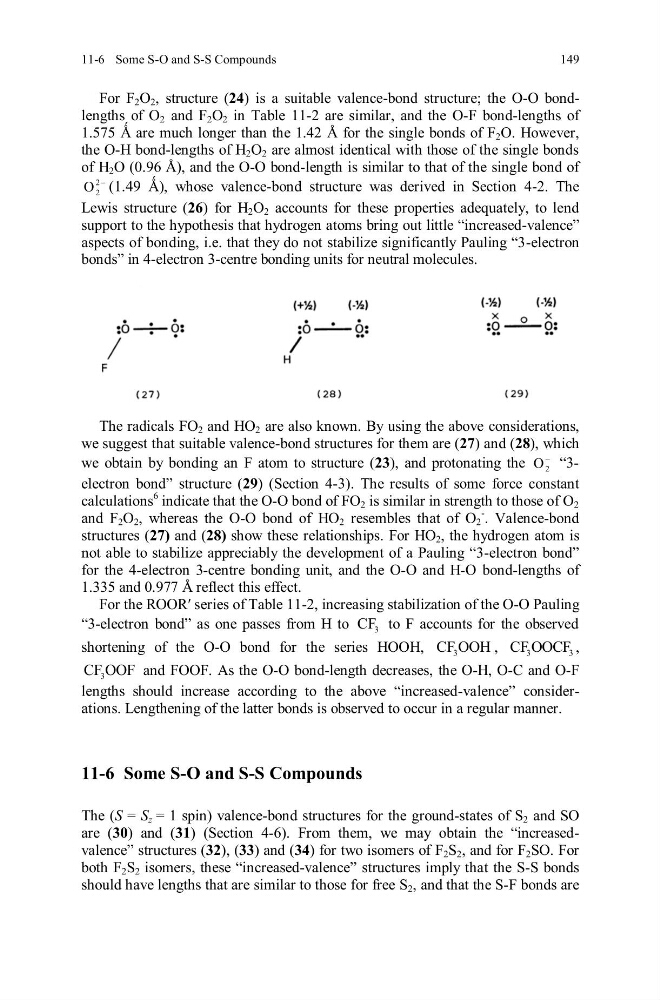
The radicals FO 2 and HO 2 are also known. By using the above considerations,
we suggest that suitable valence-bond structures for them are (27) and (28), which
we obtain by bonding an F atom to structure (23), and protonating the 2
O
“3electron bond” structure (29) (Section 4-3). The results of some force constant
calculations
6 indicate that the O-O bond of FO 2 is similar in strength to those of O 2
and F 2 O 2 , whereas the O-O bond of HO 2 resembles that of O 2
- . Valence-bond
structures (27) and (28) show these relationships. For HO 2 , the hydrogen atom is
not able to stabilize appreciably the development of a Pauling “3-electron bond”
for the 4-electron 3-centre bonding unit, and the O-O and H-O bond-lengths of
1.335 and 0.977 Å reflect this effect.
For the ROOR′ series of Table 11-2, increasing stabilization of the O-O Pauling
“3-electron bond” as one passes from H to
3
CF to F accounts for the observed
shortening of the O-O bond for the series HOOH,
3
CF OOH ,
3
3
CF OOCF ,
3
CF OOF and FOOF. As the O-O bond-length decreases, the O-H, O-C and O-F
lengths should increase according to the above “increased-valence” considerations. Lengthening of the latter bonds is observed to occur in a regular manner.
11-6 Some S-O and S-S Compounds
The (S = S z = 1 spin) valence-bond structures for the ground-states of S 2 and SO
are (30) and (31) (Section 4-6). From them, we may obtain the “increasedvalence” structures (32), (33) and (34) for two isomers of F 2 S 2 , and for F 2 SO. For
both F 2 S 2 isomers, these “increased-valence” structures imply that the S-S bonds
should have lengths that are similar to those for free S 2 , and that the S-F bonds are
149
For F 2 O 2 , structure (24) is a suitable valence-bond structure; the O-O bondlengths of O 2 and F 2 O 2 in Table 11-2 are similar, and the O-F bond-lengths of
1.575 Ǻ are much longer than the 1.42 Å for the single bonds of F 2 O. However,
the O-H bond-lengths of H 2 O 2 are almost identical with those of the single bonds
of H 2 O (0.96 Å), and the O-O bond-length is similar to that of the single bond of
2
2
O
(1.49 Ǻ), whose valence-bond structure was derived in Section 4-2. The
Lewis structure (26) for H 2 O 2 accounts for these properties adequately, to lend
support to the hypothesis that hydrogen atoms bring out little “increased-valence”
aspects of bonding, i.e. that they do not stabilize significantly Pauling “3-electron
bonds” in 4-electron 3-centre bonding units for neutral molecules.
The radicals FO 2 and HO 2 are also known. By using the above considerations,
we suggest that suitable valence-bond structures for them are (27) and (28), which
we obtain by bonding an F atom to structure (23), and protonating the 2
O
“3electron bond” structure (29) (Section 4-3). The results of some force constant
calculations
6 indicate that the O-O bond of FO 2 is similar in strength to those of O 2
and F 2 O 2 , whereas the O-O bond of HO 2 resembles that of O 2
- . Valence-bond
structures (27) and (28) show these relationships. For HO 2 , the hydrogen atom is
not able to stabilize appreciably the development of a Pauling “3-electron bond”
for the 4-electron 3-centre bonding unit, and the O-O and H-O bond-lengths of
1.335 and 0.977 Å reflect this effect.
For the ROOR′ series of Table 11-2, increasing stabilization of the O-O Pauling
“3-electron bond” as one passes from H to
3
CF to F accounts for the observed
shortening of the O-O bond for the series HOOH,
3
CF OOH ,
3
3
CF OOCF ,
3
CF OOF and FOOF. As the O-O bond-length decreases, the O-H, O-C and O-F
lengths should increase according to the above “increased-valence” considerations. Lengthening of the latter bonds is observed to occur in a regular manner.
11-6 Some S-O and S-S Compounds
The (S = S z = 1 spin) valence-bond structures for the ground-states of S 2 and SO
are (30) and (31) (Section 4-6). From them, we may obtain the “increasedvalence” structures (32), (33) and (34) for two isomers of F 2 S 2 , and for F 2 SO. For
both F 2 S 2 isomers, these “increased-valence” structures imply that the S-S bonds
should have lengths that are similar to those for free S 2 , and that the S-F bonds are