

11-4 CH3NO and HNO
147
11-4 CH 3 NO and HNO
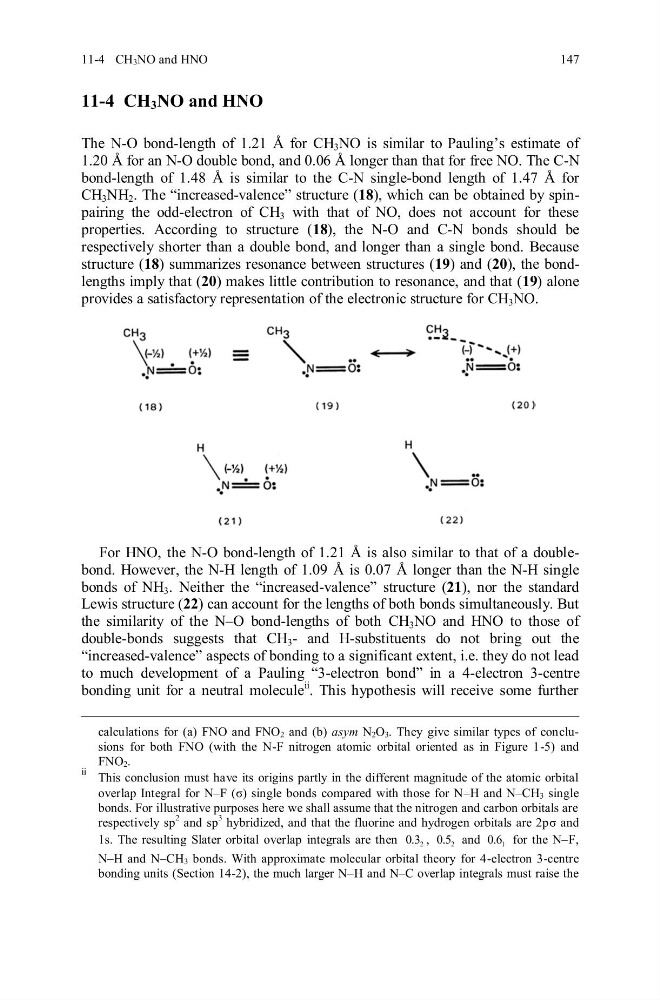
The N-O bond-length of 1.21 Å for CH 3 NO is similar to Pauling’s estimate of
1.20 Å for an N-O double bond, and 0.06 Å longer than that for free NO. The C-N
bond-length of 1.48 Å is similar to the C-N single-bond length of 1.47 Å for
CH 3 NH 2 . The “increased-valence” structure (18), which can be obtained by spinpairing the odd-electron of CH 3 with that of NO, does not account for these
properties. According to structure (18), the N-O and C-N bonds should be
respectively shorter than a double bond, and longer than a single bond. Because
structure (18) summarizes resonance between structures (19) and (20), the bondlengths imply that (20) makes little contribution to resonance, and that (19) alone
provides a satisfactory representation of the electronic structure for CH 3 NO.
For HNO, the N-O bond-length of 1.21 Å is also similar to that of a doublebond. However, the N-H length of 1.09 Å is 0.07 Å longer than the N-H single
bonds of NH 3 . Neither the “increased-valence” structure (21), nor the standard
Lewis structure (22) can account for the lengths of both bonds simultaneously. But
the similarity of the N–O bond-lengths of both CH 3 NO and HNO to those of
double-bonds suggests that CH 3 - and H-substituents do not bring out the
“increased-valence” aspects of bonding to a significant extent, i.e. they do not lead
to much development of a Pauling “3-electron bond” in a 4-electron 3-centre
bonding unit for a neutral molecule
ii
. This hypothesis will receive some further
calculations for (a) FNO and FNO2 and (b) asym N2O3. They give similar types of conclusions for both FNO (with the N-F nitrogen atomic orbital oriented as in Figure 1-5) and
FNO2.
ii This conclusion must have its origins partly in the different magnitude of the atomic orbital
overlap Integral for N–F (σ) single bonds compared with those for N–H and N–CH3 single
bonds. For illustrative purposes here we shall assume that the nitrogen and carbon orbitals are
respectively sp
2 and sp
3 hybridized, and that the fluorine and hydrogen orbitals are 2pσ and
1s. The resulting Slater orbital overlap integrals are then
2
0.3 ,
2
0.5 and
1
0.6 for the N–F,
N–H and N–CH3 bonds. With approximate molecular orbital theory for 4-electron 3-centre
bonding units (Section 14-2), the much larger N–H and N–C overlap integrals must raise the
147
11-4 CH 3 NO and HNO
The N-O bond-length of 1.21 Å for CH 3 NO is similar to Pauling’s estimate of
1.20 Å for an N-O double bond, and 0.06 Å longer than that for free NO. The C-N
bond-length of 1.48 Å is similar to the C-N single-bond length of 1.47 Å for
CH 3 NH 2 . The “increased-valence” structure (18), which can be obtained by spinpairing the odd-electron of CH 3 with that of NO, does not account for these
properties. According to structure (18), the N-O and C-N bonds should be
respectively shorter than a double bond, and longer than a single bond. Because
structure (18) summarizes resonance between structures (19) and (20), the bondlengths imply that (20) makes little contribution to resonance, and that (19) alone
provides a satisfactory representation of the electronic structure for CH 3 NO.
For HNO, the N-O bond-length of 1.21 Å is also similar to that of a doublebond. However, the N-H length of 1.09 Å is 0.07 Å longer than the N-H single
bonds of NH 3 . Neither the “increased-valence” structure (21), nor the standard
Lewis structure (22) can account for the lengths of both bonds simultaneously. But
the similarity of the N–O bond-lengths of both CH 3 NO and HNO to those of
double-bonds suggests that CH 3 - and H-substituents do not bring out the
“increased-valence” aspects of bonding to a significant extent, i.e. they do not lead
to much development of a Pauling “3-electron bond” in a 4-electron 3-centre
bonding unit for a neutral molecule
ii
. This hypothesis will receive some further
calculations for (a) FNO and FNO2 and (b) asym N2O3. They give similar types of conclusions for both FNO (with the N-F nitrogen atomic orbital oriented as in Figure 1-5) and
FNO2.
ii This conclusion must have its origins partly in the different magnitude of the atomic orbital
overlap Integral for N–F (σ) single bonds compared with those for N–H and N–CH3 single
bonds. For illustrative purposes here we shall assume that the nitrogen and carbon orbitals are
respectively sp
2 and sp
3 hybridized, and that the fluorine and hydrogen orbitals are 2pσ and
1s. The resulting Slater orbital overlap integrals are then
2
0.3 ,
2
0.5 and
1
0.6 for the N–F,
N–H and N–CH3 bonds. With approximate molecular orbital theory for 4-electron 3-centre
bonding units (Section 14-2), the much larger N–H and N–C overlap integrals must raise the