

146
Chapter 11 Pauling “3-Electron Bonds” and “Increased-Valence” Structures
We may construct similar types of “increased-valence” structures for ClNO and
BrNO; each of these molecules has a long nitrogen-halogen bond, and an N-O
bond-length similar to that of free NO. (The N-Cl and N-Br bond-lengths of 1.98
Å and 2.14 Å are longer than Pauling’s estimates of 1.73 Å and 1.86 Å for the
lengths of N-Cl and N-Br single bonds
4 ).
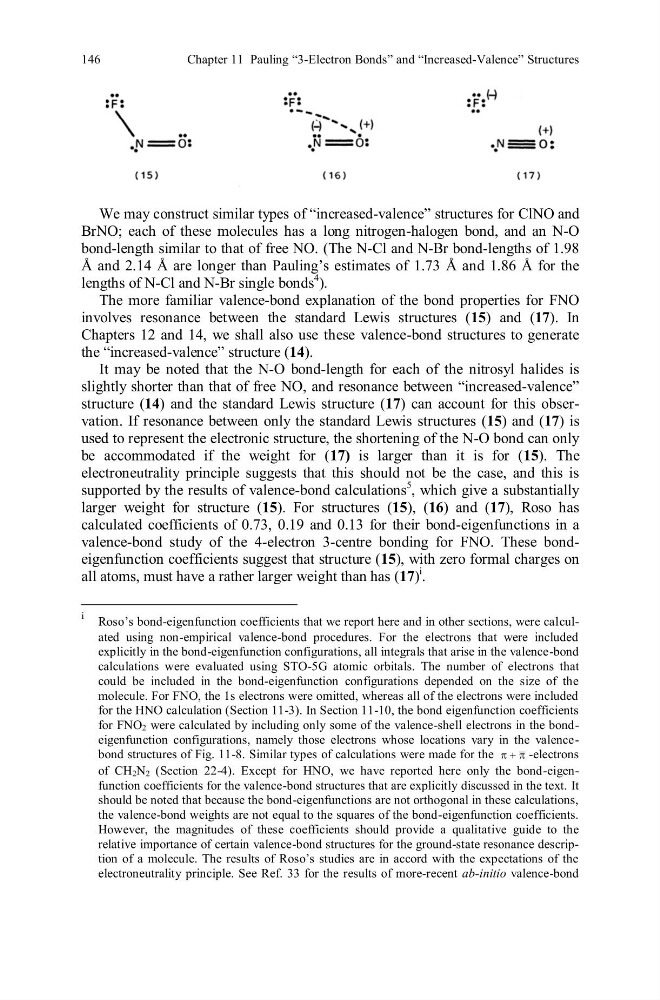
The more familiar valence-bond explanation of the bond properties for FNO
involves resonance between the standard Lewis structures (15) and (17). In
Chapters 12 and 14, we shall also use these valence-bond structures to generate
the “increased-valence” structure (14).
It may be noted that the N-O bond-length for each of the nitrosyl halides is
slightly shorter than that of free NO, and resonance between “increased-valence”
structure (14) and the standard Lewis structure (17) can account for this observation. If resonance between only the standard Lewis structures (15) and (17) is
used to represent the electronic structure, the shortening of the N-O bond can only
be accommodated if the weight for (17) is larger than it is for (15). The
electroneutrality principle suggests that this should not be the case, and this is
supported by the results of valence-bond calculations
5
, which give a substantially
larger weight for structure (15). For structures (15), (16) and (17), Roso has
calculated coefficients of 0.73, 0.19 and 0.13 for their bond-eigenfunctions in a
valence-bond study of the 4-electron 3-centre bonding for FNO. These bondeigenfunction coefficients suggest that structure (15), with zero formal charges on
all atoms, must have a rather larger weight than has (17)
i
.
i Roso’s bond-eigenfunction coefficients that we report here and in other sections, were calculated using non-empirical valence-bond procedures. For the electrons that were included
explicitly in the bond-eigenfunction configurations, all integrals that arise in the valence-bond
calculations were evaluated using STO-5G atomic orbitals. The number of electrons that
could be included in the bond-eigenfunction configurations depended on the size of the
molecule. For FNO, the 1s electrons were omitted, whereas all of the electrons were included
for the HNO calculation (Section 11-3). In Section 11-10, the bond eigenfunction coefficients
for FNO2 were calculated by including only some of the valence-shell electrons in the bondeigenfunction configurations, namely those electrons whose locations vary in the valencebond structures of Fig. 11-8. Similar types of calculations were made for the -electrons
of CH2N2 (Section 22-4). Except for HNO, we have reported here only the bond-eigenfunction coefficients for the valence-bond structures that are explicitly discussed in the text. It
should be noted that because the bond-eigenfunctions are not orthogonal in these calculations,
the valence-bond weights are not equal to the squares of the bond-eigenfunction coefficients.
However, the magnitudes of these coefficients should provide a qualitative guide to the
relative importance of certain valence-bond structures for the ground-state resonance description of a molecule. The results of Roso’s studies are in accord with the expectations of the
electroneutrality principle. See Ref. 33 for the results of more-recent ab-initio valence-bond
Chapter 11 Pauling “3-Electron Bonds” and “Increased-Valence” Structures
We may construct similar types of “increased-valence” structures for ClNO and
BrNO; each of these molecules has a long nitrogen-halogen bond, and an N-O
bond-length similar to that of free NO. (The N-Cl and N-Br bond-lengths of 1.98
Å and 2.14 Å are longer than Pauling’s estimates of 1.73 Å and 1.86 Å for the
lengths of N-Cl and N-Br single bonds
4 ).
The more familiar valence-bond explanation of the bond properties for FNO
involves resonance between the standard Lewis structures (15) and (17). In
Chapters 12 and 14, we shall also use these valence-bond structures to generate
the “increased-valence” structure (14).
It may be noted that the N-O bond-length for each of the nitrosyl halides is
slightly shorter than that of free NO, and resonance between “increased-valence”
structure (14) and the standard Lewis structure (17) can account for this observation. If resonance between only the standard Lewis structures (15) and (17) is
used to represent the electronic structure, the shortening of the N-O bond can only
be accommodated if the weight for (17) is larger than it is for (15). The
electroneutrality principle suggests that this should not be the case, and this is
supported by the results of valence-bond calculations
5
, which give a substantially
larger weight for structure (15). For structures (15), (16) and (17), Roso has
calculated coefficients of 0.73, 0.19 and 0.13 for their bond-eigenfunctions in a
valence-bond study of the 4-electron 3-centre bonding for FNO. These bondeigenfunction coefficients suggest that structure (15), with zero formal charges on
all atoms, must have a rather larger weight than has (17)
i
.
i Roso’s bond-eigenfunction coefficients that we report here and in other sections, were calculated using non-empirical valence-bond procedures. For the electrons that were included
explicitly in the bond-eigenfunction configurations, all integrals that arise in the valence-bond
calculations were evaluated using STO-5G atomic orbitals. The number of electrons that
could be included in the bond-eigenfunction configurations depended on the size of the
molecule. For FNO, the 1s electrons were omitted, whereas all of the electrons were included
for the HNO calculation (Section 11-3). In Section 11-10, the bond eigenfunction coefficients
for FNO2 were calculated by including only some of the valence-shell electrons in the bondeigenfunction configurations, namely those electrons whose locations vary in the valencebond structures of Fig. 11-8. Similar types of calculations were made for the -electrons
of CH2N2 (Section 22-4). Except for HNO, we have reported here only the bond-eigenfunction coefficients for the valence-bond structures that are explicitly discussed in the text. It
should be noted that because the bond-eigenfunctions are not orthogonal in these calculations,
the valence-bond weights are not equal to the squares of the bond-eigenfunction coefficients.
However, the magnitudes of these coefficients should provide a qualitative guide to the
relative importance of certain valence-bond structures for the ground-state resonance description of a molecule. The results of Roso’s studies are in accord with the expectations of the
electroneutrality principle. See Ref. 33 for the results of more-recent ab-initio valence-bond