

11-2 “Increased-Valence” or Electronic Hypervalence via Pauling “3-Electron Bonds
141
O X OX
Y A B
X O XO
Y A B
O XO X
Y A B
X OX O
Y A B
(8a)
(8b)
(9a)
(9b)
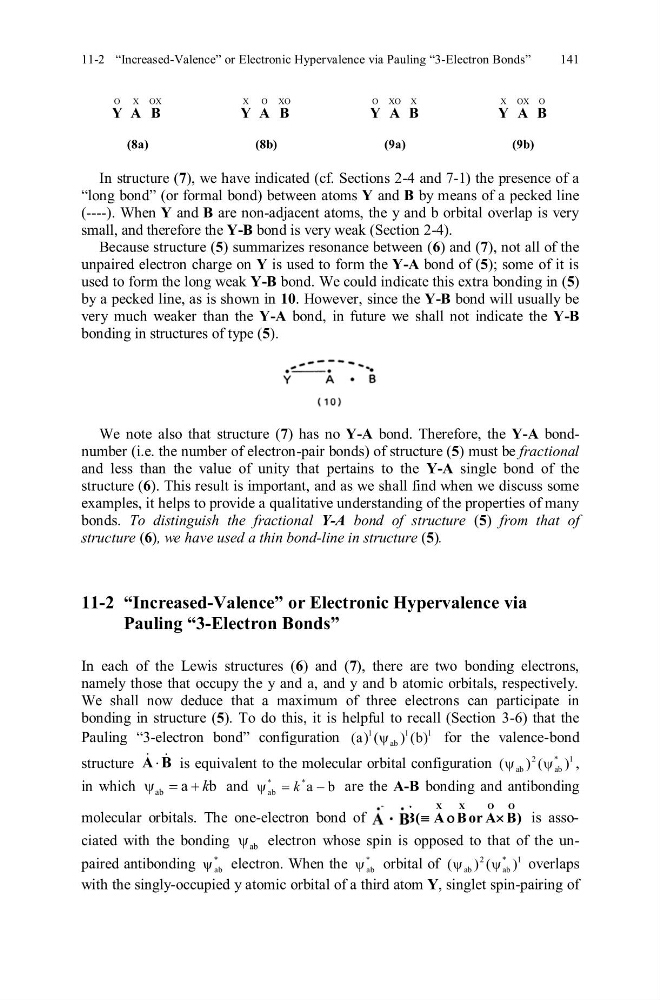
In structure (7), we have indicated (cf. Sections 2-4 and 7-1) the presence of a
“long bond” (or formal bond) between atoms Y and B by means of a pecked line
(----). When Y and B are non-adjacent atoms, the y and b orbital overlap is very
small, and therefore the Y-B bond is very weak (Section 2-4).
Because structure (5) summarizes resonance between (6) and (7), not all of the
unpaired electron charge on Y is used to form the Y-A bond of (5); some of it is
used to form the long weak Y-B bond. We could indicate this extra bonding in (5)
by a pecked line, as is shown in 10. However, since the Y-B bond will usually be
very much weaker than the Y-A bond, in future we shall not indicate the Y-B
bonding in structures of type (5).
We note also that structure (7) has no Y-A bond. Therefore, the Y-A bondnumber (i.e. the number of electron-pair bonds) of structure (5) must be fractional
and less than the value of unity that pertains to the Y-A single bond of the
structure (6). This result is important, and as we shall find when we discuss some
examples, it helps to provide a qualitative understanding of the properties of many
bonds. To distinguish the fractional Y-A bond of structure (5) from that of
structure (6), we have used a thin bond-line in structure (5).
11-2 “Increased-Valence” or Electronic Hypervalence via
Pauling “3-Electron Bonds
In each of the Lewis structures (6) and (7), there are two bonding electrons,
namely those that occupy the y and a, and y and b atomic orbitals, respectively.
We shall now deduce that a maximum of three electrons can participate in
bonding in structure (5). To do this, it is helpful to recall (Section 3-6) that the
Pauling “3-electron bond” configuration
1
1
1
ab
(a) ( ) (b)
for the valence-bond
structure
B
A
is equivalent to the molecular orbital configuration
2
* 1
ab
ab
(
) (
)
,
in which ab a b
k and
*
*
ab
a – b
k
are the A-B bonding and antibonding
molecular orbitals. The one-electron bond of
X
X
O
O
A · B( A B or A B)
is associated with the bonding ab
electron whose spin is opposed to that of the unpaired antibonding
*
ab
electron. When the
*
ab
orbital of
2
* 1
ab
ab
(
) (
)
overlaps
with the singly-occupied y atomic orbital of a third atom Y, singlet spin-pairing of
”
”
141
O X OX
Y A B
X O XO
Y A B
O XO X
Y A B
X OX O
Y A B
(8a)
(8b)
(9a)
(9b)
In structure (7), we have indicated (cf. Sections 2-4 and 7-1) the presence of a
“long bond” (or formal bond) between atoms Y and B by means of a pecked line
(----). When Y and B are non-adjacent atoms, the y and b orbital overlap is very
small, and therefore the Y-B bond is very weak (Section 2-4).
Because structure (5) summarizes resonance between (6) and (7), not all of the
unpaired electron charge on Y is used to form the Y-A bond of (5); some of it is
used to form the long weak Y-B bond. We could indicate this extra bonding in (5)
by a pecked line, as is shown in 10. However, since the Y-B bond will usually be
very much weaker than the Y-A bond, in future we shall not indicate the Y-B
bonding in structures of type (5).
We note also that structure (7) has no Y-A bond. Therefore, the Y-A bondnumber (i.e. the number of electron-pair bonds) of structure (5) must be fractional
and less than the value of unity that pertains to the Y-A single bond of the
structure (6). This result is important, and as we shall find when we discuss some
examples, it helps to provide a qualitative understanding of the properties of many
bonds. To distinguish the fractional Y-A bond of structure (5) from that of
structure (6), we have used a thin bond-line in structure (5).
11-2 “Increased-Valence” or Electronic Hypervalence via
Pauling “3-Electron Bonds
In each of the Lewis structures (6) and (7), there are two bonding electrons,
namely those that occupy the y and a, and y and b atomic orbitals, respectively.
We shall now deduce that a maximum of three electrons can participate in
bonding in structure (5). To do this, it is helpful to recall (Section 3-6) that the
Pauling “3-electron bond” configuration
1
1
1
ab
(a) ( ) (b)
for the valence-bond
structure
B
A
is equivalent to the molecular orbital configuration
2
* 1
ab
ab
(
) (
)
,
in which ab a b
k and
*
*
ab
a – b
k
are the A-B bonding and antibonding
molecular orbitals. The one-electron bond of
X
X
O
O
A · B( A B or A B)
is associated with the bonding ab
electron whose spin is opposed to that of the unpaired antibonding
*
ab
electron. When the
*
ab
orbital of
2
* 1
ab
ab
(
) (
)
overlaps
with the singly-occupied y atomic orbital of a third atom Y, singlet spin-pairing of
”
”