

142
Chapter 11 Pauling “3-Electron Bonds” and “Increased-Valence” Structures
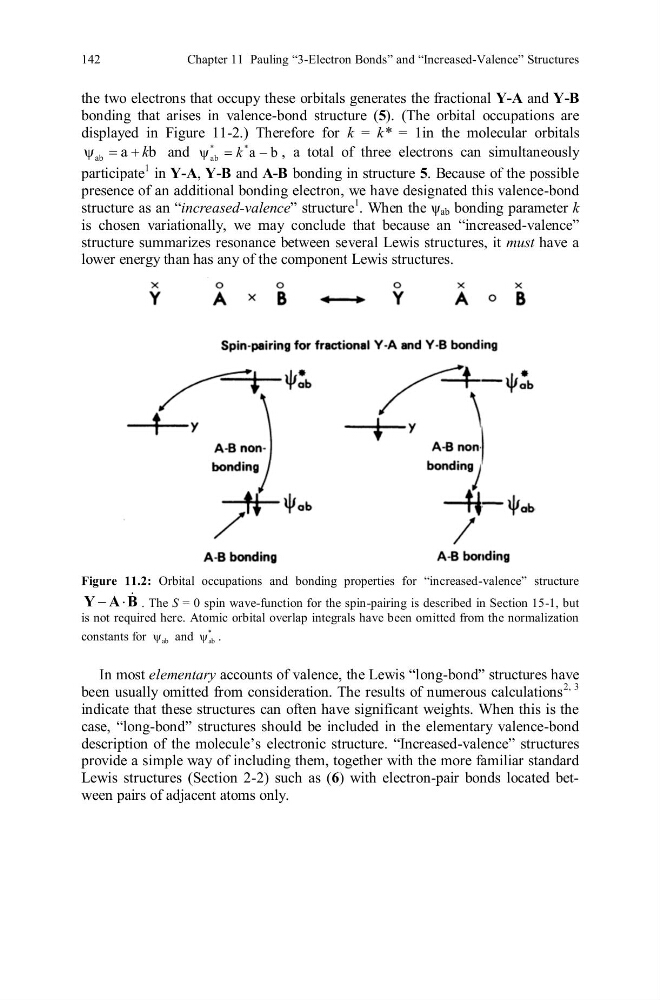
the two electrons that occupy these orbitals generates the fractional Y-A and Y-B
bonding that arises in valence-bond structure (5). (The orbital occupations are
displayed in Figure 11-2.) Therefore for k = k* = 1in the molecular orbitals
ab
a b
k and
*
*
ab
a – b
k
, a total of three electrons can simultaneously
participate
1 in Y-A, Y-B and A-B bonding in structure 5. Because of the possible
presence of an additional bonding electron, we have designated this valence-bond
structure as an “increased-valence” structure
1
. When the ψ ab bonding parameter k
is chosen variationally, we may conclude that because an “increased-valence”
structure summarizes resonance between several Lewis structures, it must have a
lower energy than has any of the component Lewis structures.
Figure 11.2: Orbital occupations and bonding properties for “increased-valence” structure
B
A
Y
. The S = 0 spin wave-function for the spin-pairing is described in Section 15-1, but
is not required here. Atomic orbital overlap integrals have been omitted from the normalization
constants for ab
and
*
ab
.
In most elementary accounts of valence, the Lewis “long-bond” structures have
been usually omitted from consideration. The results of numerous calculations
2, 3
indicate that these structures can often have significant weights. When this is the
case, “long-bond” structures should be included in the elementary valence-bond
description of the molecule’s electronic structure. “Increased-valence” structures
provide a simple way of including them, together with the more familiar standard
Lewis structures (Section 2-2) such as (6) with electron-pair bonds located between pairs of adjacent atoms only.
Chapter 11 Pauling “3-Electron Bonds” and “Increased-Valence” Structures
the two electrons that occupy these orbitals generates the fractional Y-A and Y-B
bonding that arises in valence-bond structure (5). (The orbital occupations are
displayed in Figure 11-2.) Therefore for k = k* = 1in the molecular orbitals
ab
a b
k and
*
*
ab
a – b
k
, a total of three electrons can simultaneously
participate
1 in Y-A, Y-B and A-B bonding in structure 5. Because of the possible
presence of an additional bonding electron, we have designated this valence-bond
structure as an “increased-valence” structure
1
. When the ψ ab bonding parameter k
is chosen variationally, we may conclude that because an “increased-valence”
structure summarizes resonance between several Lewis structures, it must have a
lower energy than has any of the component Lewis structures.
Figure 11.2: Orbital occupations and bonding properties for “increased-valence” structure
B
A
Y
. The S = 0 spin wave-function for the spin-pairing is described in Section 15-1, but
is not required here. Atomic orbital overlap integrals have been omitted from the normalization
constants for ab
and
*
ab
.
In most elementary accounts of valence, the Lewis “long-bond” structures have
been usually omitted from consideration. The results of numerous calculations
2, 3
indicate that these structures can often have significant weights. When this is the
case, “long-bond” structures should be included in the elementary valence-bond
description of the molecule’s electronic structure. “Increased-valence” structures
provide a simple way of including them, together with the more familiar standard
Lewis structures (Section 2-2) such as (6) with electron-pair bonds located between pairs of adjacent atoms only.