

140
Chapter 11 Pauling “3-Electron Bonds” and “Increased-Valence” Structures
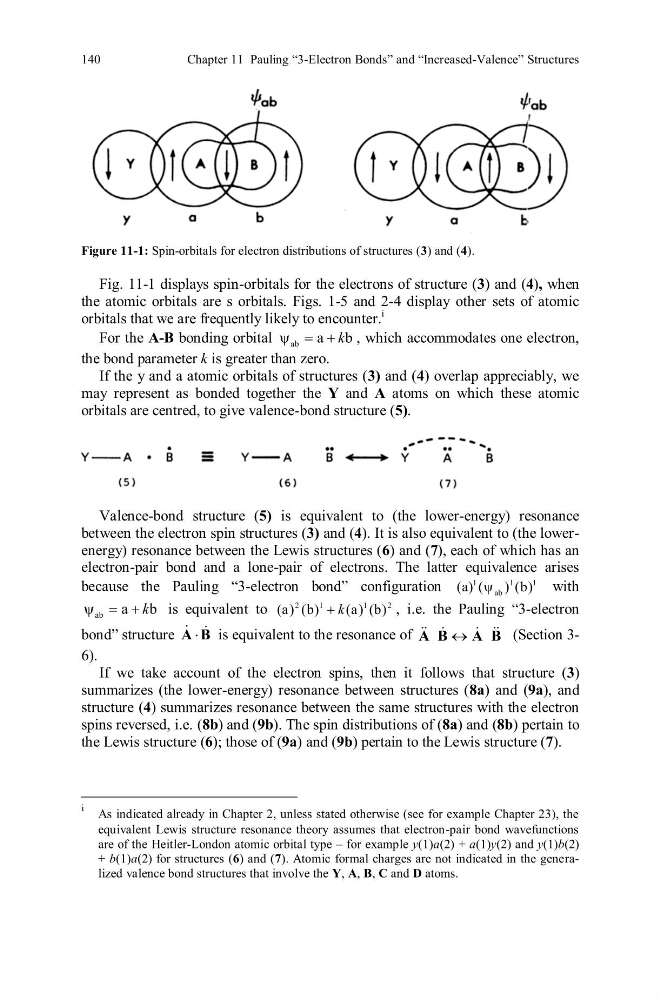
Figure 11-1: Spin-orbitals for electron distributions of structures (3) and (4).
Fig. 11-1 displays spin-orbitals for the electrons of structure (3) and (4), when
the atomic orbitals are s orbitals. Figs. 1-5 and 2-4 display other sets of atomic
orbitals that we are frequently likely to encounter.
i
For the A-B bonding orbital ab a b
k , which accommodates one electron,
the bond parameter k is greater than zero.
If the y and a atomic orbitals of structures (3) and (4) overlap appreciably, we
may represent as bonded together the Y and A atoms on which these atomic
orbitals are centred, to give valence-bond structure (5).
Valence-bond structure (5) is equivalent to (the lower-energy) resonance
between the electron spin structures (3) and (4). It is also equivalent to (the lowerenergy) resonance between the Lewis structures (6) and (7), each of which has an
electron-pair bond and a lone-pair of electrons. The latter equivalence arises
because the Pauling “3-electron bond” configuration
1
1
1
ab
(a) (
) (b)
with
ab
a b
k is equivalent to
2
1
1
2
(a) (b)
(a) (b)
k
, i.e. the Pauling “3-electron
bond” structure
B
A
is equivalent to the resonance of
A B
A B
(Section 36).
If we take account of the electron spins, then it follows that structure (3)
summarizes (the lower-energy) resonance between structures (8a) and (9a), and
structure (4) summarizes resonance between the same structures with the electron
spins reversed, i.e. (8b) and (9b). The spin distributions of (8a) and (8b) pertain to
the Lewis structure (6); those of (9a) and (9b) pertain to the Lewis structure (7).
i As indicated already in Chapter 2, unless stated otherwise (see for example Chapter 23), the
equivalent Lewis structure resonance theory assumes that electron-pair bond wavefunctions
are of the Heitler-London atomic orbital type – for example y(1)a(2) + a(1)y(2) and y(1)b(2)
+ b(1)a(2) for structures (6) and (7). Atomic formal charges are not indicated in the generalized valence bond structures that involve the Y, A, B, C and D atoms.
Chapter 11 Pauling “3-Electron Bonds” and “Increased-Valence” Structures
Figure 11-1: Spin-orbitals for electron distributions of structures (3) and (4).
Fig. 11-1 displays spin-orbitals for the electrons of structure (3) and (4), when
the atomic orbitals are s orbitals. Figs. 1-5 and 2-4 display other sets of atomic
orbitals that we are frequently likely to encounter.
i
For the A-B bonding orbital ab a b
k , which accommodates one electron,
the bond parameter k is greater than zero.
If the y and a atomic orbitals of structures (3) and (4) overlap appreciably, we
may represent as bonded together the Y and A atoms on which these atomic
orbitals are centred, to give valence-bond structure (5).
Valence-bond structure (5) is equivalent to (the lower-energy) resonance
between the electron spin structures (3) and (4). It is also equivalent to (the lowerenergy) resonance between the Lewis structures (6) and (7), each of which has an
electron-pair bond and a lone-pair of electrons. The latter equivalence arises
because the Pauling “3-electron bond” configuration
1
1
1
ab
(a) (
) (b)
with
ab
a b
k is equivalent to
2
1
1
2
(a) (b)
(a) (b)
k
, i.e. the Pauling “3-electron
bond” structure
B
A
is equivalent to the resonance of
A B
A B
(Section 36).
If we take account of the electron spins, then it follows that structure (3)
summarizes (the lower-energy) resonance between structures (8a) and (9a), and
structure (4) summarizes resonance between the same structures with the electron
spins reversed, i.e. (8b) and (9b). The spin distributions of (8a) and (8b) pertain to
the Lewis structure (6); those of (9a) and (9b) pertain to the Lewis structure (7).
i As indicated already in Chapter 2, unless stated otherwise (see for example Chapter 23), the
equivalent Lewis structure resonance theory assumes that electron-pair bond wavefunctions
are of the Heitler-London atomic orbital type – for example y(1)a(2) + a(1)y(2) and y(1)b(2)
+ b(1)a(2) for structures (6) and (7). Atomic formal charges are not indicated in the generalized valence bond structures that involve the Y, A, B, C and D atoms.