

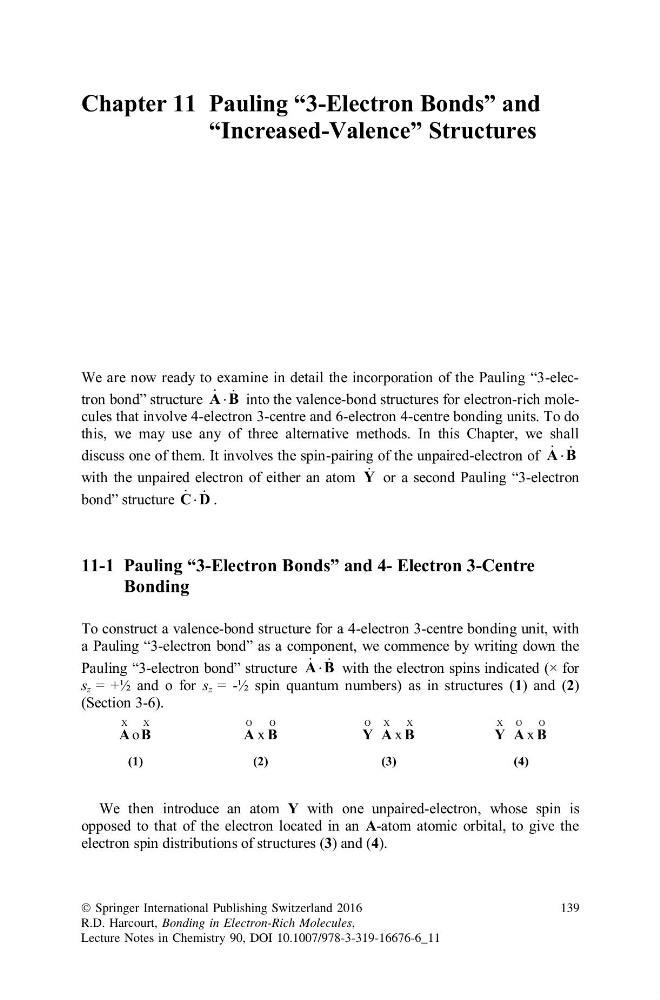
Chapter 11 Pauling “3-Electron Bonds” and
“Increased-Valence” Structures
We are now ready to examine in detail the incorporation of the Pauling “3-electron bond” structure
B
A
into the valence-bond structures for electron-rich molecules that involve 4-electron 3-centre and 6-electron 4-centre bonding units. To do
this, we may use any of three alternative methods. In this Chapter, we shall
discuss one of them. It involves the spin-pairing of the unpaired-electron of
B
A
with the unpaired electron of either an atom Y or a second Pauling “3-electron
bond” structure
D
C
.
11-1 Pauling “3-Electron Bonds” and 4- Electron 3-Centre
Bonding
To construct a valence-bond structure for a 4-electron 3-centre bonding unit, with
a Pauling “3-electron bond” as a component, we commence by writing down the
Pauling “3-electron bond” structure
B
A
with the electron spins indicated (× for
s z = +½ and o for s z = -½ spin quantum numbers) as in structures (1) and (2)
(Section 3-6).
X
X
o
A B
O
O
x
A B
O
X
X
x
Y A B
X
O
O
x
Y A B
(1)
(2)
(3)
(4)
We then introduce an atom Y with one unpaired-electron, whose spin is
opposed to that of the electron located in an A-atom atomic orbital, to give the
electron spin distributions of structures (3) and (4).
Ó Springer International Publishing Switzerland 2016
R.D. Harcourt, Bonding in Electron-Rich Molecules,
Lecture Notes in Chemistry 90, DOI 10.1007/978-3-319-16676-6_11
139
“Increased-Valence” Structures
We are now ready to examine in detail the incorporation of the Pauling “3-electron bond” structure
B
A
into the valence-bond structures for electron-rich molecules that involve 4-electron 3-centre and 6-electron 4-centre bonding units. To do
this, we may use any of three alternative methods. In this Chapter, we shall
discuss one of them. It involves the spin-pairing of the unpaired-electron of
B
A
with the unpaired electron of either an atom Y or a second Pauling “3-electron
bond” structure
D
C
.
11-1 Pauling “3-Electron Bonds” and 4- Electron 3-Centre
Bonding
To construct a valence-bond structure for a 4-electron 3-centre bonding unit, with
a Pauling “3-electron bond” as a component, we commence by writing down the
Pauling “3-electron bond” structure
B
A
with the electron spins indicated (× for
s z = +½ and o for s z = -½ spin quantum numbers) as in structures (1) and (2)
(Section 3-6).
X
X
o
A B
O
O
x
A B
O
X
X
x
Y A B
X
O
O
x
Y A B
(1)
(2)
(3)
(4)
We then introduce an atom Y with one unpaired-electron, whose spin is
opposed to that of the electron located in an A-atom atomic orbital, to give the
electron spin distributions of structures (3) and (4).
Ó Springer International Publishing Switzerland 2016
R.D. Harcourt, Bonding in Electron-Rich Molecules,
Lecture Notes in Chemistry 90, DOI 10.1007/978-3-319-16676-6_11
139