

132
Chapter 10 Pauling “3-Electron Bonds” and “Increased-Valence” Theory for N2O4
bond structure (4) for N 2 O 4 must be equivalent to resonance between the Lewis
(octet) structures (3)-(6) of Section 7-1. Consequently, valence-bond structure (4)
provides a considerable economy in the valence-bond representation of the
electronic structure of N 2 O 4 .
A comparison of the valence-bond structure (4) above with each of the Lewis
structures (3)–(6) of Section 7-1 reveals that there are two additional bonding electrons in (4). Therefore to indicate that additional bonding electrons are present,
this valence-bond structure has been designated as an “increased-valence” structure. From the discussion presented in the previous paragraph, it follows that
because structure (4) summarizes resonance between the Lewis structures (3)–(6)
of Section 7-1, this “increased-valence” structure must be more stable than any of
the component Lewis structures. N 2 O 4 is an example from a large class of
molecules, namely the “electron-rich” tri- and polyatomic molecules, for which
“increased-valence” structures can be constructed. In Chapters 11, 12 and 14 we
shall describe in more detail how this may be done. Here, we have introduced the
subject to demonstrate a further connection between the Pauling “3-electron bond”
theory for NO 2 and the Lewis valence-bond theory for N 2 O 4 . These theories may
also be related to the molecular orbital theory of Section 7-2, and we shall review
these latter connections in the next section.
10-2 “Increased-Valence” Structures and Molecular Orbital
Theory for N 2 O 4
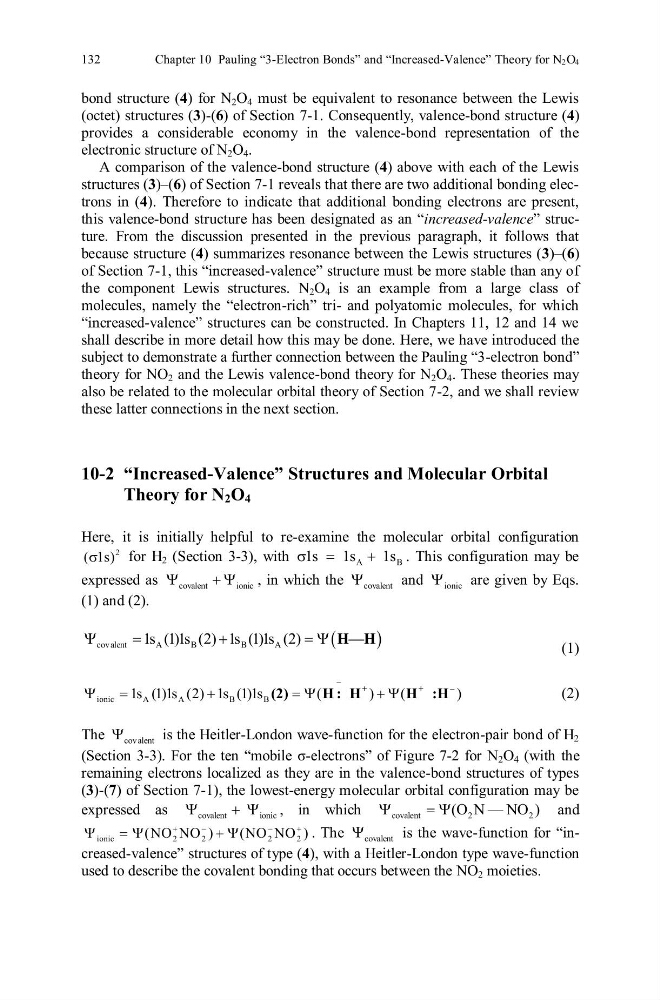
Here, it is initially helpful to re-examine the molecular orbital configuration
2
( 1s)
for H 2 (Section 3-3), with
A
B
1s
1s
1s
. This configuration may be
expressed as covalent
ionic
, in which the covalent
and ionic
are given by Eqs.
(1) and (2).
cov alent
A
B
B
A
1s (1)1s (2) 1s (1)1s (2)
H—H
(1)
ionic
A
A
B
B
1s (1)1s (2) 1s (1)1s
(
)
(
)
+
+
(2)
H : H
H :H
(2)
The cov alent
is the Heitler-London wave-function for the electron-pair bond of H 2
(Section 3-3). For the ten “mobile σ-electrons” of Figure 7-2 for N 2 O 4 (with the
remaining electrons localized as they are in the valence-bond structures of types
(3)-(7) of Section 7-1), the lowest-energy molecular orbital configuration may be
expressed as
covalent
ionic
, in which
covalent
2
2
(O N — NO )
and
ionic
2
2
2
2
(NO NO )
(NO NO )
. The covalent
is the wave-function for “increased-valence” structures of type (4), with a Heitler-London type wave-function
used to describe the covalent bonding that occurs between the NO 2 moieties.
Chapter 10 Pauling “3-Electron Bonds” and “Increased-Valence” Theory for N2O4
bond structure (4) for N 2 O 4 must be equivalent to resonance between the Lewis
(octet) structures (3)-(6) of Section 7-1. Consequently, valence-bond structure (4)
provides a considerable economy in the valence-bond representation of the
electronic structure of N 2 O 4 .
A comparison of the valence-bond structure (4) above with each of the Lewis
structures (3)–(6) of Section 7-1 reveals that there are two additional bonding electrons in (4). Therefore to indicate that additional bonding electrons are present,
this valence-bond structure has been designated as an “increased-valence” structure. From the discussion presented in the previous paragraph, it follows that
because structure (4) summarizes resonance between the Lewis structures (3)–(6)
of Section 7-1, this “increased-valence” structure must be more stable than any of
the component Lewis structures. N 2 O 4 is an example from a large class of
molecules, namely the “electron-rich” tri- and polyatomic molecules, for which
“increased-valence” structures can be constructed. In Chapters 11, 12 and 14 we
shall describe in more detail how this may be done. Here, we have introduced the
subject to demonstrate a further connection between the Pauling “3-electron bond”
theory for NO 2 and the Lewis valence-bond theory for N 2 O 4 . These theories may
also be related to the molecular orbital theory of Section 7-2, and we shall review
these latter connections in the next section.
10-2 “Increased-Valence” Structures and Molecular Orbital
Theory for N 2 O 4
Here, it is initially helpful to re-examine the molecular orbital configuration
2
( 1s)
for H 2 (Section 3-3), with
A
B
1s
1s
1s
. This configuration may be
expressed as covalent
ionic
, in which the covalent
and ionic
are given by Eqs.
(1) and (2).
cov alent
A
B
B
A
1s (1)1s (2) 1s (1)1s (2)
H—H
(1)
ionic
A
A
B
B
1s (1)1s (2) 1s (1)1s
(
)
(
)
+
+
(2)
H : H
H :H
(2)
The cov alent
is the Heitler-London wave-function for the electron-pair bond of H 2
(Section 3-3). For the ten “mobile σ-electrons” of Figure 7-2 for N 2 O 4 (with the
remaining electrons localized as they are in the valence-bond structures of types
(3)-(7) of Section 7-1), the lowest-energy molecular orbital configuration may be
expressed as
covalent
ionic
, in which
covalent
2
2
(O N — NO )
and
ionic
2
2
2
2
(NO NO )
(NO NO )
. The covalent
is the wave-function for “increased-valence” structures of type (4), with a Heitler-London type wave-function
used to describe the covalent bonding that occurs between the NO 2 moieties.