

10-2 “Increased-Valence” Structures and Molecular Orbital Theory for N2O4
133
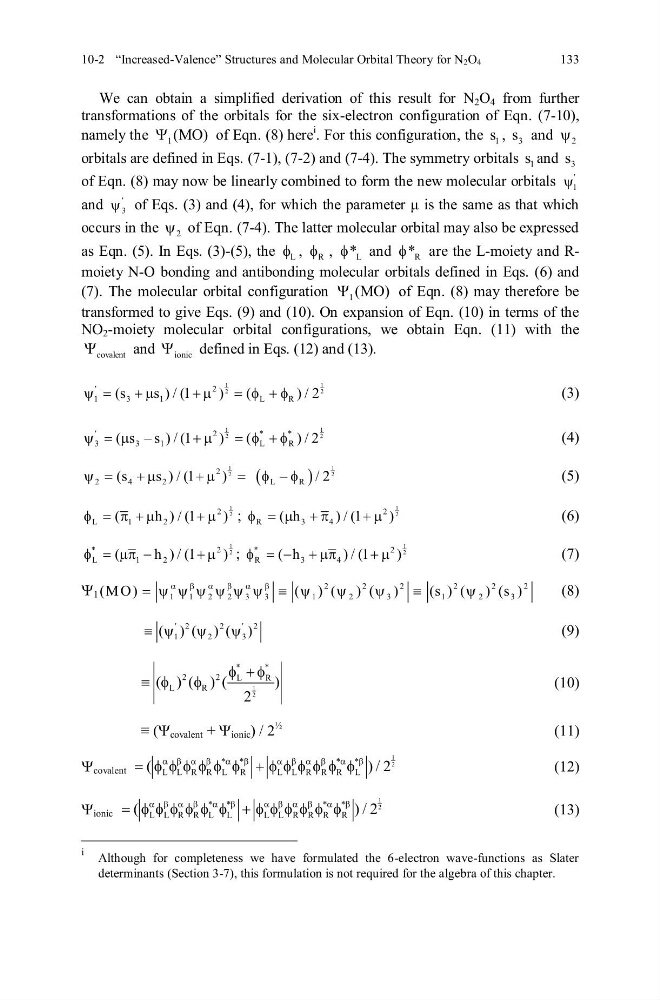
We can obtain a simplified derivation of this result for N 2 O 4 from further
transformations of the orbitals for the six-electron configuration of Eqn. (7-10),
namely the 1 (MO)
of Eqn. (8) here
i
. For this configuration, the 1
s , 3
s and 2
orbitals are defined in Eqs. (7-1), (7-2) and (7-4). The symmetry orbitals 1
s and 3
s
of Eqn. (8) may now be linearly combined to form the new molecular orbitals 1
and 3
of Eqs. (3) and (4), for which the parameter μ is the same as that which
occurs in the 2
of Eqn. (7-4). The latter molecular orbital may also be expressed
as Eqn. (5). In Eqs. (3)-(5), the L
, R
,
L
*
and
R
*
are the L-moiety and Rmoiety N-O bonding and antibonding molecular orbitals defined in Eqs. (6) and
(7). The molecular orbital configuration 1 (MO)
of Eqn. (8) may therefore be
transformed to give Eqs. (9) and (10). On expansion of Eqn. (10) in terms of the
NO 2 -moiety molecular orbital configurations, we obtain Eqn. (11) with the
covalent
and ionic
defined in Eqs. (12) and (13).
1
1
2
2
2
1
3
1
L
R
(s
s ) / (1
)
(
) / 2
(3)
1
1
2
2
2
*
*
3
3
1
L
R
( s – s ) / (1
)
(
) / 2
(4)
1
1
2
2
2
2
4
2
L
R
(s
s ) / (1
)
–
/ 2
(5)
1
2
2
L
1
2
(
h ) / (1
)
;
1
2
2
R
3
4
( h
) / (1
)
(6)
1
2
*
2
L
1
2
(
h ) / (1
)
;
1
2
*
2
R
3
4
( h
) / (1
)
(7)
1
2
2
2
2
2
2
1
1
1
2
2
3
3
1
2
3
1
2
3
(M O )
( ) ( ) ( )
(s ) ( ) (s )
(8)
2
2
2
1
2
3
( ) ( ) ( )
(9)
1
2
*
*
2
2
L
R
L
R
( ) ( ) (
)
2
(10)
≡ ( covalent + ionic ) / 2
½
(11)
covalent
1
2
*
*
*
*
cov alent
L L R R L R
L L R R R L
(
) / 2
(12)
ionic
1
2
*
*
*
*
ionic
L L R R L L
L L R R R R
(
) / 2
(13)
i Although for completeness we have formulated the 6-electron wave-functions as Slater
determinants (Section 3-7), this formulation is not required for the algebra of this chapter.
133
We can obtain a simplified derivation of this result for N 2 O 4 from further
transformations of the orbitals for the six-electron configuration of Eqn. (7-10),
namely the 1 (MO)
of Eqn. (8) here
i
. For this configuration, the 1
s , 3
s and 2
orbitals are defined in Eqs. (7-1), (7-2) and (7-4). The symmetry orbitals 1
s and 3
s
of Eqn. (8) may now be linearly combined to form the new molecular orbitals 1
and 3
of Eqs. (3) and (4), for which the parameter μ is the same as that which
occurs in the 2
of Eqn. (7-4). The latter molecular orbital may also be expressed
as Eqn. (5). In Eqs. (3)-(5), the L
, R
,
L
*
and
R
*
are the L-moiety and Rmoiety N-O bonding and antibonding molecular orbitals defined in Eqs. (6) and
(7). The molecular orbital configuration 1 (MO)
of Eqn. (8) may therefore be
transformed to give Eqs. (9) and (10). On expansion of Eqn. (10) in terms of the
NO 2 -moiety molecular orbital configurations, we obtain Eqn. (11) with the
covalent
and ionic
defined in Eqs. (12) and (13).
1
1
2
2
2
1
3
1
L
R
(s
s ) / (1
)
(
) / 2
(3)
1
1
2
2
2
*
*
3
3
1
L
R
( s – s ) / (1
)
(
) / 2
(4)
1
1
2
2
2
2
4
2
L
R
(s
s ) / (1
)
–
/ 2
(5)
1
2
2
L
1
2
(
h ) / (1
)
;
1
2
2
R
3
4
( h
) / (1
)
(6)
1
2
*
2
L
1
2
(
h ) / (1
)
;
1
2
*
2
R
3
4
( h
) / (1
)
(7)
1
2
2
2
2
2
2
1
1
1
2
2
3
3
1
2
3
1
2
3
(M O )
( ) ( ) ( )
(s ) ( ) (s )
(8)
2
2
2
1
2
3
( ) ( ) ( )
(9)
1
2
*
*
2
2
L
R
L
R
( ) ( ) (
)
2
(10)
≡ ( covalent + ionic ) / 2
½
(11)
covalent
1
2
*
*
*
*
cov alent
L L R R L R
L L R R R L
(
) / 2
(12)
ionic
1
2
*
*
*
*
ionic
L L R R L L
L L R R R R
(
) / 2
(13)
i Although for completeness we have formulated the 6-electron wave-functions as Slater
determinants (Section 3-7), this formulation is not required for the algebra of this chapter.