

Chapter 10 Pauling “3-Electron Bonds” and
“Increased-Valence” Theory for
N 2 O 4
10-1 Pauling “3-Electron Bonds” and “Increased-Valence”
Structures for N 2 O 4
In Section 7-1, we used the
2
NO Lewis structures of types (1) and (2) to construct
Lewis structures for 2 4
N O . To do this, we have spin-paired the odd-electron of
one
2
NO moiety with the odd-electron of the other moiety, to obtain the Lewis
octet structures (3)-(7) of Section 7-1 for 2 4
N O . In Section 6-1, we have also indicated that resonance between the
2
NO Lewis structures (1) and (2) may be
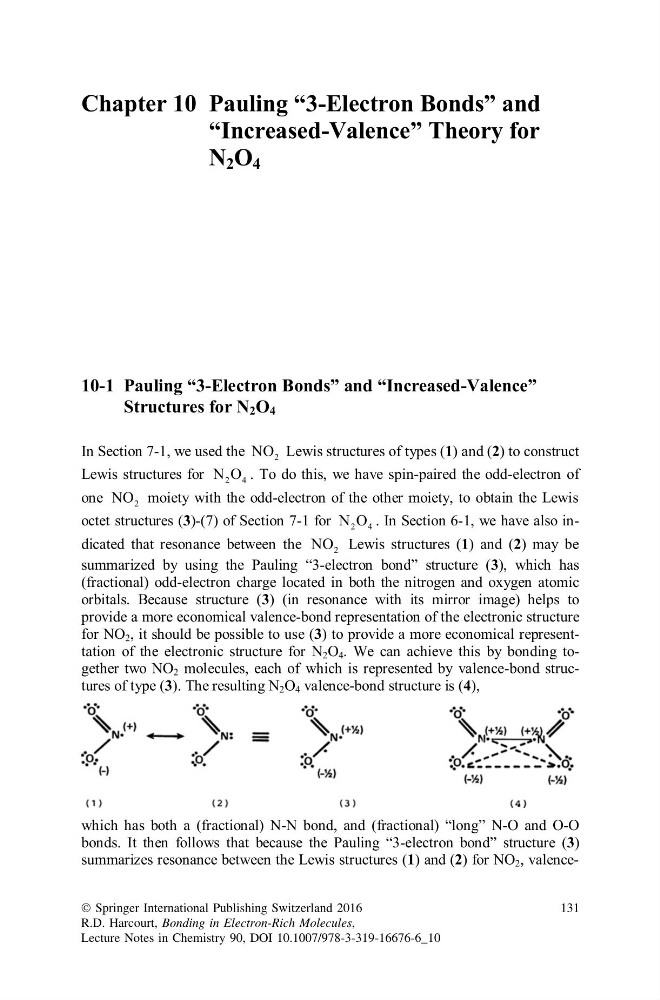
summarized by using the Pauling “3-electron bond” structure (3), which has
(fractional) odd-electron charge located in both the nitrogen and oxygen atomic
orbitals. Because structure (3) (in resonance with its mirror image) helps to
provide a more economical valence-bond representation of the electronic structure
for NO 2 , it should be possible to use (3) to provide a more economical representtation of the electronic structure for N 2 O 4 . We can achieve this by bonding together two NO 2 molecules, each of which is represented by valence-bond structures of type (3). The resulting N 2 O 4 valence-bond structure is (4),
which has both a (fractional) N-N bond, and (fractional) “long” N-O and O-O
bonds. It then follows that because the Pauling “3-electron bond” structure (3)
summarizes resonance between the Lewis structures (1) and (2) for NO 2 , valenceÓ Springer International Publishing Switzerland 2016
R.D. Harcourt, Bonding in Electron-Rich Molecules,
Lecture Notes in Chemistry 90, DOI 10.1007/978-3-319-16676-6_10
131
“Increased-Valence” Theory for
N 2 O 4
10-1 Pauling “3-Electron Bonds” and “Increased-Valence”
Structures for N 2 O 4
In Section 7-1, we used the
2
NO Lewis structures of types (1) and (2) to construct
Lewis structures for 2 4
N O . To do this, we have spin-paired the odd-electron of
one
2
NO moiety with the odd-electron of the other moiety, to obtain the Lewis
octet structures (3)-(7) of Section 7-1 for 2 4
N O . In Section 6-1, we have also indicated that resonance between the
2
NO Lewis structures (1) and (2) may be
summarized by using the Pauling “3-electron bond” structure (3), which has
(fractional) odd-electron charge located in both the nitrogen and oxygen atomic
orbitals. Because structure (3) (in resonance with its mirror image) helps to
provide a more economical valence-bond representation of the electronic structure
for NO 2 , it should be possible to use (3) to provide a more economical representtation of the electronic structure for N 2 O 4 . We can achieve this by bonding together two NO 2 molecules, each of which is represented by valence-bond structures of type (3). The resulting N 2 O 4 valence-bond structure is (4),
which has both a (fractional) N-N bond, and (fractional) “long” N-O and O-O
bonds. It then follows that because the Pauling “3-electron bond” structure (3)
summarizes resonance between the Lewis structures (1) and (2) for NO 2 , valenceÓ Springer International Publishing Switzerland 2016
R.D. Harcourt, Bonding in Electron-Rich Molecules,
Lecture Notes in Chemistry 90, DOI 10.1007/978-3-319-16676-6_10
131