

Addendum Chapter 9
129
1
* 2
2
* 1
x
x
y
y
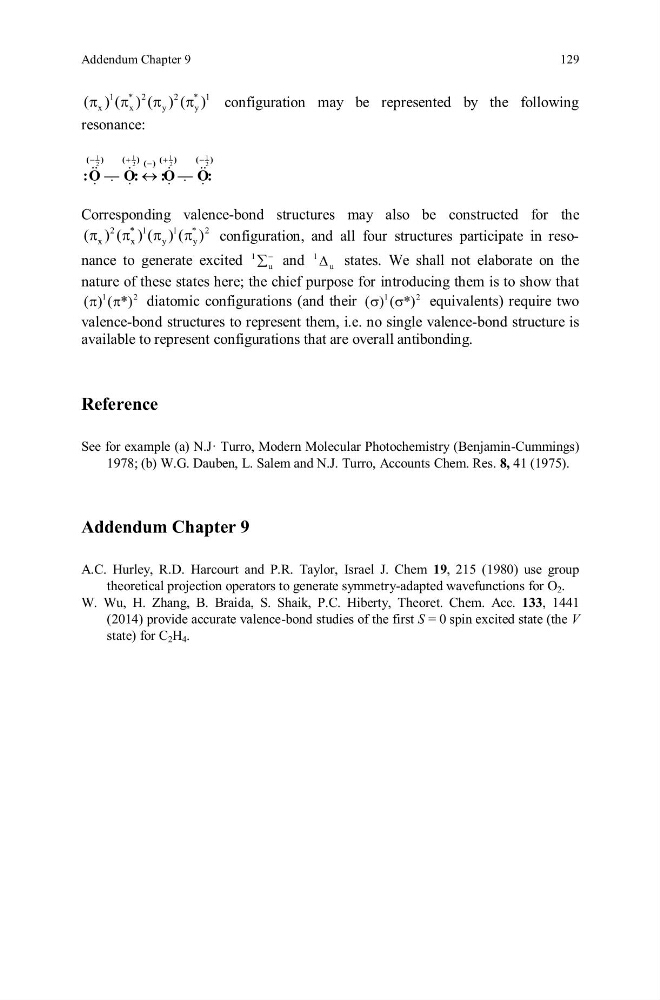
( ) ( ) ( ) ( )
configuration may be represented by the following
resonance:
1
1
1
1
2
2
2
2
( )
( )
( )
( )
( )
:O — O: :O — O:
Corresponding valence-bond structures may also be constructed for the
2
* 1
1
* 2
x
x
y
y
( ) ( ) ( ) ( )
configuration, and all four structures participate in resonance to generate excited
1
u
and
1
u
states. We shall not elaborate on the
nature of these states here; the chief purpose for introducing them is to show that
1
2
( ) ( *)
diatomic configurations (and their
1
2
( ) ( *)
equivalents) require two
valence-bond structures to represent them, i.e. no single valence-bond structure is
available to represent configurations that are overall antibonding.
Reference
See for example (a) N.J· Turro, Modern Molecular Photochemistry (Benjamin-Cummings)
1978; (b) W.G. Dauben, L. Salem and N.J. Turro, Accounts Chem. Res. 8, 41 (1975).
Addendum Chapter 9
A.C. Hurley, R.D. Harcourt and P.R. Taylor, Israel J. Chem 19, 215 (1980) use group
theoretical projection operators to generate symmetry-adapted wavefunctions for O 2 .
W. Wu, H. Zhang, B. Braida, S. Shaik, P.C. Hiberty, Theoret. Chem. Acc. 133, 1441
(2014) provide accurate valence-bond studies of the first S = 0 spin excited state (the V
state) for C 2 H 4 .
129
1
* 2
2
* 1
x
x
y
y
( ) ( ) ( ) ( )
configuration may be represented by the following
resonance:
1
1
1
1
2
2
2
2
( )
( )
( )
( )
( )
:O — O: :O — O:
Corresponding valence-bond structures may also be constructed for the
2
* 1
1
* 2
x
x
y
y
( ) ( ) ( ) ( )
configuration, and all four structures participate in resonance to generate excited
1
u
and
1
u
states. We shall not elaborate on the
nature of these states here; the chief purpose for introducing them is to show that
1
2
( ) ( *)
diatomic configurations (and their
1
2
( ) ( *)
equivalents) require two
valence-bond structures to represent them, i.e. no single valence-bond structure is
available to represent configurations that are overall antibonding.
Reference
See for example (a) N.J· Turro, Modern Molecular Photochemistry (Benjamin-Cummings)
1978; (b) W.G. Dauben, L. Salem and N.J. Turro, Accounts Chem. Res. 8, 41 (1975).
Addendum Chapter 9
A.C. Hurley, R.D. Harcourt and P.R. Taylor, Israel J. Chem 19, 215 (1980) use group
theoretical projection operators to generate symmetry-adapted wavefunctions for O 2 .
W. Wu, H. Zhang, B. Braida, S. Shaik, P.C. Hiberty, Theoret. Chem. Acc. 133, 1441
(2014) provide accurate valence-bond studies of the first S = 0 spin excited state (the V
state) for C 2 H 4 .