

128
Chapter 9 Excited States
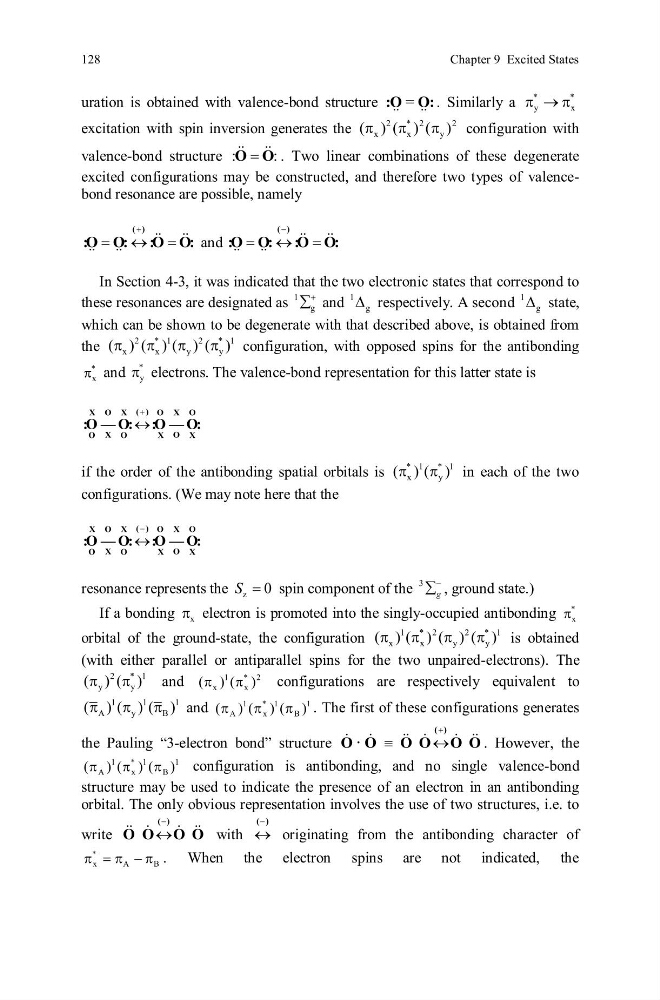
uration is obtained with valence-bond structure
=
:O O:
. Similarly a
*
*
y
x
excitation with spin inversion generates the
2
* 2
2
x
x
y
( ) ( ) ( )
configuration with
valence-bond structure :
:
O O
. Two linear combinations of these degenerate
excited configurations may be constructed, and therefore two types of valencebond resonance are possible, namely
( )
:O O: :O O: and
( )
:O O: :O O:
In Section 4-3, it was indicated that the two electronic states that correspond to
these resonances are designated as
1
g
and
1
g
respectively. A second
1
g
state,
which can be shown to be degenerate with that described above, is obtained from
the
2
* 1
2
* 1
x
x
y
y
( ) ( ) ( ) ( )
configuration, with opposed spins for the antibonding
*
x
and
*
y
electrons. The valence-bond representation for this latter state is
( )
X O X
O X O
X
O
O
O
X
X
:O — O: :O — O:
if the order of the antibonding spatial orbitals is
* 1
* 1
x
y
( ) ( )
in each of the two
configurations. (We may note here that the
( )
X O X
O X O
X
O
O
O
X
X
:O — O: :O — O:
resonance represents the z 0
S spin component of the
3
g , ground state.)
If a bonding x
electron is promoted into the singly-occupied antibonding
*
x
orbital of the ground-state, the configuration
1
* 2
2
* 1
x
x
y
y
( ) ( ) ( ) ( )
is obtained
(with either parallel or antiparallel spins for the two unpaired-electrons). The
2
* 1
y
y
( ) ( )
and
1
* 2
x
x
( ) ( )
configurations are respectively equivalent to
1
1
1
A
y
B
( ) ( ) ( )
and
1
* 1
1
A
x
B
( ) ( ) ( )
. The first of these configurations generates
the Pauling “3-electron bond” structure
( )
O · O
O O O O . However, the
1
* 1
1
A
x
B
( ) ( ) ( )
configuration is antibonding, and no single valence-bond
structure may be used to indicate the presence of an electron in an antibonding
orbital. The only obvious representation involves the use of two structures, i.e. to
write
( )
O O O O with
( )
originating from the antibonding character of
*
x
A
B
–
. When the electron spins are not indicated, the
Chapter 9 Excited States
uration is obtained with valence-bond structure
=
:O O:
. Similarly a
*
*
y
x
excitation with spin inversion generates the
2
* 2
2
x
x
y
( ) ( ) ( )
configuration with
valence-bond structure :
:
O O
. Two linear combinations of these degenerate
excited configurations may be constructed, and therefore two types of valencebond resonance are possible, namely
( )
:O O: :O O: and
( )
:O O: :O O:
In Section 4-3, it was indicated that the two electronic states that correspond to
these resonances are designated as
1
g
and
1
g
respectively. A second
1
g
state,
which can be shown to be degenerate with that described above, is obtained from
the
2
* 1
2
* 1
x
x
y
y
( ) ( ) ( ) ( )
configuration, with opposed spins for the antibonding
*
x
and
*
y
electrons. The valence-bond representation for this latter state is
( )
X O X
O X O
X
O
O
O
X
X
:O — O: :O — O:
if the order of the antibonding spatial orbitals is
* 1
* 1
x
y
( ) ( )
in each of the two
configurations. (We may note here that the
( )
X O X
O X O
X
O
O
O
X
X
:O — O: :O — O:
resonance represents the z 0
S spin component of the
3
g , ground state.)
If a bonding x
electron is promoted into the singly-occupied antibonding
*
x
orbital of the ground-state, the configuration
1
* 2
2
* 1
x
x
y
y
( ) ( ) ( ) ( )
is obtained
(with either parallel or antiparallel spins for the two unpaired-electrons). The
2
* 1
y
y
( ) ( )
and
1
* 2
x
x
( ) ( )
configurations are respectively equivalent to
1
1
1
A
y
B
( ) ( ) ( )
and
1
* 1
1
A
x
B
( ) ( ) ( )
. The first of these configurations generates
the Pauling “3-electron bond” structure
( )
O · O
O O O O . However, the
1
* 1
1
A
x
B
( ) ( ) ( )
configuration is antibonding, and no single valence-bond
structure may be used to indicate the presence of an electron in an antibonding
orbital. The only obvious representation involves the use of two structures, i.e. to
write
( )
O O O O with
( )
originating from the antibonding character of
*
x
A
B
–
. When the electron spins are not indicated, the