

9-4 O2: *
*
x
y
π
π
and
*
x
x
π
π
127
Alternatively, because the n-orbital configuration
O
1
1
1
N
NO
(h ) (n ) ( )
for the
Pauling “3-electron bond” is equivalent to
2
*
1
NO
NO
(n ) (n ) in which
O
N
NO
π
h
n
k
and
NO
*
N
O
n
* h –
k
we may describe the electronic excitation as an
NO
NO
*
*
n excitation, i.e. as
NO
NO
NO
2
*
2
2
2
*
1
2
*
1
NO
NO
NO
NO
(n ) (n ) (
)
(n ) (n ) (
) (
)
.
The S = 1 spin excited state is predicted to have an N-O bond-length which is
similar to that of the ground-state, and a linear arrangement for the C, N and O
atoms. The linearity will improve the overlap that exists between the N
h and N
orbitals ( N
h “grows” into N
) and thereby increases the strength of the Pauling
“3-electron bond” for the three n electrons (provided that the overlap integral does
not exceed 1/3 cf. Section 3-10).
3
O is isoelectronic with
3
CH NO , and a linear S = 1 spin excited state may
similarly be obtained by
OO
OO
*
*
n
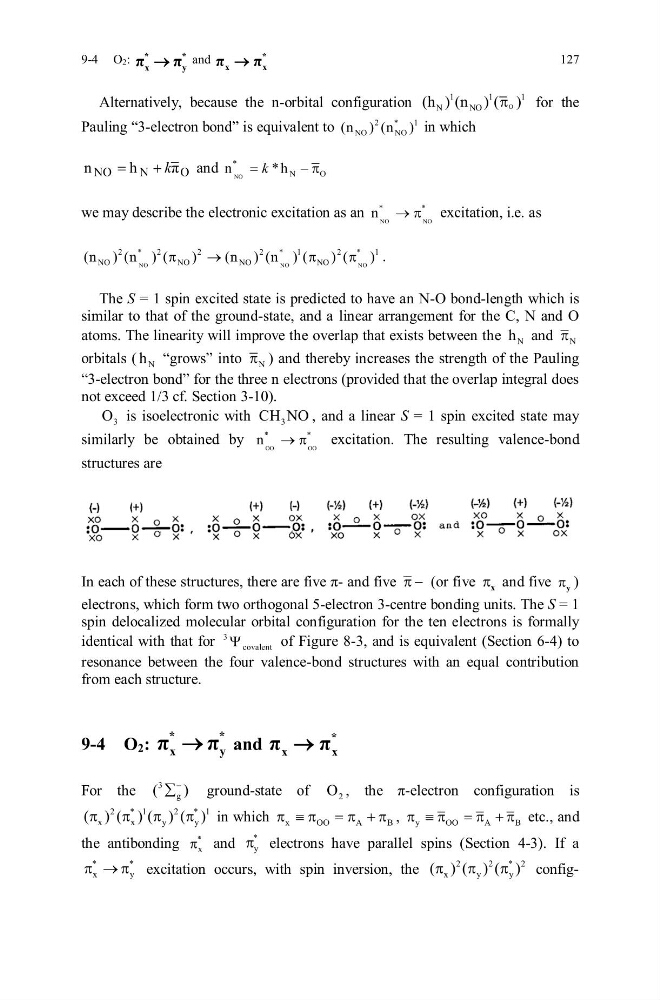
excitation. The resulting valence-bond
structures are
In each of these structures, there are five π- and five (or five x
and five y
)
electrons, which form two orthogonal 5-electron 3-centre bonding units. The S = 1
spin delocalized molecular orbital configuration for the ten electrons is formally
identical with that for
3
covalent
of Figure 8-3, and is equivalent (Section 6-4) to
resonance between the four valence-bond structures with an equal contribution
from each structure.
9-4 O 2 :
*
*
x
y
π
π
and
*
x
x
π
π
For the
3
g
(
)
ground-state of
2
O , the π-electron configuration is
2
* 1
2
* 1
x
x
y
y
( ) ( ) ( ) ( )
in which x
OO
A
B
, y
OO
A
B
etc., and
the antibonding
*
x
and
*
y
electrons have parallel spins (Section 4-3). If a
*
*
x
y
excitation occurs, with spin inversion, the
2
2
* 2
x
y
y
( ) ( ) ( )
config-
*
x
y
π
π
and
*
x
x
π
π
127
Alternatively, because the n-orbital configuration
O
1
1
1
N
NO
(h ) (n ) ( )
for the
Pauling “3-electron bond” is equivalent to
2
*
1
NO
NO
(n ) (n ) in which
O
N
NO
π
h
n
k
and
NO
*
N
O
n
* h –
k
we may describe the electronic excitation as an
NO
NO
*
*
n excitation, i.e. as
NO
NO
NO
2
*
2
2
2
*
1
2
*
1
NO
NO
NO
NO
(n ) (n ) (
)
(n ) (n ) (
) (
)
.
The S = 1 spin excited state is predicted to have an N-O bond-length which is
similar to that of the ground-state, and a linear arrangement for the C, N and O
atoms. The linearity will improve the overlap that exists between the N
h and N
orbitals ( N
h “grows” into N
) and thereby increases the strength of the Pauling
“3-electron bond” for the three n electrons (provided that the overlap integral does
not exceed 1/3 cf. Section 3-10).
3
O is isoelectronic with
3
CH NO , and a linear S = 1 spin excited state may
similarly be obtained by
OO
OO
*
*
n
excitation. The resulting valence-bond
structures are
In each of these structures, there are five π- and five (or five x
and five y
)
electrons, which form two orthogonal 5-electron 3-centre bonding units. The S = 1
spin delocalized molecular orbital configuration for the ten electrons is formally
identical with that for
3
covalent
of Figure 8-3, and is equivalent (Section 6-4) to
resonance between the four valence-bond structures with an equal contribution
from each structure.
9-4 O 2 :
*
*
x
y
π
π
and
*
x
x
π
π
For the
3
g
(
)
ground-state of
2
O , the π-electron configuration is
2
* 1
2
* 1
x
x
y
y
( ) ( ) ( ) ( )
in which x
OO
A
B
, y
OO
A
B
etc., and
the antibonding
*
x
and
*
y
electrons have parallel spins (Section 4-3). If a
*
*
x
y
excitation occurs, with spin inversion, the
2
2
* 2
x
y
y
( ) ( ) ( )
config-