

126
Chapter 9 Excited States
If a Heitler-London description of the C–O π-bond is used, the S = 0 spin
ground-state configuration involves the atomic orbital occupancies of
1
1
2
C
O
( ) ( ) (n)
, with antiparallel spins for the C
and O
electrons. When an n
electron is excited, either one of the C
or O
orbitals becomes doubly-occupied
to generate
2
1
1
C
O
( ) ( ) (n)
and
1
2
1
C
O
( ) ( ) (n)
configurations. Ignoring electron
spins, the resulting valence-bond structures are
2
( )
( )
H C— O: and 2
H C — O:
and resonance between these structures generates the Pauling “3-electron bond”
structures that we have previously described.
9-3 CH 3 NO and O 3 : “n → π*”
The measured C-N and N-O bond-lengths for
3
CH NO are 1.48 Å and 1.21 Å
(Section 2-3). Pauling’s estimates of 1.47 and 1.20 Å for the lengths of C-N single
and N=O double bonds suggest that the standard Lewis structure
reasonably represents the ground-state electronic structure for
3
CH NO . The descriptions of the electronic states that are obtained by π → π* excitations are similar to those described for both 2 2
C H and 2
H CO in Section 9-1. However because
a lone-pair electron can be excited from either an oxygen 2pπ orbital or a nitrogen
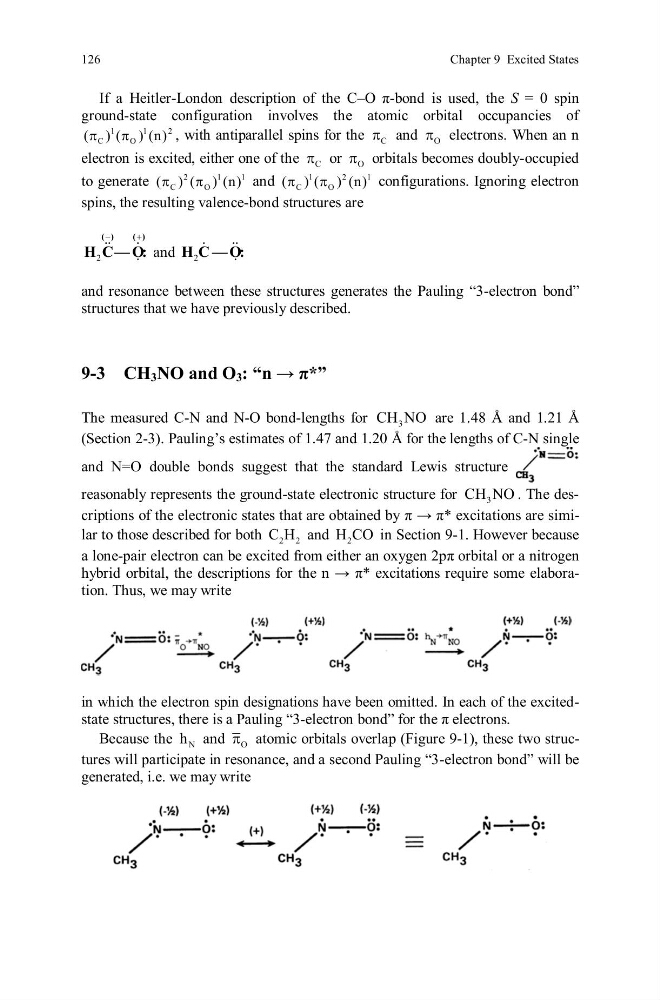
hybrid orbital, the descriptions for the n → π* excitations require some elaboration. Thus, we may write
in which the electron spin designations have been omitted. In each of the excitedstate structures, there is a Pauling “3-electron bond” for the π electrons.
Because the N
h and O
atomic orbitals overlap (Figure 9-1), these two structures will participate in resonance, and a second Pauling “3-electron bond” will be
generated, i.e. we may write
Chapter 9 Excited States
If a Heitler-London description of the C–O π-bond is used, the S = 0 spin
ground-state configuration involves the atomic orbital occupancies of
1
1
2
C
O
( ) ( ) (n)
, with antiparallel spins for the C
and O
electrons. When an n
electron is excited, either one of the C
or O
orbitals becomes doubly-occupied
to generate
2
1
1
C
O
( ) ( ) (n)
and
1
2
1
C
O
( ) ( ) (n)
configurations. Ignoring electron
spins, the resulting valence-bond structures are
2
( )
( )
H C— O: and 2
H C — O:
and resonance between these structures generates the Pauling “3-electron bond”
structures that we have previously described.
9-3 CH 3 NO and O 3 : “n → π*”
The measured C-N and N-O bond-lengths for
3
CH NO are 1.48 Å and 1.21 Å
(Section 2-3). Pauling’s estimates of 1.47 and 1.20 Å for the lengths of C-N single
and N=O double bonds suggest that the standard Lewis structure
reasonably represents the ground-state electronic structure for
3
CH NO . The descriptions of the electronic states that are obtained by π → π* excitations are similar to those described for both 2 2
C H and 2
H CO in Section 9-1. However because
a lone-pair electron can be excited from either an oxygen 2pπ orbital or a nitrogen
hybrid orbital, the descriptions for the n → π* excitations require some elaboration. Thus, we may write
in which the electron spin designations have been omitted. In each of the excitedstate structures, there is a Pauling “3-electron bond” for the π electrons.
Because the N
h and O
atomic orbitals overlap (Figure 9-1), these two structures will participate in resonance, and a second Pauling “3-electron bond” will be
generated, i.e. we may write