

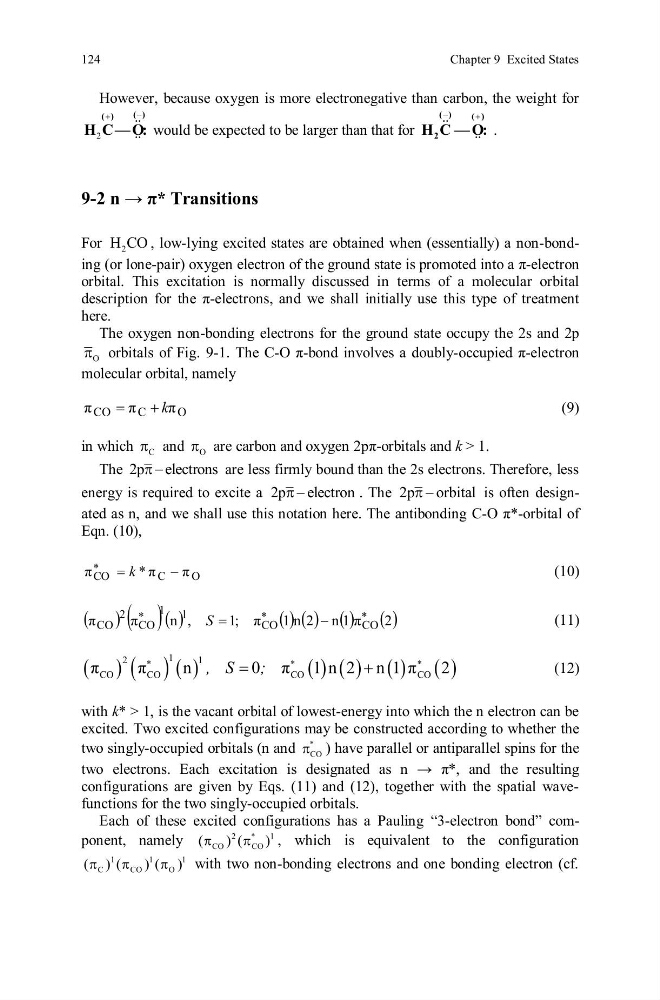
124
Chapter 9 Excited States
However, because oxygen is more electronegative than carbon, the weight for
2
( )
( )
H C— O:
would be expected to be larger than that for
( )
( )
2
H C — O:
.
9-2 n → π* Transitions
For 2
H CO , low-lying excited states are obtained when (essentially) a non-bonding (or lone-pair) oxygen electron of the ground state is promoted into a π-electron
orbital. This excitation is normally discussed in terms of a molecular orbital
description for the π-electrons, and we shall initially use this type of treatment
here.
The oxygen non-bonding electrons for the ground state occupy the 2s and 2p
O
orbitals of Fig. 9-1. The C-O π-bond involves a doubly-occupied π-electron
molecular orbital, namely
O
C
CO
π
π
π
k
(9)
in which C
and O
are carbon and oxygen 2pπ-orbitals and k > 1.
The 2p electrons
are less firmly bound than the 2s electrons. Therefore, less
energy is required to excite a 2p electron
. The 2p orbital
is often designated as n, and we shall use this notation here. The antibonding C-O π*-orbital of
Eqn. (10),
O
C
CO
π
π
*
π
k
(10)
2
π
1
n
2
n
1
π
;
1
,
n
π
π
CO
CO
1
1
CO
2
CO
S
(11)
1
2
1
CO
CO
CO
CO
π
π
n
0 π 1 n 2 n 1 π 2
, S
;
(12)
with k* > 1, is the vacant orbital of lowest-energy into which the n electron can be
excited. Two excited configurations may be constructed according to whether the
two singly-occupied orbitals (n and
*
CO
) have parallel or antiparallel spins for the
two electrons. Each excitation is designated as n → π*, and the resulting
configurations are given by Eqs. (11) and (12), together with the spatial wavefunctions for the two singly-occupied orbitals.
Each of these excited configurations has a Pauling “3-electron bond” component, namely
2
*
1
CO
CO
(
) (
)
, which is equivalent to the configuration
1
1
1
C
CO
O
( ) (
) ( )
with two non-bonding electrons and one bonding electron (cf.
Chapter 9 Excited States
However, because oxygen is more electronegative than carbon, the weight for
2
( )
( )
H C— O:
would be expected to be larger than that for
( )
( )
2
H C — O:
.
9-2 n → π* Transitions
For 2
H CO , low-lying excited states are obtained when (essentially) a non-bonding (or lone-pair) oxygen electron of the ground state is promoted into a π-electron
orbital. This excitation is normally discussed in terms of a molecular orbital
description for the π-electrons, and we shall initially use this type of treatment
here.
The oxygen non-bonding electrons for the ground state occupy the 2s and 2p
O
orbitals of Fig. 9-1. The C-O π-bond involves a doubly-occupied π-electron
molecular orbital, namely
O
C
CO
π
π
π
k
(9)
in which C
and O
are carbon and oxygen 2pπ-orbitals and k > 1.
The 2p electrons
are less firmly bound than the 2s electrons. Therefore, less
energy is required to excite a 2p electron
. The 2p orbital
is often designated as n, and we shall use this notation here. The antibonding C-O π*-orbital of
Eqn. (10),
O
C
CO
π
π
*
π
k
(10)
2
π
1
n
2
n
1
π
;
1
,
n
π
π
CO
CO
1
1
CO
2
CO
S
(11)
1
2
1
CO
CO
CO
CO
π
π
n
0 π 1 n 2 n 1 π 2
, S
;
(12)
with k* > 1, is the vacant orbital of lowest-energy into which the n electron can be
excited. Two excited configurations may be constructed according to whether the
two singly-occupied orbitals (n and
*
CO
) have parallel or antiparallel spins for the
two electrons. Each excitation is designated as n → π*, and the resulting
configurations are given by Eqs. (11) and (12), together with the spatial wavefunctions for the two singly-occupied orbitals.
Each of these excited configurations has a Pauling “3-electron bond” component, namely
2
*
1
CO
CO
(
) (
)
, which is equivalent to the configuration
1
1
1
C
CO
O
( ) (
) ( )
with two non-bonding electrons and one bonding electron (cf.